
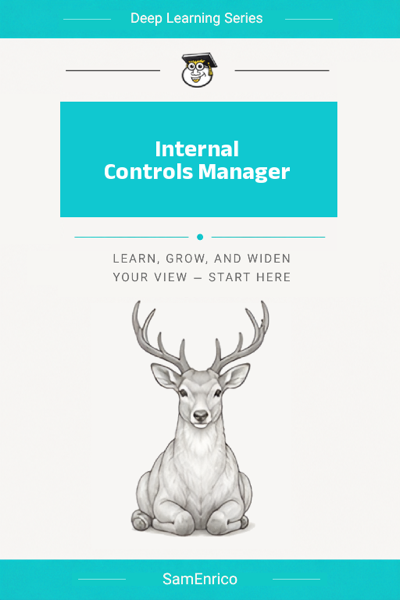
Non-FictionInformativeEducational
Internal Controls Manager eBook
A Coursebook on Internal Controls Manager
A Coursebook on Internal Controls Manager
Formats
Free sample
Chapter 1: The Control Delusion--The conference room smelled of stale coffee and desperation. Thirty-seven controls documented. Twenty-three tested quarterly. Fourteen certified as “operating effectively.” And yet, $2.3 million had walked out the door over eighteen months through a vendor that didn’t exist. The internal audit director slid a single sheet of paper across the table—a bank statement showing eleven identical monthly wire transfers to a company incorporated the same week the accounts payable clerk received a promotion and a new set of system privileges.
“How did we miss this?” the CFO whispered. The answer, though no one wanted to hear it, was simple: they had confused the appearance of controls with the reality of control.This chapter is not an academic exercise. It is an intervention. Before you can design, test, or manage a single control, you must understand what internal control actually is—and, more importantly, what it is not. The most expensive mistake new Internal Controls Managers make is believing that documentation equals protection.
It does not. A Risk Control Matrix with all the right boxes checked but no operational teeth is not a control. It is a liability dressed in a spreadsheet. This chapter dismantles the most dangerous delusions in our profession and replaces them with a working framework you can use tomorrow morning.The Definition That Changes Everything Let us start where every serious treatment of internal control must start: with the official definition from the Committee of Sponsoring Organizations of the Treadway Commission—better known as COSO. After decades of refinement and a major update in 2013, COSO defines internal control as follows:“A process, effected by an entity’s board of directors, management, and other personnel, designed to provide reasonable assurance regarding the achievement of objectives.”Every word in that sentence matters, but three elements deserve immediate attention because they contradict common misconceptions.First, internal control is a process, not an event.
It is not the annual self-assessment you complete in December. It is not the audit report you file with the board. It is a continuous, living activity woven into the fabric of daily operations. When you approve a purchase order, you are performing a control. When you reconcile a bank statement, you are performing a control.
When you review a variance report, you are performing a control. The moment you stop thinking of controls as a discrete “project” and start thinking of them as a rhythm, you have taken the first step toward effectiveness.Second, internal control is effected by people at every level. This is where many organizations fail. They write policies, install software, and assume the work is done. But a control is only as strong as the person executing it—and that person’s training, motivation, and environment.
The board sets the tone. Management designs the systems. Staff operate them. And the Internal Controls Manager ensures that all three layers are aligned and accountable. No single person can “own” internal control in a meaningful sense.
It is distributed responsibility, or it is nothing.Third, internal control provides reasonable assurance, not absolute certainty. This is the most misunderstood word in the definition. Reasonable assurance acknowledges that controls have costs, that humans make errors, and that collusion or management override can defeat even the strongest safeguards. No control regime can guarantee that fraud will never occur or that every financial statement will be perfectly accurate. What controls can do is reduce risk to a level that the board and management find acceptable—a concept known as risk appetite.
The Internal Controls Manager who promises zero errors is either naive or dishonest. The one who articulates residual risk with clarity and confidence is indispensable.The Three Objectives: Why Controls Exist Controls do not exist for their own sake. They exist to help the organization achieve specific objectives. COSO organizes these objectives into three distinct categories, and understanding the differences between them is essential for prioritization.Operations Objectives Operations objectives concern the effectiveness and efficiency of the organization’s core activities. Controls in this category are designed to ensure that the company produces goods or delivers services with minimal waste, optimal resource use, and reasonable protection of assets.
Examples include inventory cycle counts, production quality checks, and equipment maintenance schedules. When an operations control fails, the consequence is usually lost time, wasted materials, or reduced customer satisfaction—not necessarily a financial misstatement.Financial Reporting Objectives Financial reporting objectives focus on the reliability of the organization’s published financial information. Controls here ensure that transactions are recorded accurately, that account balances are complete and valid, that disclosures are appropriate, and that the financial statements comply with applicable accounting standards (such as GAAP or IFRS). Examples include segregation of duties in cash handling, reconciliation of subsidiary ledgers to the general ledger, and review of journal entries for unusual amounts. When a financial reporting control fails, the consequence can be a material misstatement, a restatement of earnings, or a regulatory enforcement action.Compliance Objectives Compliance objectives concern adherence to laws, regulations, and contractual obligations.
Controls in this category ensure that the organization does not violate tax codes, environmental regulations, labor laws, data privacy statutes, or debt covenants. Examples include automated tax calculation software, compliance training attestations, and regulatory filing checklists. When a compliance control fails, the consequence can be fines, legal sanctions, reputational damage, or even loss of the license to operate.Why this matters for the Internal Controls Manager: You will rarely have equal resources for all three categories. Public companies subject to the Sarbanes-Oxley Act (SOX) typically prioritize financial reporting controls because the law requires an annual attestation. However, a failure in operations (a factory shutdown) or compliance (a data privacy breach) can be just as damaging.
Your job is to help the organization allocate its limited control resources across all three objectives based on risk—a theme we will explore deeply in Chapter 4.The Five Components: How Controls Work Together COSO organizes internal control into five interrelated components. Think of them as the layers of an onion. The outermost layers shape the environment in which controls operate. The innermost layers are the specific activities that prevent or detect errors. All five must function together; a weakness in any component undermines the others.Component 1: Control Environment The control environment is the set of standards, processes, and structures that provide the basis for carrying out internal control across the organization.
It is often called the “tone at the top” because it starts with the board and senior management. Key elements include:Integrity and ethical values Commitment to competence Board independence and oversight Management’s philosophy and operating style Organizational structure and assignment of authority If the control environment is weak, no other controls can compensate. A company whose CFO routinely overrides approval limits will see those limits ignored by everyone else. A company whose board never reviews control reports will soon find that no one bothers to write them. Chapter 2 is devoted entirely to this component because it is simultaneously the most important and the most neglected.Component 2: Risk Assessment Risk assessment is the identification and analysis of risks that threaten the achievement of the three objectives.
Every organization faces internal risks (employee error, system failure, fraud) and external risks (economic downturns, new regulations, competitor actions). The…
This is the end of the free sample. Get the eBook to keep going. Buy now
About this book
Details
- Author
- Fortenberry Stefany
- Publisher
- SamEnrico
- Language
- English
- Genre
- Non-Fiction, Informative, Educational
- Released
- 2026-06-02
- Pages (approx.)
- 160
- Available as
- eBook, Audiobook

Read better in the ZLOADR app
Your eBooks on your phone or tablet. Sign in with your SamEnrico account and start reading.
More by Fortenberry Stefany
 TM Biological AgingFortenberry Stefany$11.99
 Resentment at Work HandbookFortenberry Stefany$11.99
 Ramirez Prison Years FinalFortenberry Stefany$11.99
 Medicaid Coverage for MATFortenberry Stefany$11.99
 Imposter Syndrome and Decision MakingFortenberry Stefany$11.99
 The Great Solar Scam: How a Billion-Dollar Green Energy Bet Went Up in FlamesFortenberry Stefany$11.99
 The Forgotten Battle of Caporetto: How Italy’s Defeat Changed the WarFortenberry Stefany$11.99
 UNNET Web Application GuideFortenberry Stefany$12.99
 Gross Vs Net Lease UpdateFortenberry Stefany$12.99
 Understanding Craniostenosis With Congenital Heart Disease Mental RetardationFortenberry Stefany$17.99
 How to Start a Cartoon Film Production Business (Beginners Guide)Fortenberry Stefany$11.99
You may also like
 Hong Kong Handover 1997Dunn Johnnie$11.99
 Zumba For Postnatal Recovery CourseNeal Christian$11.99
 Zumba for BeginnersLadner Nikia$11.99
 YouTube Comment Mining GuideHumes Pandora$12.99
 Worry Box MeditationCarlin Rudy$11.99
 Workplace Stress MeditationNguyen Lynn$11.99
 Workplace Stress and Sleep RepairHawley Ivory$11.99
 Workplace Perfectionism CureDelaney Jeffry$11.99
 Workplace Injustice Anger GuideWallen Isabelle$11.99
 Work Addiction and Burnout LinkGreenwood Ester$11.99
 Women in Yoga and WellnessBeattie Galina$11.99
 Women in Stand Up ComedyChun Evangeline$11.99