
Non-FictionProfessional's Cheat SheetRetrospective
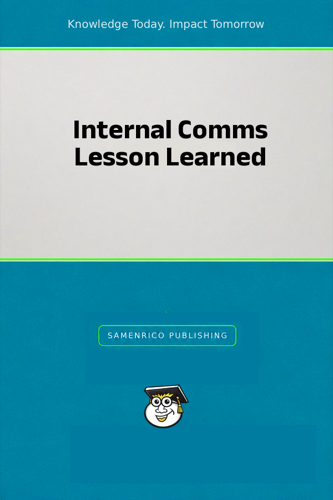
Internal Comms Lesson Learned eBook
Capture post campaign insights to improve future e
by Folse Mozell
Capture post campaign insights to improve future efforts.
Formats
Free sample
Chapter 1: The Vanity Metrics Trap--–- The email arrived at 9:47 AM on a Tuesday. Maria, the Internal Communications Director for a retail chain with forty-three thousand employees, opened it with her morning coffee. The subject line read: "Q3 Culture Campaign Results – 89% Open Rate!" She smiled. Her team had worked nights and weekends for six weeks. The campaign featured a video from the CEO, three intranet banners, a talking points document for managers, and a beautiful email series with animated graphics.
The open rate was the highest in company history. Maria forwarded the results to her boss with a proud note: "Great engagement this quarter. Team is firing on all cylinders."Six months later, the annual employee engagement survey dropped. The culture score had declined by 4 percent. The CEO called Maria into his office.
"What happened?" he asked. "We spent two million dollars on that campaign." Maria pulled up the email analytics again. "But look," she said, pointing at the screen. "Eighty-nine percent open rate. People saw the message." The CEO stared at her for a long moment.
"Maria," he said quietly, "I don't care how many people opened an email. I care that my frontline managers don't remember what the campaign was about, my warehouse staff think 'culture' is something that happens in the corporate office, and my engagement score just dropped for the third quarter in a row."That conversation happened. The numbers are real. And Maria is not alone. She is every internal comms leader who has ever celebrated a metric that meant nothing, defended a campaign that changed no behavior, or presented a dashboard that felt good while the business quietly suffered.This chapter is about why your metrics are lying to you, why your team keeps running in circles, and why the most dangerous words in internal communications are "that campaign worked." By the time you finish these pages, you will never look at an open rate the same way again.The Fire, Forget, Repeat Cycle Let us name the enemy before we learn how to defeat it.
It is called the "Fire, Forget, Repeat" cycle. It operates in thousands of organizations worldwide, consuming millions of dollars and producing nothing but exhaustion.The cycle works like this. You identify a business problem that requires communication. Low engagement. Poor safety compliance.
Confusion about a new policy. Resistance to a change initiative. You gather your team and plan a campaign. You write emails, design graphics, schedule town halls, and create manager toolkits. You launch with enthusiasm, track your metrics in real time, and watch the numbers climb.Then the campaign ends.
You pull a report. Open rates look good. Click rates look acceptable. A quick survey shows that employees "agree" or "strongly agree" that they received the information. You declare victory.
You move on to the next campaign. Six months later, the same business problem reappears. No behavior changed. No knowledge stuck. No process improved.
You run another campaign. You measure the same metrics. You declare victory again. And the cycle continues.This cycle is not a failure of effort. Internal comms professionals work brutally hard.
They juggle dozens of stakeholders, tight deadlines, shrinking budgets, and the impossible task of reaching deskless workers, remote employees, and hybrid teams all at once. The problem is not laziness or incompetence. The problem is a missing feedback loop.According to industry data compiled from multiple studies across the last decade, approximately 70 percent of internal campaigns fail to move the metrics that actually matter to the business. Not open rates. Not click rates.
The metrics that matter: behavior change, knowledge retention, process adoption, safety compliance, cultural alignment, trust, and discretionary effort. Seventy percent. That means for every ten campaigns your team runs, seven of them are producing no measurable business value.But here is the twist. Most teams cannot identify which seven. Because they measure the wrong things, at the wrong time, with the wrong method, and then they forget what they learned before the next campaign even launches.
They are running on a treadmill that goes nowhere, exhausted and confused about why they are not making progress.The Day Maria Learned the Truth Let us return to Maria. After her painful conversation with the CEO, she did something most internal comms leaders never do. She asked for permission to find out what actually happened. Not to defend her team. Not to explain away the results.
To discover the truth.She assembled a small team of three people and spent two weeks conducting what this book will teach you to call a "post-campaign autopsy." She interviewed thirty frontline employees from six different stores. She interviewed twelve managers, from team leads to regional directors. She interviewed five senior leaders who had sponsored the campaign. She pulled not just open rates but dwell time, scroll depth, repeat visit data, and completion rates on the campaign's call to action. She compared what the campaign intended to communicate with what employees actually remembered, using a simple free-recall test.The findings were brutal, and they changed Maria's career.The animated email graphics that her team had spent days designing had loaded slowly on mobile devices.
Sixty percent of employees read email exclusively on their phones. Those beautiful animations became blank spaces or spinning load icons. Most employees gave up and deleted the email.The CEO's video was three minutes and forty seconds long. Maria's team had been proud of the production quality. Professional lighting.
A teleprompter. Smooth transitions. The average watch time was nineteen seconds. Most employees clicked play, watched the CEO say "I'm excited to announce," realized the video was long, and closed it.The talking points document for managers was eight pages. It included background research, frequently asked questions, suggested language, and links to additional resources.
Seventy percent of managers admitted in anonymous interviews that they had not read it. Most had skimmed the first page, printed it to look prepared, and never opened it again.When asked to describe what the campaign was about in their own words, frontline employees gave answers that would be funny if they were not so sad. "Something about customer service." "A new policy, I think. Maybe HR?" "Honestly, I deleted it because I get too many emails." "Oh, that was the thing about culture. Wait, what is culture again?"But here was the most painful discovery, the one that kept Maria awake that night.
Two years earlier, Maria's predecessor had run a nearly identical campaign. It had failed for the same reasons. The lessons had been documented in a single email, sent to the entire comms team, saved in a folder on the shared drive that no one had opened since. The team had repeated the exact same mistakes because there was no system to remember them.That was the moment Maria stopped being a communications professional and started being a learning professional. She stopped caring about open rates and started caring about behavior change.
She stopped defending her campaigns and started diagnosing them. She stopped moving on and started closing the loop.Over the next eighteen months, her team's metrics transformed. Not because they worked harder. They worked smarter. They cut campaign waste by 30 percent.
They reduced manager confusion by half. They turned a declining engagement score into a rising one. They did it without…
This is the end of the free sample. Get the eBook to keep going. Buy now
About this book
Details
- Author
- Folse Mozell
- Publisher
- SamEnrico
- Language
- English
- Genre
- Non-Fiction, Professional's Cheat Sheet, Retrospective
- Released
- 2026-06-09
- Pages (approx.)
- 147
- Available as
- eBook, Audiobook

Read better in the ZLOADR app
Your eBooks on your phone or tablet. Sign in with your SamEnrico account and start reading.
More by Folse Mozell
 Letting Go Of Social Media EnvyFolse Mozell$11.99
 Workaholics Anonymous GuideFolse Mozell$11.99
 Anger for AccountantsFolse Mozell$11.99
 The Cybersecurity Spending ForecastFolse Mozell$11.99
 Phoenix Rising: The Fall and Rebirth of the Silk RoadFolse Mozell$11.99
 Producer Cooperative GuideFolse Mozell$12.99
 Social Engagement Micro BreaksFolse Mozell$12.99
 How to Become a Pipe BufferFolse Mozell$11.99
 ArchivistFolse Mozell$11.99
 Understanding Spondyloepimetaphyseal Dysplasia Joint LaxityFolse Mozell$17.99
You may also like
 Hong Kong Handover 1997Dunn Johnnie$11.99
 Zumba For Postnatal Recovery CourseNeal Christian$11.99
 Zumba for BeginnersLadner Nikia$11.99
 YouTube Comment Mining GuideHumes Pandora$12.99
 Worry Box MeditationCarlin Rudy$11.99
 Workplace Stress MeditationNguyen Lynn$11.99
 Workplace Stress and Sleep RepairHawley Ivory$11.99
 Workplace Perfectionism CureDelaney Jeffry$11.99
 Workplace Injustice Anger GuideWallen Isabelle$11.99
 Work Addiction and Burnout LinkGreenwood Ester$11.99
 Women in Yoga and WellnessBeattie Galina$11.99
 Women in Stand Up ComedyChun Evangeline$11.99