
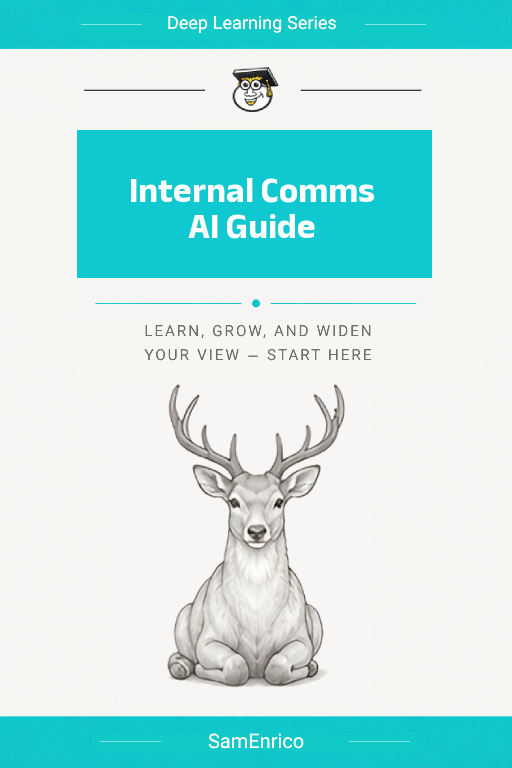
Non-FictionAI OperatorInternal Comms
Internal Comms AI Guide eBook
Craft internal marketing communications including
Craft internal marketing communications including newsletters and announcements using AI prompts.
Formats
Free sample
Chapter 1: The Efficiency Trap--–- Sarah had spent fourteen years climbing the internal communications ladder. She’d survived three CEOs, two mergers, and one catastrophic intranet migration that still gave her nightmares. She knew how to write a CEO memo that actually got read. She knew how to cascade a restructuring announcement without triggering a Slack meltdown. She was, by every measure, good at her job.Then her company bought an enterprise Chat GPT license.Within six weeks, a junior coordinator on her team—someone with barely two years of experience—was producing first drafts in thirty seconds that used to take Sarah forty-five minutes.
The coordinator wasn’t smarter. She wasn’t a better writer. She had simply learned something Sarah hadn’t: how to talk to machines.Sarah’s first instinct was defensiveness. “It’s generic,” she told herself, reading the AI’s output. “It has no soul.
Our employees will spot this from a mile away.”But the engagement metrics told a different story. The AI-assisted newsletter drafts, lightly edited by the junior coordinator, were achieving open rates Sarah hadn’t seen in three years. The CEO, who had never once complimented Sarah’s weekly updates, started forwarding them to the leadership team with one-word approvals: “Good.”Sarah wasn’t replaced. She wasn’t fired. But something worse happened: she became invisible.
The work that had defined her career—the crafting, the shaping, the polishing of internal messages—was now being done faster, cheaper, and with equal or better results by a twenty-three-year-old who knew how to prompt.This chapter is for every Sarah in every organization right now. Because the question isn’t whether AI will change internal communications. It already has. The question is whether you will be the one who learns to harness it—or the one who gets left behind wondering what happened.The Myth That’s Killing IC Careers Let’s name the enemy. It’s not artificial intelligence.
It’s not your junior colleague who figured out Chat GPT before you did. It’s not even your budget-conscious CFO who’s wondering why they need a team of writers when a $20 monthly subscription exists.The enemy is a seductive, deeply comfortable belief that I call the Efficiency Trap.The Efficiency Trap sounds reasonable. It sounds like progress. It sounds like this: “If I can use AI to do my current tasks faster, I’ll have more time for strategic work. AI is a tool, like spellcheck or a template library.
It just makes me more efficient.”Here’s why that’s a trap: doing the wrong things faster doesn’t create value. It creates accelerated irrelevance.Think about the internal communications professional in 2010. Their job was distribution. They took a message from leadership, formatted it for email, and sent it to everyone. That was valuable because employees had no other reliable way to get information.
The company controlled the pipe.Then Slack happened. Then Teams happened. Then endless internal newsletters happened. Employees started drowning in information. The problem flipped from “not enough communication” to “too much noise.” The IC professional who kept doing the same thing—formatting and distributing—became less valuable even as they worked harder.Now AI is causing a second flip.
When anyone—not just the IC team—can generate a polished newsletter draft in thirty seconds, the value of production collapses. The IC professional who focuses on producing content faster is running in place while the ground moves beneath them.The MIT Sloan Management Review studied 3,000 organizations and found that 95% saw no measurable ROI from their AI investments. That’s not because AI doesn’t work. It’s because most organizations use AI to do the same things they were already doing, just faster. They fall into the Efficiency Trap.The 5% who succeed do something different.
They use AI to ask different questions, serve different audiences, and measure different outcomes. They don’t automate their current job. They reinvent it.The Three Archetypes: Which One Are You?Every IC professional and every organization falls into one of three archetypes when it comes to AI. These categories will appear throughout this book as diagnostic tools. By the end of this chapter, you will know exactly where you stand—and what it will take to move to the category where you actually want to be.Archetype 1: The Denier The Denier believes AI is a fad, a toy, or a threat to be banned.
They say things like:“AI writing has no soul.”“Our employees will know it’s not human.”“Legal won’t allow it.”“I’ve been doing this for fifteen years without AI.”The Denier’s strategy is avoidance. They block Chat GPT on company devices. They write policies forbidding AI use. They pretend the technology doesn’t exist or isn’t relevant to their work.The problem is that avoidance doesn’t stop AI from changing the world around them. It just ensures they have no influence over how it changes their world.
The Denier’s junior colleagues use AI on their phones anyway. The Denier’s competitors quietly adopt AI and outperform them. The Denier wakes up one day to find their role eliminated—not by AI directly, but by someone who used AI to do the Denier’s job for a fraction of the cost.Archetype 2: The Dabbler The Dabbler has tried AI. They have a Chat GPT account. They’ve used it to write a few emails or summarize a long document.
They might even feel a little proud of themselves for being “tech-forward.”But the Dabbler uses AI the way someone in 2005 used email: as a slightly faster version of what they were already doing. They prompt: “Write a newsletter about the new benefits policy.” They get a generic output. They spend twenty minutes editing it to sound like a human. They save maybe ten minutes compared to writing from scratch.The Dabbler tells themselves this is progress. And it is—a little.
But the Dabbler is still in the Efficiency Trap. They’re doing the same work, just marginally faster. They haven’t changed what they produce, how they produce it, or what value they bring to their organization.The Dabbler is vulnerable. Not because they’re doing anything wrong, but because they’re not doing anything different. Anyone with basic prompting skills can do what they do.
And basic prompting skills are spreading fast.Archetype 3: The Strategist The Strategist uses AI to do work that was impossible before. They don’t just write faster; they write differently. They personalize at scale. They test twenty subject lines before breakfast. They analyze sentiment from thousands of open-ended survey comments.
They give every manager a custom toolkit for cascading messages to their team.The Strategist has stopped asking “How can I do this faster?” and started asking “What can I do now that I couldn’t do before?”This shift is everything. The Strategist’s job description doesn’t say “writer” anymore. It says “orchestrator,” “analyst,” “architect.” The Strategist doesn’t compete with AI. They command it.The rest of this book is a playbook for becoming a Strategist. But first, you need to know where you’re starting from.The Self-Audit…
This is the end of the free sample. Get the eBook to keep going. Buy now
About this book
Details
- Author
- Whitcomb Meda
- Publisher
- SamEnrico
- Language
- English
- Genre
- Non-Fiction, AI Operator, Internal Comms
- Released
- 2026-06-01
- Pages (approx.)
- 153
- Available as
- eBook, Audiobook

Read better in the ZLOADR app
Your eBooks on your phone or tablet. Sign in with your SamEnrico account and start reading.
More by Whitcomb Meda
 Laid Off Anger ProcessingWhitcomb Meda$11.99
 Age Discrimination Self EsteemWhitcomb Meda$11.99
 Trance Based Anxiety ReliefWhitcomb Meda$11.99
 Melatonin for Children GuideWhitcomb Meda$11.99
 The Discord Server Overload GuideWhitcomb Meda$11.99
 The Last Diplomat of ConstantinopleWhitcomb Meda$11.99
 Understanding Microdontia Hypodontia Short StatureWhitcomb Meda$17.99
 The 42-Day Restorative Yoga JourneyWhitcomb Meda$11.99
 Clean Tech Patent Investment GuideWhitcomb Meda$12.99
 How to Start a Bulk Haulage In Tanker Trucks Business (Beginners Guide)Whitcomb Meda$11.99
You may also like
 Hong Kong Handover 1997Dunn Johnnie$11.99
 Zumba For Postnatal Recovery CourseNeal Christian$11.99
 Zumba for BeginnersLadner Nikia$11.99
 YouTube Comment Mining GuideHumes Pandora$12.99
 Worry Box MeditationCarlin Rudy$11.99
 Workplace Stress MeditationNguyen Lynn$11.99
 Workplace Stress and Sleep RepairHawley Ivory$11.99
 Workplace Perfectionism CureDelaney Jeffry$11.99
 Workplace Injustice Anger GuideWallen Isabelle$11.99
 Work Addiction and Burnout LinkGreenwood Ester$11.99
 Women in Yoga and WellnessBeattie Galina$11.99
 Women in Stand Up ComedyChun Evangeline$11.99