
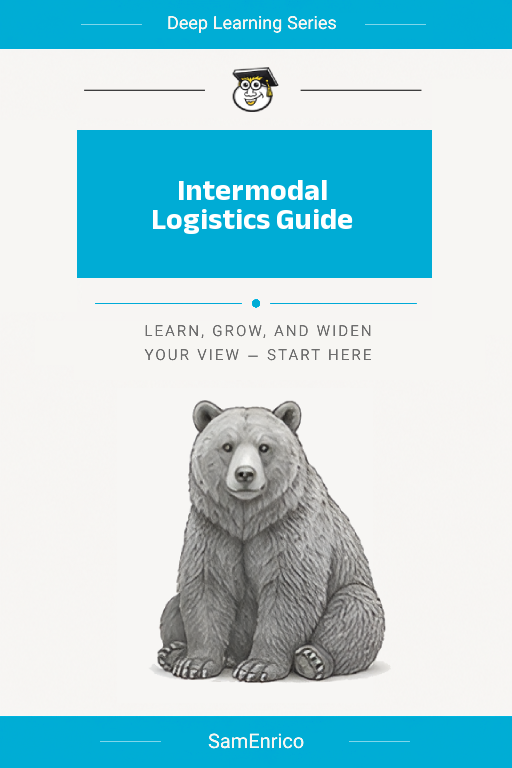
Intermodal Logistics Guide eBook
Directory of rail and intermodal transport provide
by Shell Debby
Directory of rail and intermodal transport providers connecting ports to inland distribution centers.
Formats
Free sample
Chapter 1: The Vanishing Container--–- The phone rings at 4:47 PM on a Friday. You are the supply chain director for a mid-sized importer of home furnishings. On the other end of the line is your customer—a regional furniture chain with forty-seven stores across the Midwest. They are out of stock on your best-selling sofa. They have been out of stock for nine days.
Their peak sales weekend starts tomorrow. Your container, they tell you, was supposed to be at their distribution center in Columbus, Ohio, this morning. It is not there. You check your tracking system. The last update is from four days ago: "In transit – rail." No location.
No estimated arrival. No human to call. Your container has vanished.This is not a hypothetical. This scene plays out thousands of times every week across North America. The container is not literally missing—it is sitting on a rail car in a yard somewhere between the Port of Los Angeles and Columbus.
But for all practical purposes, it might as well be on the moon. You cannot see it. You cannot touch it. You cannot expedite it. And every hour it sits, your customer loses revenue, your company loses credibility, and you lose sleep.Welcome to the world of port-to-inland intermodal logistics.
This chapter is the foundation of everything that follows. Before you can understand the economics, the contracts, the technology, or the directory of providers in later chapters, you must first understand the physical journey. You must visualize the path your container takes from the ship's crane to your warehouse door. You must know where the handoffs occur, who touches the container at each stage, and—most importantly—where things go wrong. By the end of this chapter, you will never look at a tracking update the same way again.The Eight Stages of a Container's Journey Every container moving from an ocean vessel to an inland distribution center passes through exactly eight physical stages.
Some stages happen in minutes; others can take days. Some are visible; others are invisible to all but the most sophisticated tracking systems. Understanding these stages is the first step toward controlling your supply chain.Stage One: Vessel Discharge The journey begins when a ship arrives at port. Giant gantry cranes—each costing more than $10 million—lift containers from the vessel's hold and place them onto waiting chassis or directly onto the terminal yard. This process, called "discharge," typically moves between twenty-five and forty containers per crane per hour.
For a vessel carrying 10,000 containers, full discharge can take two to three days. Your container, assuming no customs holds or inspection flags, will sit in a stack at the terminal yard for anywhere from four hours to four days, depending on port congestion, rail availability, and the efficiency of your drayage provider.Stage Two: Port Terminal Yard Storage Once discharged, your container enters the port terminal yard. This is not a warehouse. It is a paved expanse—often hundreds of acres—where containers are stacked six or seven high. The terminal operator's job is to balance the flow of inbound containers from ships with outbound containers to trucks and trains.
When the yard exceeds 80% capacity, congestion spirals. Trucks wait hours to enter. Containers get buried under newer arrivals. Your container's location becomes a guess.Stage Three: Transfer to Rail Ramp Here, the path diverges based on infrastructure. At ports with on-dock rail—such as Los Angeles/Long Beach's ICTF (Intermodal Container Transfer Facility) or Savannah's Garden City Terminal—your container moves directly from the ship's crane to a waiting rail car without ever touching a truck.
This is the gold standard: seamless, fast, and low-cost. At ports with near-dock rail—such as New York/New Jersey or Houston—your container must first be loaded onto a truck for a short move, typically three to ten miles, to a separate rail ramp. This "drayage bubble," as it is called, adds cost, time, and risk. The bubble is where containers most often go missing from tracking systems, because the handoff between port terminal and drayage carrier is notoriously paper-based and manual.Stage Four: Train Departure Once at the rail ramp, your container is loaded onto a well car—a specialized rail car designed to carry containers double-stacked. The train will not depart until it has enough containers to justify the trip.
For high-density lanes like Los Angeles to Chicago, that might be a few hours. For less frequent lanes, it could be two or three days. Railroads call this "building the train." You call it waiting.Stage Five: Intermodal Terminal Arrival After travel—typically two to five days for cross-country moves—your train arrives at an intermodal terminal near your destination. These terminals are not passenger stations. They are sprawling industrial facilities on the outskirts of cities like Chicago, Kansas City, Dallas, Atlanta, or Columbus.
Your container is lifted off the rail car and placed into a storage stack. This is where the second drayage bubble begins.Stage Six: Container Storage at the Ramp Your container now sits in the rail terminal yard, waiting for a drayage carrier to pick it up. The terminal operator gives you a limited amount of free time—typically forty-eight to seventy-two hours—before charging storage fees that escalate daily. This is where per diem charges begin to mount. And this is where communication often breaks down, because rail terminal operators are not in the business of customer service.
They are in the business of moving boxes.Stage Seven: Drayage Truck Pickup A local drayage carrier—one of the thousands of small trucking companies that operate exclusively within the fifty-mile radius around rail terminals—enters the gate, presents paperwork, locates your container in the stack, and pulls it out. This sounds simple. It is not. Gate queues can exceed three hours. Containers are often "grounded" (stacked on the pavement without a chassis), requiring additional time to mount them.
And if your drayage carrier misses the terminal's cut-off time for pickup—often 3:00 PM for same-day delivery—your container will sit another full day.Stage Eight: Final Delivery to Distribution Center The last stage is a short truck move—fifteen to sixty miles—from the rail terminal to your distribution center. The driver arrives at your DC's receiving dock, where an appointment system dictates the exact arrival window. Miss that window by even fifteen minutes, and the driver may be turned away, forced to reschedule, and your container sits another day.That is the journey. Eight stages. Multiple handoffs.
Zero end-to-end visibility by default. And at every single stage, things can and will go wrong.The Drayage Bubble: Where Time and Money Disappear The single most misunderstood concept in intermodal logistics is what this book calls the drayage bubble. The term refers to the local truck moves at both ends of the rail journey. On the port end, the drayage bubble moves containers from the terminal yard to the rail ramp. On the destination end, it moves containers from the rail ramp to the distribution center.
These moves are short—typically under fifty miles—but they consume an outsized proportion of total transit time and cost.Why? Because drayage is broken.Consider the port-end bubble first. A…
This is the end of the free sample. Get the eBook to keep going. Buy now
About this book
Details
- Author
- Shell Debby
- Publisher
- SamEnrico
- Language
- English
- Genre
- Non-Fiction, Market Entry Directory, Intermodal
- Released
- 2026-06-01
- Pages (approx.)
- 148
- Available as
- eBook, Audiobook

Read better in the ZLOADR app
Your eBooks on your phone or tablet. Sign in with your SamEnrico account and start reading.
More by Shell Debby
 Cardio For Couch To ActiveShell Debby$11.99
 Trance Depth Control WorkbookShell Debby$11.99
 Negotiation Pattern MemoryShell Debby$11.99
 The Anger Log MethodShell Debby$11.99
 Lab Research Stress ManagementShell Debby$11.99
 The Silk Road's Golden Ledger: How a Merchant Dynasty Shaped the WorldShell Debby$11.99
 The Phoenix Code: How the Beatles Regained Their CrownShell Debby$11.99
 How to Start a Process Pressure Vessel Business (Beginners Guide)Shell Debby$11.99
 Bookkeeping Pricing PsychologyShell Debby$12.99
 Understanding Encephalo Cranio Cutaneous LipomatosisShell Debby$17.99
 Fire Door Inspection (Basic Visual)Shell Debby$11.99