
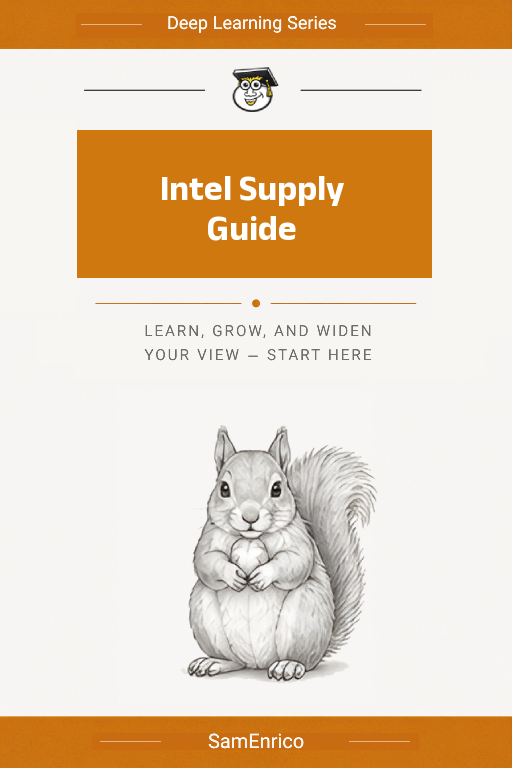
Non-FictionStrategic AtlasSemiconductor Logistics
Intel Supply Guide eBook
Trace multi-sourcing, copy-exact manufacturing, an
Trace multi-sourcing, copy-exact manufacturing, and capacity expansion that ensured chip leadership through demand cycles.
Formats
Free sample
Chapter 1: The Volcano Warning...--The phone rang at 3:47 AM on June 15, 1991. On the other end of the line, a logistics manager in Manila was shouting over what sounded like thunder. But it wasn't thunder. It was ash. Millions of tons of it, falling from a sky that had turned black at noon.Mount Pinatubo, a volcano that had been dormant for more than four centuries, had erupted with a force ten times greater than Mount St.
Helens. The ash cloud rose twenty-two miles into the atmosphere. Within hours, it would circle the globe. Within days, it would bring the world's most sophisticated industry to its knees.Not because the volcano struck a single factory. It didn't.
Pinatubo was fifty miles from Manila's export processing zones, where semiconductors were assembled and tested. The eruption didn't shatter a single wafer. It didn't melt a single circuit. But it did something far more insidious: it closed the skies.Every flight into and out of the Philippines was grounded. Cargo ships were rerouted.
Trucks couldn't navigate roads buried under feet of abrasive, corrosive ash. And in that moment, dozens of electronics companies discovered something terrifying about their supply chains.They had built them wrong.Not accidentally. Not carelessly. They had built them according to the gospel of efficiency that had dominated business thinking for a decade: just-in-time inventory, single-source suppliers, lean manufacturing, zero slack. Every metric said they were doing everything right.
Until a mountain exploded.The Pinatubo eruption became known in industry circles as the "Actel Volcano" problem, named after one small semiconductor company whose entire supply chain collapsed. But the real story was not about Actel. It was about Intel. And about what Intel did differently that would, over the next thirty years, turn supply chain management from a back-office cost center into the most powerful competitive weapon in technology.This chapter debunks the myth that Intel's decades of dominance came solely from superior chip design. It argues that Intel's true, underappreciated competitive moat was its supply chain philosophy—a philosophy built on three pillars that the company would develop over thirty years.
But before we get to those pillars, we must understand the world that Intel inherited and the crisis that forced it to change.The Fragile World Before To understand Intel's supply chain revolution, we must first understand the industry that existed before it. The semiconductor business of the 1970s and 1980s was, by modern standards, astonishingly primitive. Not in its technology—the chips themselves were marvels of engineering. But in its logistics, its risk management, and its supply chain architecture, the industry operated like a collection of village artisans rather than a global industry.Most semiconductor companies of that era followed a simple, seductive model. They would design a chip in California or Massachusetts or Texas.
They would manufacture it in one location—often a single fab in a single region. They would assemble and test it nearby. Then they would ship it to customers who had learned to expect disruptions as a normal cost of doing business.This model had a name. It was called "efficiency." And by the metrics of the time, it was exactly that. Single-site manufacturing minimized capital expenditure.
Just-in-time inventory reduced working capital. Lean staffing kept headcount low. Every number on every spreadsheet said this was the optimal way to run a business.But those spreadsheets had a hidden assumption. They assumed that nothing would ever go wrong.Not a volcano. Not an earthquake.
Not a labor strike. Not a trade war. Not a pandemic. Not a fire at a chemical plant. Not a ship stuck in a canal.
Not a single point of failure anywhere in the global network.The assumption was never stated explicitly. It was embedded in the equations. And it was catastrophically wrong.The Illusion of Control The semiconductor supply chain of the 1980s was a marvel of engineering and a monument to fragility. Consider the typical path of a single chip in that era.A design team in Silicon Valley would spend eighteen months creating a new microprocessor. They would send the masks (the photographic templates used to etch circuits) to a single fab, usually in California or Texas or, increasingly, Japan or Taiwan.
That fab would process silicon wafers through hundreds of steps—deposition, etching, doping, photolithography, annealing—over the course of two to three months. The finished wafers would then ship to an assembly plant, often in a different country, where they would be cut into individual chips, mounted in packages, and tested. Finally, the finished chips would travel to distributors or directly to customers like Dell, Compaq, and IBM.At every step, there was exactly one path. One fab. One assembly line.
One logistics route. One source for the chemicals that etched the circuits. One supplier for the gases that created the plasma. One vendor for the ultrapure water that rinsed away contaminants.The supply chain was not designed for resilience. It was designed for cost.
And for most of the 1980s, that seemed like a perfectly reasonable trade-off.The industry's leaders believed they had achieved something remarkable: predictability. They had reduced variability. They had optimized flows. They had squeezed out waste. They had created a machine that hummed along, quarter after quarter, delivering chips to customers on schedules measured in days.What they had actually created was a house of cards.
And the wind was about to blow.The 1991 Warning The Pinatubo eruption was not the first supply chain disruption in semiconductor history. There had been fires at chemical plants, strikes at ports, bankruptcies of suppliers. But Pinatubo was different. It was simultaneous, systemic, and inescapable.Within forty-eight hours of the eruption, every semiconductor company with assembly or test operations in the Philippines was in crisis. Not because their factories were damaged—most were fine.
But because they couldn't ship anything out. The airports were closed. The ports were clogged with ash. The roads were impassable.The industry had never faced anything like it. Supply chain managers who had spent years optimizing for efficiency suddenly discovered that they had no slack, no alternatives, no Plan B.
Their just-in-time inventory meant they had perhaps a week of finished goods on hand. Their single-source suppliers meant they had no backup. Their lean staffing meant they had no one to call.The small companies failed first. Actel, a manufacturer of programmable logic devices, became the poster child for the disaster. Its entire assembly operation was in the Philippines.
Its customers couldn't get chips. Its revenue disappeared. The company nearly died.But the big companies weren't much better off. Even industry giants found themselves scrambling. They chartered private planes.
They bribed customs officials. They airlifted wafers out on military transport. They did whatever it took to keep the supply chain moving. And they made a quiet promise to themselves: never again.The Intel Exception There was one company that did not panic in 1991. One company that did not scramble for private planes or beg for military transport.
One company that had built its supply chain differently, and that weathered the Pinatubo eruption with barely a ripple.That company was Intel.At the time, Intel was not yet the dominant force it…
This is the end of the free sample. Get the eBook to keep going. Buy now
About this book
Details
- Author
- Reinhart Corrina
- Publisher
- SamEnrico
- Language
- English
- Genre
- Non-Fiction, Strategic Atlas, Semiconductor Logistics
- Released
- 2026-06-01
- Pages (approx.)
- 143
- Available as
- eBook, Audiobook

Read better in the ZLOADR app
Your eBooks on your phone or tablet. Sign in with your SamEnrico account and start reading.
More by Reinhart Corrina
 Starlight Relaxation MethodReinhart Corrina$11.99
 Mongolian American Return To Ulaanbaatar CourseReinhart Corrina$11.99
 The Imposter Syndrome Comparison TrapReinhart Corrina$11.99
 Metta for Menopause TransitionReinhart Corrina$11.99
 Libya Kingdom Idris GuideReinhart Corrina$11.99
 The Golden Quill of the Nile: The Literary Majesty of Ancient EgyptReinhart Corrina$11.99
 In Home Customer Service RepresentativeReinhart Corrina$11.99
 Technical Writing ROI GuideReinhart Corrina$12.99
 A Beginners Guide to Cycle speedway (Volume 1)Reinhart Corrina$11.99
 Understanding Morgani–Turner–albright SyndromeReinhart Corrina$17.99
You may also like
 Hong Kong Handover 1997Dunn Johnnie$11.99
 Zumba For Postnatal Recovery CourseNeal Christian$11.99
 Zumba for BeginnersLadner Nikia$11.99
 YouTube Comment Mining GuideHumes Pandora$12.99
 Worry Box MeditationCarlin Rudy$11.99
 Workplace Stress MeditationNguyen Lynn$11.99
 Workplace Stress and Sleep RepairHawley Ivory$11.99
 Workplace Perfectionism CureDelaney Jeffry$11.99
 Workplace Injustice Anger GuideWallen Isabelle$11.99
 Work Addiction and Burnout LinkGreenwood Ester$11.99
 Women in Yoga and WellnessBeattie Galina$11.99
 Women in Stand Up ComedyChun Evangeline$11.99