
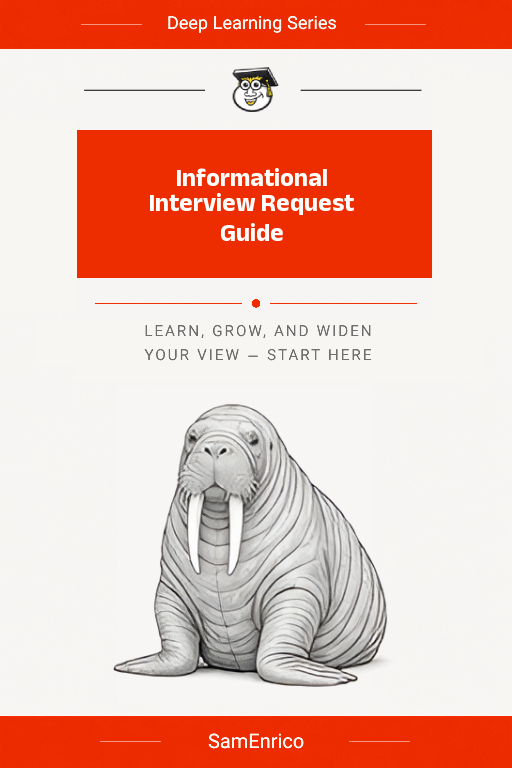
Non-FictionFirst 30 DaysInformational Interviews
Informational Interview Request Guide eBook
Requests low-pressure informational interviews ins
Requests low-pressure informational interviews instead of formal mentorship, building connections that often lead to guidance.
Formats
Free sample
Chapter 1: The Mentorship Lie--–- Three days after graduating with honors from a top university, Sarah Chen sent what she thought was a perfect email. She had carefully crafted every word, researched the recipient's career trajectory, and even asked a professor to review her draft before hitting send. The recipient was a senior vice president at a leading tech company—an alum of her program who had spoken at a career panel six months earlier. Sarah's email was polite, professional, and direct: she asked the executive to be her mentor.Three weeks later, the email had received no reply.Sarah sent a follow-up, assuming her first message had been lost in an overflowing inbox. She was even more careful this time, referencing the panel discussion and expressing her admiration for the executive's career.
Another two weeks passed. Nothing.By the end of that month, Sarah had sent similar mentorship requests to seven other professionals. Six went unanswered. One responded with a polite but firm decline, citing a "busy schedule and existing commitments." Sarah was devastated. She had done everything right.
She had been respectful, thorough, and genuine. Why was no one willing to help her?The answer, which took Sarah nearly a year of frustration to discover, is the subject of this chapter. Her mistake was not in her grammar, her research, or her sincerity. Her mistake was in the fundamental framing of her request. She asked for something that cannot be requested.
She asked for mentorship.The Vocabulary of Desperation Let us begin with a hard truth that most career advice books dance around: asking a stranger to be your mentor is not ambitious. It is not proactive. It is, in most cases, a subtle form of social aggression.This sounds harsh, so let me explain precisely what I mean. When you send an unsolicited email asking someone to serve as your mentor, you are implicitly making several demands of that person. You are asking them to invest emotional energy in your development.
You are asking them to remember your name, your goals, and your progress over an extended period. You are asking them to prioritize your growth alongside their own professional responsibilities, their family, their health, and everything else competing for their attention.And you are asking all of this from someone who has never met you.The language of mentorship requests is, upon close examination, a language of entitlement dressed in the clothes of humility. We write "I would be so grateful if you could find the time to mentor me" as if gratitude somehow lowers the cost of the request. We write "I admire your career so much" as if admiration is a form of currency. But admiration does not pay for the hour a mentor spends reviewing your resume.
Gratitude does not cover the mental load of tracking your progress.The professionals you are contacting understand this instinctively, even if they cannot articulate it. When they read your request for mentorship, they do not think, "How flattering." They think, "How exhausting." And then they delete the email.This is what I call the Vocabulary of Desperation—language that signals neediness rather than curiosity, extraction rather than exchange. It includes phrases like:"I was hoping you could mentor me...""I would love to pick your brain...""Can I buy you coffee and ask for your advice?""I'm looking for a mentor to help guide my career...""Would you be open to a quick call to discuss my situation?"Every single one of these phrases triggers the same defensive response in the recipient. They feel the weight of your unmet needs being placed on their shoulders. They sense, accurately, that you are asking for something open-ended and potentially draining.
And they protect their time by saying nothing at all.The Creepy Factor Explained There is a specific psychological mechanism at work here, and understanding it is essential to rewriting your approach entirely. Let me call it the Creepy Factor—not because mentorship requests are morally wrong, but because they trigger the same alarm bells as any unsolicited request for emotional labor from a stranger.Psychologists have studied what makes people feel comfortable or uncomfortable with requests from strangers. The research consistently shows that three factors predict discomfort: perceived obligation, lack of clear boundaries, and uncertainty about duration. An open-ended mentorship request scores high on all three.When you ask someone to be your mentor, you are implicitly asking them to accept an ongoing obligation to you. There is no clear end date.
There are no explicit boundaries around what you will ask for or how often you will reach out. The other person cannot predict whether this request will cost them one hour or twenty hours over the next year. And humans are wired to reject uncertainty.The Creepy Factor explains why so many mentorship requests go unanswered. It is not that the professionals you contact are cruel or selfish. They are simply responding to a request that feels, at some subconscious level, like a trap.
They cannot see the exit. So they never enter.Here is the counterintuitive insight that changes everything: the way to make a professional want to talk to you is to make it easy for them to say no.This is not a trick. It is not manipulation. It is the fundamental logic of human relationships. When someone knows they can decline your request without guilt, without pressure, and without damaging a relationship, they feel safe.
And when they feel safe, they are far more likely to say yes.Think about the last time someone asked you for a favor that felt open-ended. Perhaps a colleague asked you to "help out with a project" without specifying what that would entail. Perhaps a friend asked to "crash for a few days" without saying how many. How did you feel? Anxious?
Resentful? Did you want to say yes less, not more?The same psychology applies to informational interviews. The professionals you want to talk to are not avoiding you because they are too important. They are avoiding you because your request feels like a commitment they cannot measure. Remove the uncertainty, and you remove the resistance.The 30-Minute Rule Let me introduce a concept that will serve as the backbone of every successful request you make from this point forward: The 30-Minute Rule.The 30-Minute Rule is simple.
Busy professionals will almost always say yes to a thirty-minute conversation if you ask correctly. They will almost always say no to an open-ended request for guidance, advice, or mentorship. The difference between yes and no is not the content of your questions. It is the container you place around them.Thirty minutes is a magical number in the psychology of professional generosity. It is long enough to have a meaningful conversation but short enough to fit into a busy calendar without disruption.
It is substantial enough to signal seriousness but brief enough to feel low-stakes. Most importantly, it has a clear ending. The professional knows exactly what they are agreeing to: thirty minutes of their time, after which the conversation will end and they will be released from any further obligation.This is why the 30-Minute…
This is the end of the free sample. Get the eBook to keep going. Buy now
About this book
Details
- Author
- Andersen Curt
- Publisher
- SamEnrico
- Language
- English
- Genre
- Non-Fiction, First 30 Days, Informational Interviews
- Released
- 2026-06-01
- Pages (approx.)
- 147
- Available as
- eBook, Audiobook

Read better in the ZLOADR app
Your eBooks on your phone or tablet. Sign in with your SamEnrico account and start reading.
More by Andersen Curt
 Memory Reconstruction TheoryAndersen Curt$11.99
 PCOS Pregnancy Loss Support GuideAndersen Curt$11.99
 The Refugee Metta GuideAndersen Curt$11.99
 Consumer Electronics ESG GuideAndersen Curt$11.99
 The Virtual Meeting NonverbalsAndersen Curt$11.99
 The Lion of Pasargadae: Artaxerxes I and the Achaemenid Empire's Golden AgeAndersen Curt$11.99
 Understanding Schereshevskij TurnerAndersen Curt$17.99
 AliExpress Dropshipping GuideAndersen Curt$12.99
 Platform Bed CraftAndersen Curt$11.99
 How to Become a Dry-starch OperatorAndersen Curt$11.99
You may also like
 Hong Kong Handover 1997Dunn Johnnie$11.99
 Zumba For Postnatal Recovery CourseNeal Christian$11.99
 Zumba for BeginnersLadner Nikia$11.99
 YouTube Comment Mining GuideHumes Pandora$12.99
 Worry Box MeditationCarlin Rudy$11.99
 Workplace Stress MeditationNguyen Lynn$11.99
 Workplace Stress and Sleep RepairHawley Ivory$11.99
 Workplace Perfectionism CureDelaney Jeffry$11.99
 Workplace Injustice Anger GuideWallen Isabelle$11.99
 Work Addiction and Burnout LinkGreenwood Ester$11.99
 Women in Yoga and WellnessBeattie Galina$11.99
 Women in Stand Up ComedyChun Evangeline$11.99