
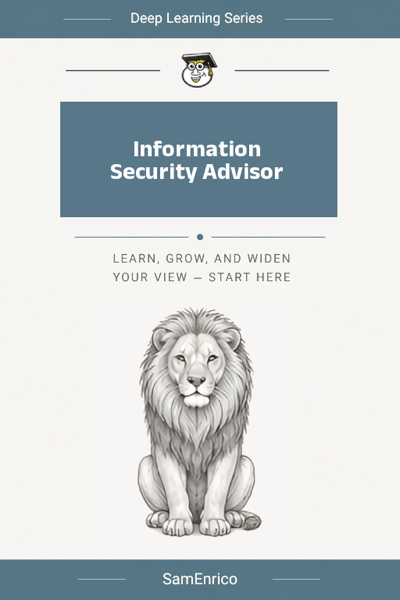
Non-FictionInformativeEducational
Information Security Advisor eBook
A Coursebook on Information Security Advisor
A Coursebook on Information Security Advisor
Formats
Free sample
Chapter 1: The Mirror Test...-- Every morning, information security professionals around the world look in the mirror and see a technician. They see someone who configures firewalls, scans for vulnerabilities, and responds to alerts. This book exists to change that reflection. By the time you finish this chapter, you will understand why the most successful security advisors no longer see themselves as technicians at all—they see themselves as business strategists who happen to specialize in risk. That single shift in identity separates the advisor who is invited to the boardroom from the one who is summoned only after a breach.The question at the heart of this transformation is deceptively simple: Does your organization view security as a roadblock or as a business enabler?
If you answered "roadblock," you are not alone. Most security professionals have been trained—explicitly or implicitly—to say "no." They are measured by how many attacks they block, how many vulnerabilities they patch, and how many compliance checkboxes they tick. These are valuable metrics, but they are technician metrics. They measure activity, not impact. An advisor, by contrast, is measured by how much risk they reduce relative to the cost of doing business.
They are invited into strategic conversations because they speak the language of revenue, reputation, and resilience.This chapter dismantles the common misconception that security is a blocking function. It reframes security as a business enabler—something that protects revenue, brand reputation, and customer trust. It synthesizes lessons from dozens of best-selling security handbooks to move beyond the classic CIA Triad (Confidentiality, Integrity, Availability) and toward a model that directly aligns with corporate objectives like market share growth, regulatory compliance, and operational continuity. Most importantly, it introduces a framework for understanding threats that will guide every subsequent chapter in this book. By the end, you will have the conceptual foundation to transform from a technician who implements controls into an advisor who shapes strategy.The Crisis of Identity in Information Security The security industry suffers from a profound identity crisis.
Walk into any large organization and ask ten different people what the security team does. You will hear ten different answers. The CFO will say security is a cost center that consumes budget without generating revenue. The CIO will say security is a set of compliance requirements that slow down projects. The average employee will say security is the department that makes them change their password every ninety days.
And the security team itself will say they are protecting the organization from threats. All of these perspectives are incomplete, and all of them reveal a fundamental problem: security has been defined by its tactics rather than its purpose.Consider the difference between a locksmith and a security architect. A locksmith installs deadbolts. They know how to pick locks, rekey cylinders, and drill out broken mechanisms. A security architect designs the entire entry system, balancing the cost of different lock types against the value of the assets being protected, the likelihood of different attack methods, and the convenience of authorized users.
The locksmith is a technician. The security architect is an advisor. Most information security professionals have been trained to be locksmiths—highly skilled, deeply technical, and narrowly focused. The organizations that need them most, however, require architects.This identity crisis has real consequences. When security is perceived as a roadblock, business units find ways around it.
They spin up Shadow IT projects using unauthorized cloud services. They share passwords over Slack. They disable security controls that interfere with productivity. None of these actions come from malice. They come from frustration.
The security team has positioned itself as the enemy of getting work done, so employees naturally seek to bypass them. The advisor recognizes this dynamic and changes it. Instead of saying "no," they ask "how can we do this safely?" Instead of blocking Shadow IT, they create fast, painless pathways for sanctioned innovation. Instead of demanding compliance, they demonstrate how security enables the business to enter new markets, win customer trust, and avoid catastrophic losses.Beyond the CIA Triad: A Business-Aligned Security Model Every introductory security course teaches the CIA Triad: Confidentiality, Integrity, and Availability. These are important concepts.
Confidentiality ensures that only authorized parties access data. Integrity ensures that data is not tampered with. Availability ensures that systems and data are accessible when needed. The CIA Triad is useful for technicians because it maps directly to technical controls. Encryption provides confidentiality.
Hashing and digital signatures provide integrity. Redundant servers and backups provide availability.The CIA Triad is largely useless for business leaders. A CEO does not wake up thinking about confidentiality. They wake up thinking about quarterly earnings, market share, and customer retention. An advisor bridges this gap by translating the CIA Triad into business outcomes.
Confidentiality becomes protection of trade secrets and customer privacy—directly tied to competitive advantage and regulatory fines. Integrity becomes trust in financial reporting and operational data—directly tied to investor confidence and decision quality. Availability becomes revenue continuity and customer satisfaction—directly tied to uptime SLAs and brand reputation.A more useful framework for the advisor is what this book calls the Business Protection Model. It consists of four pillars that map security outcomes directly to corporate objectives:Pillar One: Revenue Protection. Every security control ultimately exists to protect revenue streams.
An e-commerce site that goes down loses direct sales. A manufacturer whose production line is encrypted by ransomware loses output. A bank whose online platform is defaced loses customer deposits. The advisor calculates the revenue at risk for each system and prioritizes controls accordingly.Pillar Two: Reputation Preservation. Breaches erode customer trust.
Studies consistently show that a significant percentage of customers will leave a company that suffers a data breach involving their personal information. Reputation damage can exceed the direct costs of incident response by an order of magnitude. The advisor quantifies brand value and models how different breach scenarios would impact customer loyalty and acquisition costs.Pillar Three: Regulatory Compliance. Fines from GDPR, HIPAA, SOX, and CCPA can reach millions or even billions of dollars for a single violation. Beyond fines, non-compliance can trigger consent decrees, mandatory audits, and even business shutdowns.
The advisor maps regulatory requirements to technical controls and tracks compliance as a risk reduction metric.Pillar Four: Operational Continuity. Downtime is expensive. The advisor calculates the cost of an hour of downtime for each critical business function, then designs controls that balance protection against productivity. This is where security most visibly intersects with business operations, and where the advisor must demonstrate the most diplomatic skill.The Modern Threat Landscape: A 2x2 Matrix Traditional security training presents threat categories as a list: malware, phishing, insider threats, denial of service, advanced persistent threats, and so on. This list-based approach fails because it does not help the advisor prioritize.
A list gives equal weight to a teenage script kiddie and a state-sponsored espionage team. The advisor needs a framework that distinguishes threats by their sophistication and their source of automation.This book introduces the Threat Matrix, a 2x2 framework that categorizes threats along two axes. The horizontal axis represents Adversary Sophistication, ranging from Low to High. Low sophistication attackers use off-the-shelf tools, follow published…
This is the end of the free sample. Get the eBook to keep going. Buy now
About this book
Details
- Author
- Chan Krystyna
- Publisher
- SamEnrico
- Language
- English
- Genre
- Non-Fiction, Informative, Educational
- Released
- 2026-05-23
- Pages (approx.)
- 153
- Available as
- eBook, Audiobook

Read better in the ZLOADR app
Your eBooks on your phone or tablet. Sign in with your SamEnrico account and start reading.
More by Chan Krystyna
 Russian Arms Trafficking GuideChan Krystyna$11.99
 Compulsive Spending And Boredom CourseChan Krystyna$11.99
 Dream Location TrackerChan Krystyna$11.99
 Mindfulness for OverthinkersChan Krystyna$11.99
 Food Addiction in AthletesChan Krystyna$11.99
 The Lost Kingdoms of the Sahel: The Forgotten Cartographers of the Ancient SaharaChan Krystyna$11.99
 The Great Bitcoin Heist: How a Rogue Trader Lost $1 Billion in 48 HoursChan Krystyna$11.99
 Sachet Marketing For BoPChan Krystyna$12.99
 Safety for InternationalsChan Krystyna$12.99
 Understanding Congenital AChan Krystyna$17.99
 How to Start a Mouldings Made of Wood Business (Beginners Guide)Chan Krystyna$11.99
You may also like
 Hong Kong Handover 1997Dunn Johnnie$11.99
 Zumba For Postnatal Recovery CourseNeal Christian$11.99
 Zumba for BeginnersLadner Nikia$11.99
 YouTube Comment Mining GuideHumes Pandora$12.99
 Worry Box MeditationCarlin Rudy$11.99
 Workplace Stress MeditationNguyen Lynn$11.99
 Workplace Stress and Sleep RepairHawley Ivory$11.99
 Workplace Perfectionism CureDelaney Jeffry$11.99
 Workplace Injustice Anger GuideWallen Isabelle$11.99
 Work Addiction and Burnout LinkGreenwood Ester$11.99
 Women in Yoga and WellnessBeattie Galina$11.99
 Women in Stand Up ComedyChun Evangeline$11.99