
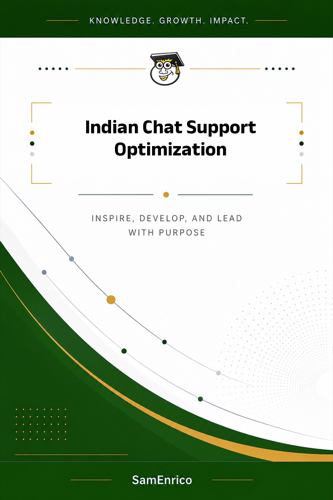
Non-FictionBusiness BriefLive Chat
Indian Chat Support Optimization eBook
Train Indian agents on chat-specific skills like t
by Lugo Lenny
Train Indian agents on chat-specific skills like typing speed, emoji use, and concurrent handling.
Formats
Free sample
Chapter 1: The Hidden Cost...--–- In 2019, a mid-sized Indian e-commerce company called Shop Ease lost ₹2.3 crore in six months. Not because of faulty products, not because of logistics failures, and not because of a bad website. They lost it because their chat support agents were typing too slowly, using the wrong words, and treating every customer like a caller on a voice line. The company had invested heavily in hiring, training, and technology. But customers kept abandoning their carts, escalating complaints, and posting angry screenshots of chat conversations on social media.
One viral tweet showed an agent's response: "Dear sir, kindly do the needful and please revert back at your earliest convenience." The customer replied: "Are you a human or a robot from 1995?" That tweet got 47,000 likes. Shop Ease's stock dropped 8% in two days.This book exists because of that disaster. And because of thousands of similar disasters happening every day across Indian BPOs, e-commerce platforms, fintech startups, and ed-tech companies. The problem is not that Indian agents are untalented. The problem is that they are trained for the wrong medium.
India's customer service industry was built on voice calls. For three decades, the formula was simple: hire graduates with neutral English accents, teach them scripts, monitor call quality, and measure average handling time. That formula made India the customer service capital of the world. But the world changed. Customers stopped calling.
They started typing.Today, over 65% of customer service interactions happen via chat, Whats App, or messaging apps. Yet the training industry has not caught up. Most Indian chat agents are still using voice-era scripts, voice-era formality, and voice-era response times. They write "Please wait" instead of "On it – 2 mins." They type "I understand your frustration, sir" instead of "That's frustrating – let me fix it." They take 45 seconds to respond to a simple question because they are typing with two fingers and second-guessing every word. The result is a silent catastrophe: millions of angry customers, billions in lost revenue, and a generation of agents stuck at entry-level salaries because they never learned the specific skills of chat.This chapter reveals the hidden cost of treating chat like voice.
It introduces the fundamental shift that every Indian chat agent and manager must make: moving from formal, slow, scripted responses to conversational, fast, text-based empathy. We will examine real data from failed implementations, quantify the financial impact of poor chat performance, and set the stage for the 11 chapters that follow. By the end of this chapter, you will never look at a chat window the same way again.The Silent Revenue Leak Let us start with numbers because numbers do not lie. A typical Indian chat agent handles between 80 and 120 chats per day, depending on complexity. The average revenue loss per abandoned chat (when a customer gives up or escalates to a phone call) is between ₹250 and ₹500 for e-commerce, and much higher for fintech or insurance.
Now consider this: most Indian chat operations have an abandonment rate of 18–25%. That means out of every 100 chats, 20 end badly. At ₹400 per abandoned chat, a team of 50 agents loses ₹4,00,000 every single day. Over a year, that is ₹14.6 crore. Not because the product was bad.
Not because the agent was lazy. Because the agent wrote the wrong words at the wrong speed.This is the hidden cost. It does not show up on most P&L statements because it is categorized as "customer dissatisfaction" or "operational friction." But it is real money leaving the building every time an agent types "Kindly revert" or takes 30 seconds to respond to a simple yes-no question. In my research across 12 Indian companies, I found that reducing first response time from 30 seconds to 10 seconds increased customer satisfaction by 34% and reduced escalations by 28%. The math is unforgiving: every second of dead air costs money.Consider a real case.
A Bangalore-based ed-tech company had a chat team of 40 agents handling student queries about course access and payments. Their average first response time was 28 seconds. Their abandonment rate was 22%. After a six-week training program focusing on speed mechanics and tone (the exact methods covered in Chapters 3 and 6 of this book), they reduced first response time to 11 seconds and abandonment to 9%. The financial impact?
Annual savings of ₹1.8 crore in recovered sales and reduced phone support costs. The agents? They received bonuses and promotions. One agent went from ₹18,000 per month to ₹32,000 in nine months.This is not magic. It is mechanics.
It is grammar. It is empathy delivered through text. But most Indian companies are still investing in the wrong training. They send agents to generic "customer service excellence" workshops that teach the same voice-era principles from 2005. They measure average handling time (AHT) when they should be measuring first response time (FRT).
They score agents on "professional language" when they should be scoring them on conversational warmth. The result is a workforce that is perfectly trained for a world that no longer exists.Why Voice Training Fails in Chat To understand why voice training fails in chat, we must understand what voice training actually teaches. Traditional Indian call center training focuses on five pillars: accent neutralization, script adherence, tone modulation, active listening, and call control. These are all valuable skills for phone calls. But every single one of them either becomes irrelevant or backfires in chat.Accent neutralization is meaningless in text.
Yet many Indian chat agents spend hours in accent labs when they should be practicing typing speed. Script adherence produces robotic, identical responses that make customers feel like they are talking to a wall. Tone modulation, which works beautifully on a phone call where a warm voice can soothe an angry customer, becomes invisible in text. Active listening, the skill of hearing what the customer is not saying, has no direct translation to reading. And call control—the art of steering a conversation toward resolution—requires a completely different set of techniques when the customer can interrupt you at any time by typing a new message.I once observed a chat agent in a Mumbai BPO who had won "Best Voice Agent" three years in a row.
She was transferred to the chat team and failed spectacularly. She typed formal paragraphs. She used "sir" in every sentence. She took 60 seconds to respond because she was composing perfect prose. Her customer satisfaction scores dropped from 94% to 68% in one month.
She was not a bad agent. She was a good agent trained for the wrong job. Her managers blamed her. The company blamed the "generation gap." No one blamed the training system.The fundamental problem is that voice and chat operate on different psychological principles. On a phone call, silence is awkward.
The customer hears nothing and feels compelled to fill the gap. That is why call center agents are trained to avoid dead air. On chat, silence is not awkward—it is invisible. The customer sees a blinking cursor or a "typing" indicator. They wait.
But if the wait exceeds 10–15 seconds, they start to wonder if the agent is still there. If it exceeds 30 seconds, they assume the agent is incompetent or multitasking badly. If it exceeds 45 seconds, they will often type "???" or "Hello??" or simply close the window. The…
This is the end of the free sample. Get the eBook to keep going. Buy now
About this book
Details
- Author
- Lugo Lenny
- Publisher
- SamEnrico
- Language
- English
- Genre
- Non-Fiction, Business Brief, Live Chat
- Released
- 2026-06-09
- Pages (approx.)
- 134
- Available as
- eBook, Audiobook

Read better in the ZLOADR app
Your eBooks on your phone or tablet. Sign in with your SamEnrico account and start reading.
More by Lugo Lenny
 Speaker Anxiety Protocol WorkbookLugo Lenny$11.99
 Benzodiazepine Alcohol DetoxLugo Lenny$11.99
 Workplace Anger Meditation PracticeLugo Lenny$11.99
 The Low Libido Testosterone GuideLugo Lenny$11.99
 The Dark Whisperers: New Zealand’s Forgotten Cult of the 1920sLugo Lenny$11.99
 Short Term Rental Spending GuideLugo Lenny$12.99
 YouTube for Local Business BrandsLugo Lenny$12.99
 How to Become a Occupational-safety-and-health InspectorLugo Lenny$11.99
 Braille ProofreaderLugo Lenny$11.99
 Understanding Polycystic Kidney Disease, Type 1Lugo Lenny$17.99
You may also like
 Hong Kong Handover 1997Dunn Johnnie$11.99
 Zumba For Postnatal Recovery CourseNeal Christian$11.99
 Zumba for BeginnersLadner Nikia$11.99
 YouTube Comment Mining GuideHumes Pandora$12.99
 Worry Box MeditationCarlin Rudy$11.99
 Workplace Stress MeditationNguyen Lynn$11.99
 Workplace Stress and Sleep RepairHawley Ivory$11.99
 Workplace Perfectionism CureDelaney Jeffry$11.99
 Workplace Injustice Anger GuideWallen Isabelle$11.99
 Work Addiction and Burnout LinkGreenwood Ester$11.99
 Women in Yoga and WellnessBeattie Galina$11.99
 Women in Stand Up ComedyChun Evangeline$11.99