
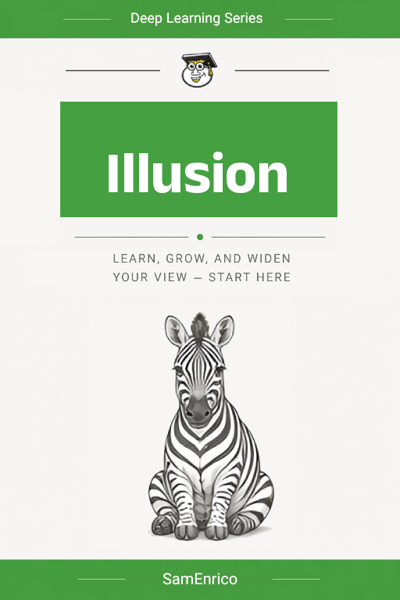
Non-FictionInformativeEducational
Illusion eBook
A Coursebook on Illusion
by Cooley Isiah
A Coursebook on Illusion
Formats
Free sample
Chapter 1: The Dream Machine--–- Look at your hand. Really look at it. Notice the skin, the lines, the way light catches your fingernails. Now answer this question honestly: Are you seeing your hand as it actually is, or are you seeing your brain's best guess about your hand?The answer, which most people find deeply unsettling, is the latter. You have never once seen the world as it is.
You have only ever seen your brain's construction of it. This is not a philosophical abstraction or a New Age platitude. It is a neurological fact, demonstrated thousands of times across decades of rigorous experiments. Your brain is not a camera. Cameras record passively.
Your brain builds actively. Every second of every waking moment, your brain is performing a miracle of improvisation, taking incomplete, noisy, ambiguous data from your senses and manufacturing a coherent, stable, meaningful experience that you call "reality."This chapter is the foundation of everything that follows. Without understanding how your brain constructs reality, none of the later chapters—on magic, on politics, on digital deception, on the nature of the self—will fully land. So we are going to start at the very beginning: the three pounds of tissue between your ears that is simultaneously the most sophisticated prediction engine in the known universe and the most reliable liar you will ever meet.The Movie Camera Myth Most people walk through life believing what philosophers call "naive realism"—the assumption that they see the world exactly as it is. If you ask someone, "What color is a ripe banana?" they will say "yellow," as if yellowness is a property of the banana itself.
But color does not exist in the world. Color exists in your brain. What exists in the world is electromagnetic radiation of various wavelengths. Your brain takes that radiation, compares it to your evolutionary history, your personal history, your expectations, and your current context, and then constructs the experience of "yellow." A bee sees that same banana as ultraviolet patterns we cannot even imagine. A mantis shrimp sees sixteen color receptors where we have three.
Who is seeing the "real" color? No one. Everyone is seeing their brain's construction.This is the movie camera myth: the belief that perception is a passive recording of an objective external world. It feels true because perception feels effortless and immediate. But effortless and immediate are not the same as accurate.
Consider your visual field right now. It feels rich, detailed, continuous. You feel like you are seeing everything in front of you in high definition. This is the first and most pervasive illusion we will encounter in this book: the illusion of a rich, detailed visual world. You are not seeing everything.
You are seeing a tiny fraction of what is available, and your brain is filling in the rest with educated guesses. Most of the time, those guesses are good enough to keep you alive. But good enough is not the same as true.Sensation vs. Perception: The Crucial Distinction To understand how your brain builds reality, you must first understand the difference between sensation and perception. Sensation is the raw, noisy, ambiguous data that your sensory organs collect from the environment.
Photons hit your retina. Pressure waves hit your eardrums. Molecules land on your olfactory receptors. That is sensation. It is not experienced.
You never experience raw sensation. What you experience is perception: the brain's interpreted, cleaned-up, edited, and often distorted story about what that sensation means.Here is a simple demonstration. Hold your hand out to the side, as far as you can reach, and slowly bring it forward while keeping your eyes focused straight ahead. At some point, you will see your hand appear in your peripheral vision. But here is what you will not notice: your hand appears out of nowhere, fully formed.
You do not see it fade in. You do not see it assemble itself. One moment it is not there, and the next moment it is completely there. That is because your brain is not showing you reality in real time. Your brain is showing you a completed, edited video, and it has deleted the frames where your hand was partially visible because partial visibility is confusing.
Your brain hates confusion. Your brain loves clean, stable, meaningful stories. So it tells you one.The neuroscientist David Eagleman puts it this way: "Your brain perceives not what is out there, but what it expects to be out there." This expectation mechanism is so powerful that it can override actual sensory data. The hollow mask illusion is a perfect example. A hollow mask of a face—concave rather than convex—is rotated slowly.
Your brain knows, from a lifetime of experience, that faces are convex. So even when the hollow side is facing you, your brain refuses to see it as hollow. It flips the perception, forcing you to see a convex face where none exists. You cannot choose to see the hollow mask as hollow. Try as you might, your brain's expectation overrides your intention.
That is top-down processing in action.Top-Down vs. Bottom-Up Processing These two terms will appear throughout this book, so let us cement them now. Bottom-up processing is when perception is driven by sensory data. You see a red shape, and your brain processes the wavelengths, the edges, the contrast, and gradually builds up to "fire truck." Bottom-up processing is data-driven. Top-down processing is when perception is driven by expectations, knowledge, beliefs, and context.
You are expecting to see a fire truck because you heard a siren, so your brain interprets a vague red blur as "fire truck" even before the sensory details resolve.Both happen simultaneously, all the time. But top-down processing is far more powerful than most people realize. Consider the famous "rat-man" ambiguous figure. An ambiguous line drawing can be seen as either a rat or a man, depending on what you are primed to expect. Show someone a series of animal pictures first, and they see the rat.
Show someone a series of human faces first, and they see the man. The sensory data is identical. The perception is different. This is why eyewitness testimony is famously unreliable. Two people can witness the exact same event and report completely different experiences because they brought different expectations, different prior experiences, and different top-down frameworks to the scene.
Neither is lying. Both are reporting what their brain constructed. But only one—or neither—may be accurate.This has profound implications for everything from criminal justice to political disagreement. When you watch a political debate, you are not seeing the debate as it is. You are seeing your brain's construction of the debate, filtered through your prior beliefs, your team loyalties, and your emotional state.
When you remember a childhood event, you are not remembering the event as it happened. You are remembering the last time you remembered it, with all the edits and embellishments that have accumulated over decades. Your memory is not a recording. It is a story you tell yourself, revised with each retelling.The Brain as Prediction Engine The most powerful framework for understanding perception has emerged in the last twenty…
This is the end of the free sample. Get the eBook to keep going. Buy now
About this book
Details
- Author
- Cooley Isiah
- Publisher
- SamEnrico
- Language
- English
- Genre
- Non-Fiction, Informative, Educational
- Released
- 2026-06-02
- Pages (approx.)
- 145
- Available as
- eBook, Audiobook

Read better in the ZLOADR app
Your eBooks on your phone or tablet. Sign in with your SamEnrico account and start reading.
More by Cooley Isiah
 Self Hypnosis for LonelinessCooley Isiah$11.99
 The Radical Acceptance of Emotions WorkbookCooley Isiah$11.99
 360 Review Response ProtocolCooley Isiah$11.99
 The Parent Isolation Recovery GuideCooley Isiah$11.99
 AI Music Composition for VideosCooley Isiah$11.99
 The Phantom of the Sahara: The Lost Expedition of Heinrich BarthCooley Isiah$11.99
 Understanding Branchial Arch DefectsCooley Isiah$17.99
 Corporate Bootcamp Sponsorship GuideCooley Isiah$12.99
 Latin America Ecommerce OutlookCooley Isiah$12.99
 How to Become a Diamond MounterCooley Isiah$11.99
You may also like
 Hong Kong Handover 1997Dunn Johnnie$11.99
 Zumba For Postnatal Recovery CourseNeal Christian$11.99
 Zumba for BeginnersLadner Nikia$11.99
 YouTube Comment Mining GuideHumes Pandora$12.99
 Worry Box MeditationCarlin Rudy$11.99
 Workplace Stress MeditationNguyen Lynn$11.99
 Workplace Stress and Sleep RepairHawley Ivory$11.99
 Workplace Perfectionism CureDelaney Jeffry$11.99
 Workplace Injustice Anger GuideWallen Isabelle$11.99
 Work Addiction and Burnout LinkGreenwood Ester$11.99
 Women in Yoga and WellnessBeattie Galina$11.99
 Women in Stand Up ComedyChun Evangeline$11.99