
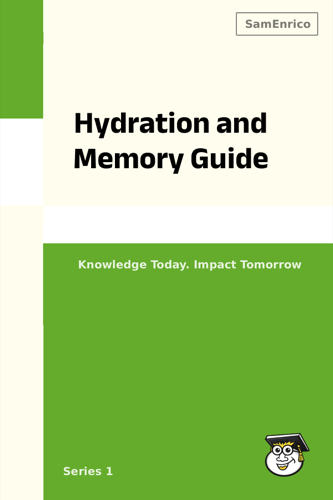
Hydration and Memory Guide eBook
Drink enough water to prevent cognitive fog using
Drink enough water to prevent cognitive fog using this practical guide.
Formats
Free sample
Chapter 1: The 2% Deception--–- You wake up tired. You drink coffee. You push through the morning, feeling vaguely off but unable to name why. By 2:00 PM, you cannot remember what you read ten minutes ago. You blame age, stress, bad sleep, or perhaps early-onset dementia.
You are wrong on all counts. The real thief of your mental clarity is hiding in plain sight, and it has been stealing from you every single day of your adult life without you ever noticing.This book will show you what that thief is and how to catch it. But before we get to solutions, you need to understand the deception. The deception is this: you believe that if you were dehydrated, you would know it. You imagine dry mouth, dizziness, a parched throat.
You imagine being stranded in a desert. Since you are sitting in a climate-controlled office or home, you assume hydration is not your problem. That assumption is the 2% deception, and it is the single greatest blind spot in modern cognitive health.The science is clear, and it is shocking. Losing just 2 percent of your body weight in water—a level of dehydration that produces no thirst in most people, no dry mouth, no obvious physical symptoms—reduces short-term memory, attention, and psychomotor speed by 20 to 30 percent. In plain language: you lose nearly a third of your usable intelligence, and you do not feel thirsty while it happens.
You simply feel tired, slow, and foggy. And because those symptoms are indistinguishable from ordinary fatigue, you reach for coffee, sugar, or resignation. You never reach for water.This chapter will dismantle the 2% deception completely. You will learn what 2% dehydration actually means in real-world terms. You will discover the studies that prove mild dehydration impairs cognition as much as alcohol intoxication.
You will understand why your body hides this deficit from you. And you will confront the uncomfortable possibility that some of the cognitive struggles you have accepted as normal—the forgotten names, the lost keys, the afternoon slumps, the inexplicable irritability—are not signs of aging or stress. They are signs of thirst.By the end of this chapter, you will never look at a glass of water the same way again.The Number That Changes Everything Let us start with a number: 2 percent.It sounds small. In everyday life, a 2 percent change is barely noticeable. A 2 percent raise at work feels like nothing.
A 2 percent discount at the grocery store is not worth clipping a coupon for. But in the human body, 2 percent is a cliff.Your body is approximately 60 percent water by weight. Your brain is approximately 75 percent water. When you lose just 2 percent of your body weight in fluid, you have lost enough water to change the volume of your blood, the conductivity of your neurons, and the pressure inside your skull. You have not lost enough to feel thirsty in most cases, but you have lost enough to think like someone who has been drinking alcohol.A 160-pound person reaches 2 percent dehydration after losing 3.2 pounds of water.
That is 51.2 ounces of fluid. To put that in perspective: you lose about 8 to 12 ounces of water overnight just from breathing and sweating while you sleep. A 30-minute workout in a gym can cost you another 16 to 24 ounces. A morning coffee, which is a mild diuretic, can increase urine output by 4 to 8 ounces beyond what you drank. Add these together, and you can reach 2 percent dehydration by lunchtime without ever feeling thirsty.
This is not a hypothetical. This is the average Tuesday for millions of people.The studies that established the 2 percent rule are robust and replicated. In a landmark 2012 study published in the Journal of Nutrition, researchers took young, healthy women and induced mild dehydration of just 1.36 percent body weight loss. The women reported increased fatigue, lower alertness, and greater difficulty concentrating. When tested on cognitive tasks, their reaction times slowed, their working memory errors increased, and their mood scores dropped significantly.
The participants did not report feeling thirsty. They reported feeling tired and grumpy.A companion study in men found similar results: 1.5 percent dehydration led to degraded performance on vigilance tasks, working memory tests, and complex problem-solving exercises. The men also reported higher levels of tension, anxiety, and fatigue. When rehydrated, their cognitive scores returned to baseline within 20 to 30 minutes.These are not extreme conditions. The studies did not involve marathon running or desert heat.
Participants achieved these levels of dehydration by skipping water for a few hours while performing normal office work in a room-temperature environment. In other words, the 2 percent deception is not something that happens to athletes and soldiers. It happens to everyone who works indoors and forgets to drink.The Hidden Symptoms You Mistake for Something Else Here is where the deception becomes dangerous. The symptoms of 2 percent dehydration are almost identical to the symptoms of ordinary mental fatigue, stress, poor sleep, and even depression. Your brain does not send you a clear signal that says "I need water." It sends you signals that say "I am tired," "I cannot focus," "I am annoyed," or "I am hungry for sugar."Let us walk through the most common mislabeled symptoms.Brain fog is the number one complaint.
You sit down to work, and the words will not come. You read a paragraph three times and absorb nothing. You walk into a room and forget why. Most people attribute this to aging or lack of sleep. But brain fog is a direct consequence of reduced cerebral blood flow.
When you are dehydrated, your blood volume drops. Your heart pumps harder to maintain pressure, but the volume of blood reaching your brain decreases. Less blood means less oxygen and less glucose. Your neurons literally have less fuel to fire. The result is a sluggish, foggy feeling that no amount of caffeine can truly fix because caffeine does not restore blood volume—water does.Irritability is the second most common symptom.
You snap at your partner, your child, or a coworker. Later, you feel guilty and cannot explain why you overreacted. Dehydration activates the sympathetic nervous system—the fight-or-flight response. Your body perceives fluid loss as a threat, so it raises cortisol and adrenaline. In that state, small annoyances feel like major provocations.
Your patience evaporates. A 2015 study found that even mild dehydration significantly increased feelings of tension, anger, and hostility in both men and women. The participants did not know they were dehydrated. They just knew they felt angry.False hunger is the third symptom, and it is one of the most insidious. The hypothalamus regulates both thirst and hunger, and the signals can cross.
When you are mildly dehydrated, your brain may interpret the sensation as a need for food, specifically for sugar or carbohydrates. This is why you crave a cookie or a soda at 3:00 PM even after a full lunch. You are not hungry. You are thirsty. But because the craving feels like hunger, you eat, and the problem gets worse.
Digesting food requires water. Eating when you are already dehydrated further depletes your fluid reserves, deepening the cognitive fog you were trying to solve.Headaches are the fourth symptom. Dehydration reduces the volume of cerebrospinal…
This is the end of the free sample. Get the eBook to keep going. Buy now
About this book
Details
- Author
- Moffett Jackson
- Publisher
- SamEnrico
- Language
- English
- Genre
- Non-Fiction, Self-Help, Hydration
- Released
- 2026-06-12
- Pages (approx.)
- 149
- Available as
- eBook, Audiobook

Read better in the ZLOADR app
Your eBooks on your phone or tablet. Sign in with your SamEnrico account and start reading.
More by Moffett Jackson
 Stress Cold Hands Feet GuideMoffett Jackson$11.99
 Warm Introduction MethodMoffett Jackson$11.99
 Step Four Inventory Sharing With Sponsor GuideMoffett Jackson$11.99
 The Nonprofit Side Hustle TransitionMoffett Jackson$11.99
 SMART Goals for ADHDMoffett Jackson$11.99
 Bug Out Bag ListMoffett Jackson$11.99
 Pet Accident Death GriefMoffett Jackson$11.99
 The Siege of Robben Island: South Africa's Forgotten Prison UprisingMoffett Jackson$11.99
 How to Produce Mites (Control Products)Moffett Jackson$11.99
 How to Produce Adhesive Tape, Film and PaperMoffett Jackson$11.99
 A Collector's Handbook to the Plymouth Wimbledon)Moffett Jackson$11.99
 Mailchimp Urgency and Scarcity TacticsMoffett Jackson$12.99
You may also like
 Hong Kong Handover 1997Dunn Johnnie$11.99
 Zumba For Postnatal Recovery CourseNeal Christian$11.99
 Zumba for BeginnersLadner Nikia$11.99
 YouTube Comment Mining GuideHumes Pandora$12.99
 Worry Box MeditationCarlin Rudy$11.99
 Workplace Stress MeditationNguyen Lynn$11.99
 Workplace Stress and Sleep RepairHawley Ivory$11.99
 Workplace Perfectionism CureDelaney Jeffry$11.99
 Workplace Injustice Anger GuideWallen Isabelle$11.99
 Work Addiction and Burnout LinkGreenwood Ester$11.99
 Women in Yoga and WellnessBeattie Galina$11.99
 Women in Stand Up ComedyChun Evangeline$11.99