
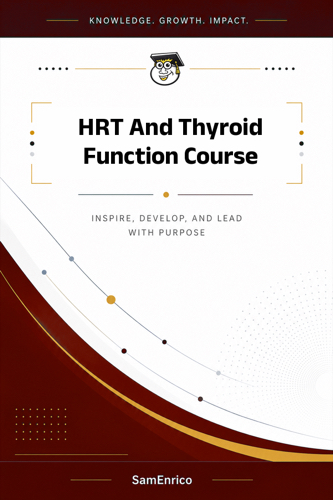
HRT And Thyroid Function Course eBook
Discusses how estrogen affects thyroid binding glo
by Short Oren
Discusses how estrogen affects thyroid binding globulin and medication adjustments.
Formats
Free sample
Chapter 1: The Liver's Secret...--It was a routine follow-up visit that changed everything for Sarah, a 42-year-old marketing executive with well-managed Hashimoto's thyroiditis. For five years, her levothyroxine dose of 88 mcg daily had kept her TSH comfortably between 1.2 and 1.8 m IU/L. She felt energetic, maintained her weight, and had mostly forgotten she had a thyroid condition. Then she started a low-dose oral contraceptive to manage debilitating perimenopausal bleeding. Three months later, she sat in her endocrinologist's office with a TSH of 4.2 m IU/L, complaining of fatigue so profound she could barely complete her afternoon meetings.
Her hair was thinning. She was gaining weight despite no change in diet or exercise. Her doctor's response? "Your thyroid labs are within range. Maybe you're just stressed."Sarah's story is not an anomaly.
It is a daily occurrence in primary care clinics and endocrinology practices worldwide. And it represents a fundamental failure in medical education: the near-complete absence of training on how estrogen therapy—whether for contraception, fertility, menopause, or gender affirmation—profoundly alters thyroid function tests and thyroid hormone requirements.The Clinical Blind Spot The interaction between estrogen and thyroid function is not a niche curiosity. It is a predictable, dose-dependent, mechanistically understood pharmacologic reality. Yet surveys of primary care physicians consistently show that fewer than 30% can accurately describe how oral estrogen affects thyroxine-binding globulin (TBG), and even fewer know when to adjust levothyroxine doses in response. This knowledge gap has real consequences.
Women on combined hormone therapy are more likely to be labeled as "non-compliant" with their thyroid medication when their TSH rises, more likely to be prescribed antidepressants for what is actually iatrogenic hypothyroidism, and more likely to cycle through multiple HRT formulations without ever achieving symptomatic relief.This book exists to close that gap. It is written for clinicians who want to practice evidence-based, patient-centered endocrinology, and for patients who have been failed by a system that treats the thyroid and the ovaries as if they operate in separate universes. Together, we will explore the biochemical collision between two major endocrine axes, decode the lab traps that ensnare even experienced practitioners, and build a practical toolkit for managing thyroid medication before, during, and after estrogen therapy.What This Chapter Covers Before we dive into the molecular details of TBG synthesis, estrogen metabolism, and dose adjustment algorithms, we must establish the foundation. This chapter will:Define the scope of the problem: how common estrogen therapy is and how often thyroid patients use it Introduce the two endocrine axes that will govern everything we discuss: the Hypothalamic-Pituitary-Thyroid (HPT) axis and the Hypothalamic-Pituitary-Gonadal (HPG) axis Reveal where these axes collide—the liver—and why that collision site matters more than most clinicians realize Present a corrected case study (different from the symptom vignettes in Chapter 6) that illustrates a pure lab interpretation error, not just a TSH rise Outline the structure of the book and what each section will deliver By the end of this chapter, you will understand why standard thyroid care so often fails women starting HRT, and you will be prepared to follow the logical progression from biochemistry to clinical action.The Scope of the Problem: How Common Is This?To appreciate the scale of the clinical blind spot, we must first understand how frequently estrogen therapy and thyroid disease coexist.Thyroid disease is predominantly a condition of women. Autoimmune thyroiditis (Hashimoto's disease) affects women at a rate 5 to 8 times that of men.
By age 50, approximately 12% of women will have been diagnosed with hypothyroidism, and another 8-10% will have subclinical disease. This means that in any primary care practice of 2,000 women, roughly 200 to 400 are on thyroid hormone replacement.Simultaneously, estrogen therapy is ubiquitous. Among women of reproductive age, approximately 40% use oral contraceptives at some point. Among perimenopausal women, roughly 25% will use some form of hormone therapy. Among postmenopausal women, the numbers vary by country, but in the United States, approximately 4-5% are on systemic estrogen at any given time, with higher rates in women under 60 with bothersome vasomotor symptoms.
When we add fertility treatments (which use supraphysiologic estrogen doses) and gender-affirming hormone therapy for trans women, the population at risk is substantial.The overlap is inevitable. Using conservative estimates, hundreds of thousands of women each year initiate or change estrogen therapy while already on thyroid medication. And most of them will receive no change in their thyroid dose, no adjusted monitoring schedule, and no warning that their fatigue might be pharmacological rather than psychological.The Financial and Human Cost The consequences extend beyond symptoms. A 2018 analysis of insurance claims data found that women on both oral contraceptives and levothyroxine had 40% more thyroid function tests ordered than matched controls, yet their TSH remained out of range 30% of the time—suggesting that labs were being drawn but not acted upon appropriately. These women also had higher rates of antidepressant prescriptions, sleep aid use, and short-term disability claims than women on levothyroxine alone.Sarah, our opening case study, eventually saw a different clinician who recognized the problem.
Her levothyroxine was increased to 112 mcg daily, her TSH returned to 1.5 m IU/L, and her symptoms resolved within six weeks. The solution was simple. The failure was not medical—it was educational.The Two Endocrine Axes: A Refresher To understand how estrogen disrupts thyroid function, we must first understand how each axis works independently. This section provides a rapid but essential review. Readers already comfortable with the HPT and HPG axes may skim ahead, but the concepts introduced here will be referenced throughout the book.The Hypothalamic-Pituitary-Thyroid (HPT) Axis The HPT axis is a classic negative feedback loop.
It begins in the hypothalamus, a small region at the base of the brain that serves as a master regulator of endocrine function. When the hypothalamus senses low levels of thyroid hormone in the bloodstream—or when it receives signals from other parts of the brain about energy balance, temperature, or illness—it secretes thyrotropin-releasing hormone (TRH).TRH travels through the hypothalamic-pituitary portal blood system to the anterior pituitary gland. There, it binds to TRH receptors on thyrotrope cells, stimulating them to produce and secrete thyroid-stimulating hormone (TSH). TSH then enters the systemic circulation and travels to the thyroid gland, where it binds to TSH receptors on the surface of thyroid follicular cells. This binding triggers a cascade of events that culminates in the production and release of thyroxine (T4) and smaller amounts of triiodothyronine (T3).T4 is the primary secretory product of the thyroid, accounting for approximately 90% of its output.
T4 is often called a "prohormone" because it has relatively low biologic activity. Most of the active thyroid hormone—the molecule that actually binds to nuclear receptors in cells and alters gene transcription—is T3. The body converts T4 to T3 in peripheral tissues, primarily the liver and kidneys, through the action of deiodinase enzymes.The negative feedback loop operates at two levels. First, T4 and T3 inhibit TRH secretion from the hypothalamus. Second, they directly inhibit TSH secretion from the pituitary.
This means that when thyroid hormone levels rise, TRH and TSH fall. When thyroid hormone levels fall, TRH and TSH rise. TSH is therefore an exquisitely sensitive marker of thyroid hormone status in…
This is the end of the free sample. Get the eBook to keep going. Buy now
About this book
Details
- Author
- Short Oren
- Publisher
- SamEnrico
- Language
- English
- Genre
- Non-Fiction, Health & Wellness, Thyroid
- Released
- 2026-06-12
- Pages (approx.)
- 141
- Available as
- eBook, Audiobook

Read better in the ZLOADR app
Your eBooks on your phone or tablet. Sign in with your SamEnrico account and start reading.
More by Short Oren
 Learning Speed AnchorShort Oren$11.99
 PCOS Ultrasound Findings GuideShort Oren$11.99
 Validating Chronic Illness EmotionsShort Oren$11.99
 Space Economy Investment OutlookShort Oren$11.99
 The Ballad of the Singing Mailman: How a Rural Postman Brought Country Music to the WorldShort Oren$11.99
 Understanding Pepck 1 DeficiencyShort Oren$17.99
 Real Estate ConsultantShort Oren$11.99
 Paystack Webhook Setup GuideShort Oren$12.99
 10x Genomics GuideShort Oren$12.99
 How to Start a Orchestras Business (Beginners Guide)Short Oren$11.99
You may also like
 The Iodine ProtocolJefferson Ada$11.99
 Vegan Iodine GuideWhitley Reta$11.99
 The Thyroid Micronutrient GuideJefferies Tenisha$11.99
 Gluten And Thyroid Connection GuideLira Bernie$11.99
 Thyroid Weight Loss StrategiesDugger Ardelia$11.99
 HGH And Thyroid FunctionWitte Glory$11.99
 Bipolar And Thyroid DiseaseWoods Sheryl$11.99
 The Thyroid and Metabolism GuideBlair Marian$11.99
 The Postpartum and ThyroidShumate Adam$11.99
 Testosterone and Thyroid ConnectionZarate Deshawn$11.99
 Hyperthyroidism GuideCarrillo Melani$11.99
 Hair Loss and Thyroid DiseaseKemp Janella$11.99