
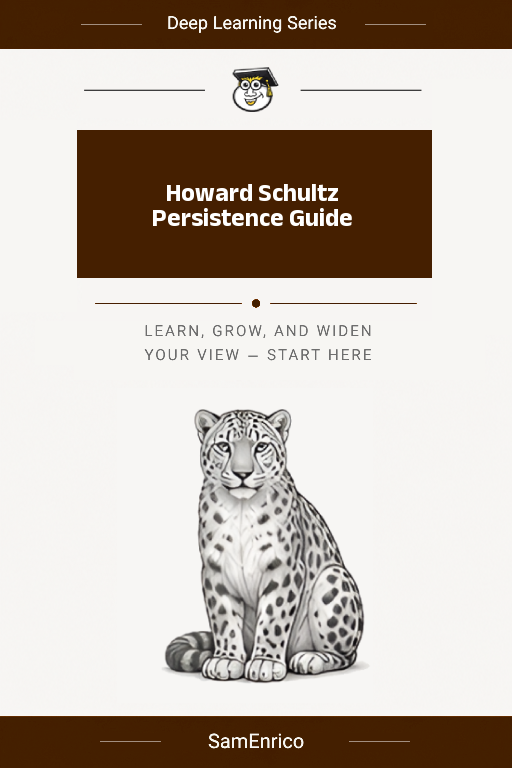
Howard Schultz Persistence Guide eBook
Keep pitching after being told no 242 times for St
Keep pitching after being told no 242 times for Starbucks' original concept. Covers rejection-proofing your self-worth, separating feedback from identity, and resilience rituals.
Formats
Free sample
Chapter 1: The Car Ride--–- The car was a 1978 Datsun, blue, with a dent in the passenger side door and an engine that knocked when the weather turned cold. Howard Schultz sat in the driver's seat, both hands on the steering wheel, staring at the rain-streaked windshield of a Seattle parking garage. He had just walked fourteen blocks in a cheap suit that didn't fit quite right, carrying a leather portfolio that contained exactly three things: a business plan he had written on yellow legal paper, a photocopied article about the Italian espresso culture, and a list of two hundred names—every wealthy person in the Pacific Northwest whose address he could find.The meeting had lasted eleven minutes. The investor—a retired lumber executive with a office overlooking Puget Sound—had listened to Schultz's pitch with the patience of a man who had heard a hundred versions of the same story. At minute nine, he had leaned back in his chair and said the words Schultz would hear 216 more times: "Son, I don't think America is ready for a three-dollar cup of coffee."Schultz had thanked him, shaken his hand, and walked out.
He had not argued. He had not presented additional evidence. He had not cried, though he felt the pressure building behind his eyes like water against a dam. He had simply walked fourteen blocks to his car, and now he was sitting in the driver's seat, watching the rain, trying to remember why he had left a good job with health insurance and a 401(k) to do this.The year was 1985. Howard Schultz was thirty-two years old.
His wife, Sheri, was seven months pregnant with their first child. They were living on her salary as a graphic designer because Schultz had stopped paying himself months ago. Their savings account had $1,800 in it. And Howard Schultz had just been told, for the one hundred and seventeenth time, that his dream was a fantasy.He reached into his jacket pocket and pulled out a spiral notebook—the kind you buy at a drugstore for ninety-nine cents. He flipped past pages of investor names, phone numbers, and notes in cramped handwriting.
He found a blank page. He took out a pen. And he wrote one word:Next.Then he turned the key in the ignition, the Datsun's engine knocked twice and caught, and he drove home to his pregnant wife to tell her that today had not been the day.This chapter is about that car ride. It is about the ten seconds between the no and the "Next." It is about what happens in the space between rejection and response—a space that most people fill with self-doubt, self-criticism, and self-abandonment, but that Howard Schultz learned to fill with something else entirely.The Seatbelt Theory of Persistence Before we go any further, I need to tell you something that might sound strange: Schultz was not tougher than you.I know that's not what the business books say. The business books say that successful people have more grit, more resilience, more emotional fortitude.
They say that Schultz could endure 217 no's because he was somehow built differently—that his childhood in public housing had hardened him, that his father's injury had forged him into steel.This is wrong. And believing it will prevent you from building your own persistence.Schultz was not tougher than you. He was not more resilient by nature. He was, by his own admission, a sensitive kid who cried easily, who hated conflict, who would rather avoid a difficult conversation than initiate one. When he started pitching investors, his hands shook.
His voice cracked. He had nightmares about being laughed out of boardrooms.What Schultz had—and what you can build—was a system. Not a personality trait. Not a genetic gift. A system.
A set of repeatable, teachable, mechanical responses to rejection that he practiced until they became automatic.Think of it like a seatbelt. A seatbelt does not make you a better driver. It does not make the road less dangerous. It does not prevent accidents. But when the accident happens—when the no comes out of nowhere and the car is flipping through the air—the seatbelt keeps you in your seat.
It does not stop the crash. It stops you from flying through the windshield.Schultz's system was his seatbelt. The "Next" protocol was his seatbelt. The Rejection Log was his seatbelt. The Canarsie Firewall—which we will build in this chapter—was his seatbelt.
He still felt the crash of every no. He still sat in his car, hands on the steering wheel, staring at the rain. But he did not fly through the windshield. He did not abandon himself. He wrote "Next" and turned the key.This chapter will teach you to build your own seatbelt.
Not because you will stop getting rejected—you won't—but because you will stop being destroyed by it.The Anatomy of a Rejection Let me describe what happened to Schultz in that parking garage, because the same thing happens to you every time you are told no.Second one: The prefrontal cortex—the rational part of your brain—kicks in and tries to interpret what just happened. You think: Why did they say no? Was it me? Was it my idea? Was it my tie?
This is the interpretation phase, and it is where most people go wrong.Second two through ten: The interpretation phase bleeds into the identity phase. You stop asking "Why did they say no?" and start asking "What does this no say about me?" This is the most dangerous moment. Your brain is desperate for a narrative, and the easiest narrative is self-blame. I'm not good enough. I'm not smart enough.
I'm not persuasive enough. I should have prepared more. I should have dressed better. I should have been someone else.By second ten, you have usually arrived at a conclusion. That conclusion is almost always some version of: This no is evidence that I am fundamentally inadequate.Here is what Schultz did differently.
In the first second—the pain phase—he did nothing. He let the pain happen. He did not fight it. He did not try to be "tough." He sat in his car and breathed. He acknowledged that it hurt to be told no for the 117th time by a man who hadn't even let him finish his pitch.Then, in second two, he did not ask "Why did they say no?" He asked a different question: What did I learn?Not "What did I do wrong?" Not "What's wrong with me?" Not "Why don't they believe in me?" Those questions are traps.
They lead to the identity phase, the self-blame, the conclusion of inadequacy. Schultz's question—What did I learn?—led somewhere else. It led to data. It led to iteration. It led to the Rejection Log.By second ten, Schultz had not concluded that he was inadequate.
He had concluded that his pitch needed work. Those are different conclusions. One is a verdict on his soul. The other is a diagnosis of his presentation. One ends the conversation.
The other continues it.This is the seatbelt. Not the absence of pain. The redirection of interpretation.The Canarsie Firewall (Revisited)Now we…
This is the end of the free sample. Get the eBook to keep going. Buy now
About this book
Details
- Author
- Whaley Mikaela
- Publisher
- SamEnrico
- Language
- English
- Genre
- Non-Fiction, Mental Wealth, Resilience Training, Persistence Guide
- Released
- 2026-06-01
- Pages (approx.)
- 130
- Available as
- eBook, Audiobook

Read better in the ZLOADR app
Your eBooks on your phone or tablet. Sign in with your SamEnrico account and start reading.
More by Whaley Mikaela
 The Car Wash Presidential SuccessionWhaley Mikaela$11.99
 Assertiveness Without AggressionWhaley Mikaela$11.99
 Fitness Goal Action PlanningWhaley Mikaela$11.99
 Phobia Success StoriesWhaley Mikaela$11.99
 Reverse Mortgage for Retirement HousingWhaley Mikaela$11.99
 The Tower of Babel's Fall: Enki's Divine DeceptionWhaley Mikaela$11.99
 Data Science DirectorWhaley Mikaela$11.99
 A Beginners Guide to Big-game fishing (Volume 1)Whaley Mikaela$11.99
 Southeast Asia B2B Spending GuideWhaley Mikaela$12.99
 Understanding Intestinal LipodystrophyWhaley Mikaela$17.99