
Non-FictionInformativeEducational
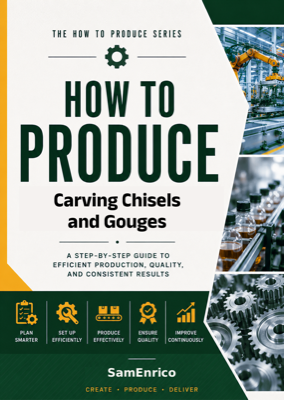
How to Produce Carving Chisels and Gouges eBook
This publication, published by SamEnrico, covers H
This publication, published by SamEnrico, covers How to Produce Carving Chisels and Gouges
Formats
Free sample
Chapter 1: The Broken Promise--–- The first time I held a brand-new, “professional-grade” carving gouge, I felt the same disappointment you probably have. The steel arrived with a factory grind so obtuse it might as well have been a pry bar. The sweep didn’t match its stamped number. The handle felt like a polished broomstick designed by someone who had never touched a piece of wood in their life. And within twenty minutes of carving soft basswood, the edge folded like aluminum foil.I paid two hundred dollars for that gouge.
I was not a beginner. I had been carving for fifteen years. And yet, standing there in my shop, surrounded by sharpening stones and strops and burnishers, I realized something that would change the entire trajectory of my work: the tool industry had failed me. Not because the companies were malicious, but because mass production has fundamental limits that no amount of quality control can overcome. A machine cannot feel the weight of a carver’s hand.
A production line cannot adjust a sweep to match the idiosyncrasies of a particular piece of curly maple. And a profit margin cannot accommodate the time required to properly finish a tool by hand.This book exists because that failure is not inevitable. It is, in fact, completely solvable. The solution requires no factory, no industrial equipment, and no formal apprenticeship in a nineteenth-century Sheffield works. It requires only heat, steel, patience, and the willingness to understand that making your own tools is not a compromise or a cost-saving measure.
It is an upgrade. A fundamental, irreversible upgrade to every carving project you will ever undertake.Over the next twelve chapters, you will learn to produce carving chisels and gouges that outperform anything available in any catalog. You will learn to forge them from raw stock. You will learn to make them by stock removal from recycled hacksaw blades. You will learn to select steel, heat treat it to precise hardness, fit handles that disappear in your hand, and sharpen to edges measured in microns.
But before any of that technical work begins, we must understand why this journey matters. Because if you do not believe that a handmade tool can be better than a factory tool, you will never have the motivation to push through the inevitable failures and frustrations of learning a new craft.Let me show you why the tools you buy are broken. Then let me show you how to fix them forever.The Three Failures of Mass-Produced Tools Every mass-produced carving tool on the market today suffers from at least one of three systemic failures. Many suffer from all three. These are not design flaws in the sense of a mistake that could be corrected by a better factory process.
They are structural limitations inherent to the very concept of mass production. Understanding them is the first step toward seeing handmade tools not as a nostalgic alternative but as a technical superior.Failure One: Inconsistent Geometry The sweep of a gouge—the curvature of its cutting edge—is not a random shape. It is a precise mathematical curve that determines how the tool will cut, how deep it will penetrate, and how easily it will release chips. The standard sweep chart, developed over centuries of European carving tradition, assigns numbers to specific curves. A #3 is shallow, almost flat.
A #5 is moderately curved. A #7 is deeper. A #9 is very deep. An #11 is nearly a circle, often called a “veiner” or “fluter.” These numbers are supposed to be consistent across manufacturers. A #7 from Pfeil should match a #7 from Henry Taylor should match a #7 from Two Cherries.In practice, they do not.
I have personally measured three different #7 gouges from three reputable manufacturers. One had a radius of curvature equivalent to a true #6. One matched the #7 spec exactly. One was closer to a #8. The differences seem small—millimeters of radius variation—but they produce dramatically different cutting behaviors.
A gouge that is shallower than advertised will ride over concave forms instead of cutting into them. A gouge that is deeper than advertised will bind in shallow work and leave ridged tracks. You cannot trust the stamp on the blade. You can only trust your own eyes and your own measuring tools.Mass production creates this problem because grinding the interior flute of a gouge is a difficult operation to automate. Factories use abrasive wheels shaped to approximate sweeps, but those wheels wear down.
The grinding operators adjust on the fly. The tolerances drift. And because most carvers do not have the equipment to measure sweep radii accurately, the factories have little incentive to tighten those tolerances. A tool that is “close enough” passes inspection and goes into the box. You, the carver, discover the discrepancy only after you have paid for the tool and begun to use it.When you make your own gouges, you control the geometry.
You can measure the sweep at every stage. You can adjust. You can create exactly the curve your work requires, not the curve that survived a factory’s quality control lottery.Failure Two: Poor Steel Quality and Unreliable Heat Treatment The steel in a carving tool is not a single substance. It is a crystalline matrix of iron and carbon that has been heated, transformed, quenched, and tempered. The specific alloy matters—O1, W1, A2, D2, and high-speed steels all have different properties.
But the heat treatment matters more. A superb alloy with poor heat treatment becomes a mediocre tool. A mediocre alloy with excellent heat treatment becomes a good tool. A superb alloy with excellent heat treatment becomes an extraordinary tool.Mass-produced carving tools rarely receive excellent heat treatment. The economics of production favor speed over precision.
Blades are loaded into mesh baskets and passed through continuous furnaces that heat, quench, and temper in a matter of minutes. The process is repeatable but coarse. It does not account for variations in blade thickness, steel batch chemistry, or the specific geometry of a thin-walled gouge versus a thick chisel. The result is steel that is either too soft (edge folds or rolls under use) or too hard (edge chips and breaks) or inconsistent within the same blade (hard spots next to soft spots).I have tested factory tools with calibrated hardness files. I have found #7 gouges that measured Rc 52 on one wing and Rc 58 on the other—a difference of six points, which is enormous in tool steel terms.
I have found chisels that were so over-tempered that they dulled after three passes through basswood. I have found V-tools that were so under-tempered that the tips snapped off in the middle of a straight cut.The problem is not that factories are incompetent. The problem is that their processes are optimized for throughput, not for the specific requirements of carving tools. A carving tool needs different heat treatment than a knife, a plane blade, or an axe. It needs fine grain structure, high hardness for edge retention, but enough toughness to resist lateral forces when the tool is twisted in a deep cut.
Factories cannot easily adjust their processes for a single product line. They set a middle-ground heat treatment and hope it…
This is the end of the free sample. Get the eBook to keep going. Buy now
About this book
Details
- Author
- Tavares Evette
- Publisher
- SamEnrico
- Language
- English
- Genre
- Non-Fiction, Informative, Educational
- Released
- 2026-06-03
- Pages (approx.)
- 136
- Available as
- eBook, Audiobook

Read better in the ZLOADR app
Your eBooks on your phone or tablet. Sign in with your SamEnrico account and start reading.
More by Tavares Evette
 Worst Audience Response PlanTavares Evette$11.99
 IBD Biologic Therapy ExplainedTavares Evette$11.99
 Outsourcing Podcast ProductionTavares Evette$11.99
 Nonverbal Voice Tone GuideTavares Evette$11.99
 The Siege of Fort Pitt: A Colonial Gambit in the WildernessTavares Evette$11.99
 Introductory Offer Pricing Without FearTavares Evette$12.99
 Merchandiser Convenience Food PTTavares Evette$11.99
 How to Become a Meat DresserTavares Evette$11.99
You may also like
 Hong Kong Handover 1997Dunn Johnnie$11.99
 Zumba For Postnatal Recovery CourseNeal Christian$11.99
 Zumba for BeginnersLadner Nikia$11.99
 YouTube Comment Mining GuideHumes Pandora$12.99
 Worry Box MeditationCarlin Rudy$11.99
 Workplace Stress MeditationNguyen Lynn$11.99
 Workplace Stress and Sleep RepairHawley Ivory$11.99
 Workplace Perfectionism CureDelaney Jeffry$11.99
 Workplace Injustice Anger GuideWallen Isabelle$11.99
 Work Addiction and Burnout LinkGreenwood Ester$11.99
 Women in Yoga and WellnessBeattie Galina$11.99
 Women in Stand Up ComedyChun Evangeline$11.99