
Non-FictionInformativeEducational
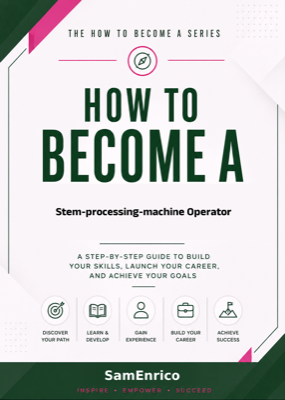
How to Become a Stem-processing-machine Operator eBook
How to Become a Stem-processing-machine Operator
by Colvin Adena
How to Become a Stem-processing-machine Operator
Formats
Free sample
Chapter 1: The Blue-Collar Brain...--– The shop smells like coolant and coffee. It is 7:32 on a Tuesday morning. You are standing in front of a machine that costs more than a house, holding a block of aluminum that will become part of a jet engine. Around you, chips of metal spiral onto the floor like coiled springs. The spindle whirs to 12,000 RPM.
You press a green button. Three minutes later, you pull out a finished part accurate to half the width of a dust mite. An engineer signs off. You just made $48 of value in three minutes. By Friday, you have paid your own salary for the week.This is not a story about college degrees or corner offices.
This is a story about leverage. A STEM-processing-machine operator takes raw material and raw intelligence and turns both into precision components that fly, heal, drive, and defend. You are about to learn how to become that person.But here is what no one tells you before you walk onto a shop floor: the machines are the easy part. The real transformation happens inside your own head. You will learn to think in thousandths of an inch.
You will learn why a hot spindle changes everything. You will learn to hear a bad cut before you see it. And you will discover that “STEM” does not only stand for Science, Technology, Engineering, and Mathematics. In this trade, it stands for Skill, Tenacity, Execution, and Mastery.This chapter is your first step. We will answer three questions before you ever touch a control panel: What exactly is a STEM-processing-machine operator?
Why does this career matter more now than ever before? And what will the next twelve chapters do for you?Let us begin.The Hidden Workforce You Have Never Heard Of There is a quiet crisis in American manufacturing. According to the National Association of Manufacturers, more than half a million machining and metalworking jobs sit unfilled. Not because the work is dirty or dangerous, though it can be both. Not because the pay is low, because it is not.
The jobs sit empty because most people have no idea they exist.High school counselors talk about college. Parents talk about white-collar safety. Meanwhile, a nineteen-year-old with six months of training can earn more than a recent graduate with a bachelor’s degree in English. A certified operator with five years of experience often out-earns a schoolteacher, a journalist, or a social worker. And a lead operator on night shift can clear eighty thousand dollars before overtime.Who are these people?
They are the hidden STEM workforce. They sit between the engineers who design parts and the managers who count beans. Engineers create digital models on computer screens. Operators turn those models into physical objects that meet impossible tolerances. The engineer says, “Make this hole within one thousandth of an inch.” The operator says, “Watch me.”You have seen their work every day.
The titanium hip in your elderly relative’s body. The brake caliper on your car. The turbine blade spinning inside a power plant. The housing of your smartphone. The casing of a military drone.
Everything that is machined, milled, turned, ground, or electrical-discharge-machined passes through the hands of someone like you.That someone is not a button pusher. That someone is a problem solver, a mathematician, a physicist, a detective, and an artist all at once. And that someone can be you.Defining the STEM-Processing-Machine Operator Let us be precise about the title because words matter in this trade. “STEM-processing-machine operator” is not a phrase you will hear in every shop. But the concept is universal.
It means an operator who works with computer-controlled machines that shape metal, plastic, or composite materials using principles of science, technology, engineering, and mathematics.More simply: you run machines that think, and you think while running them.The old name was “machinist.” That term still exists, but it has changed. A traditional machinist worked with manual levers, hand wheels, and analog dials. That skill set still has value, but the modern world demands more. Today’s machines are computers with spindles. They store hundreds of programs.
They communicate with robots. They track their own wear and suggest maintenance. The operator must understand not only the metal but also the code.The new name in many job postings is “CNC machinist,” “CNC operator,” “manufacturing technician,” or “precision production specialist.” This book uses “STEM-processing-machine operator” because it captures the intellectual demands of the role. You are not just processing parts. You are processing information, materials, and problems.What do you actually do?
On a given day, you may:Read a blueprint and identify missing dimensions before cutting starts Load a raw billet of 6061 aluminum into a vise and indicate it square within 0.0005 inches Call up a G-code program from the machine’s memory and verify the work offsets Press cycle start and listen for the sound of a healthy cut Measure every fifth part with a micrometer and record the data on a Statistical Process Control chart Notice that chips are coming off as long, stringy ribbons instead of small commas, then adjust the feed rate to break them properly Replace a dull endmill before it snaps and scrapes the part Communicate a process improvement to the day shift engineer using a written template Shut down the machine, clean the coolant tank filter, and lock out the electrical panel for maintenance None of these tasks requires a four-year degree. All of them require training, practice, and a particular kind of focused attention. That is what this book delivers.Why This Career Matters More Than Ever Let us talk about the skills gap. Manufacturing executives use this phrase constantly, and here is what it actually means: companies have machines but not enough qualified people to run them. The baby boom generation of machinists is retiring.
They took decades of knowledge out the door with them. The generation behind them is smaller and, in many cases, steered away from the trades by school systems that measure success only by college enrollment.The result is a labor market that rewards you. Starting wages for entry-level operators range from 18to18 to 18to28 per hour depending on geography and industry. Overtime is plentiful. Sign-on bonuses of 1,000to1,000 to 1,000to5,000 are common.
Some employers offer tuition reimbursement for advanced certifications, even if you never step foot in a university.But money is only part of the story. This career matters because you become indispensable. A robot cannot set itself up. An artificial intelligence cannot dial in a vise. A spreadsheet cannot listen to a spindle and hear a bad bearing.
The machines get smarter, yes. But someone must program them, maintain them, troubleshoot them, and trust them. That someone is you.Consider the industries that depend on STEM processing machines. Aerospace requires parts with zero margin for error. A turbine blade that fails at 30,000 feet kills people.
Medical devices must fit the human body with microscopic precision. A hip implant that is 0.002 inches too large causes pain and revision surgery. Automotive manufacturers run millions of parts per year, and a single out-of-spec component can trigger a recall that costs hundreds of…
This is the end of the free sample. Get the eBook to keep going. Buy now
About this book
Details
- Author
- Colvin Adena
- Publisher
- SamEnrico
- Language
- English
- ISBN
- 9781506071275
- Genre
- Non-Fiction, Informative, Educational
- Released
- 2026-05-02
- Pages (approx.)
- 144
- Available as
- eBook, Paperback, Audiobook

Read better in the ZLOADR app
Your eBooks on your phone or tablet. Sign in with your SamEnrico account and start reading.
More by Colvin Adena
 Perfectionism Burnout ConnectionColvin Adena$11.99
 Ocean Breath for InsomniaColvin Adena$11.99
 Alcohol Calories and Weight LossColvin Adena$11.99
 Validation for Elderly ParentsColvin Adena$11.99
 The DMX Ruff Ryder StoryColvin Adena$11.99
 The Silk Road to Timbuktu: African Merchants Who Shaped the WorldColvin Adena$11.99
 Software Application EngineerColvin Adena$11.99
 Scrum vs Kanban for StartupsColvin Adena$12.99
 Learn to Play the SubidorColvin Adena$11.99
You may also like
 Hong Kong Handover 1997Dunn Johnnie$11.99
 Zumba For Postnatal Recovery CourseNeal Christian$11.99
 Zumba for BeginnersLadner Nikia$11.99
 YouTube Comment Mining GuideHumes Pandora$12.99
 Worry Box MeditationCarlin Rudy$11.99
 Workplace Stress MeditationNguyen Lynn$11.99
 Workplace Stress and Sleep RepairHawley Ivory$11.99
 Workplace Perfectionism CureDelaney Jeffry$11.99
 Workplace Injustice Anger GuideWallen Isabelle$11.99
 Work Addiction and Burnout LinkGreenwood Ester$11.99
 Women in Yoga and WellnessBeattie Galina$11.99
 Women in Stand Up ComedyChun Evangeline$11.99