
Non-FictionInformativeEducational
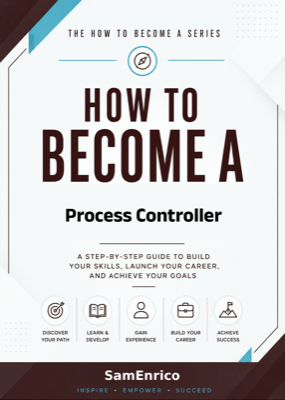
How to Become a Process Controller Paperback
How to Become a Process Controller
by Ligon Bess
How to Become a Process Controller
Formats
Free sample
Chapter 1: The Three Chairs...--At 2:47 on a Tuesday morning, a junior engineer named Priya watched a DCS screen flicker through thirty-seven alarms in forty-two seconds. A distillation column was flooding. The console operator beside her – a woman with twenty-three years of experience – didn't flinch. She clicked three buttons, typed two numbers, and the alarms stopped. The column stabilized.
Priya asked, "How did you know which alarms were real?" The operator replied, "Because I understand what's inside the tower, not just what's on the screen."That exchange captures the single most important lesson of process control: the screen is not the process. A controller does not manipulate numbers on a display. A controller manipulates pressure, temperature, flow, and level inside pipes, vessels, and towers that often contain flammable, toxic, or explosive materials. The numbers on the DCS are just messengers. Kill the messenger, and the process continues – often toward a dangerous outcome.This book exists because the gap between academic control theory and industrial practice is vast and dangerous.
Universities teach Laplace transforms, root locus diagrams, and state-space models. These are valuable tools, but they do not prepare you for a plant where a pressure transmitter drifts because a condensate line is partially plugged, or where a valve sticks because the packing gland was overtightened by a well-meaning maintenance technician, or where an operator has bypassed an interlock because "it always false trips."Process control is not mathematics applied to physics. Process control is physics applied to economics, wrapped in human factors, constrained by safety, and executed through fallible hardware.If you are reading this book, you likely fit into one of three categories. You might be a student or recent graduate who has studied control theory but has never seen a real P&ID. You might be a technician who can calibrate a transmitter blindfolded but struggles to understand why a loop oscillates.
Or you might be an engineer who has been tuning loops by trial and error and suspects there is a better way.All three paths converge on the same destination: the control room. But the seats in that control room are not all the same. Before you can become a process controller – before you can design, tune, operate, or troubleshoot – you must first understand which chair you are aiming for.The Three Archetypes of Process Control Walk into any major industrial facility – a refinery, a chemical plant, a pharmaceutical manufacturing site, a power station – and you will find three distinct roles working together. They are often confused by outsiders, and sometimes even by insiders. But the distinction is critical because each role requires a different combination of skills, different career paths, and different day-to-day realities.The Console Operator The first chair belongs to the Console Operator.
This person sits in the control room for twelve-hour shifts, often on a rotating schedule that includes nights, weekends, and holidays. Their eyes move constantly across a bank of screens displaying hundreds of process variables, alarms, and trends. Their hands rest on a keyboard and trackball, ready to adjust setpoints, transfer control, or acknowledge alarms.The console operator's superpower is situational awareness. They know, at any given moment, where the process is, where it is going, and what could go wrong. They have memorized the normal ranges for dozens of key variables.
They can feel – almost viscerally – when a controller is "fighting" or when a measurement seems "off."Their day-to-day work includes:Monitoring the DCS for deviations from normal operating conditions Acknowledging and responding to alarms according to priority Making real-time adjustments to setpoints, tuning parameters, and modes (auto/manual)Communicating with field…
This is the end of the free sample. Get the Paperback to keep going. Buy now
About this book
Details
- Author
- Ligon Bess
- Publisher
- SamEnrico
- Language
- English
- ISBN
- 9781505930665
- Genre
- Non-Fiction, Informative, Educational
- Released
- 2026-05-08
- Pages (approx.)
- 153
- Available as
- eBook, Paperback, Audiobook

Read better in the ZLOADR app
Your eBooks on your phone or tablet. Sign in with your SamEnrico account and start reading.
More by Ligon Bess
 Opioid Induced HypogonadismLigon Bess$11.99
 NVC For Imposter SyndromeLigon Bess$11.99
 Franchising Your Local Brand Across Borders Territorial RestrictionsLigon Bess$11.99
 Stimulant and RelationshipsLigon Bess$11.99
 Mindfulness Based Relapse Prevention for AlcoholLigon Bess$11.99
 Home Sharing Platform GuideLigon Bess$11.99
 Short Answer Exam GuideLigon Bess$11.99
 Anabolic Steroid ReversalLigon Bess$11.99
 The Opium Wars' Poisoned Legacy: The Triads' Deadly Medical ConspiracyLigon Bess$11.99
 The Counterfeit Kings of Berlin: The Great Prohibition ScandalLigon Bess$11.99
 How to Produce Colored Exterior StainLigon Bess$11.99
 How to Produce GrommetsLigon Bess$11.99
You may also like
 Hong Kong Handover 1997Dunn Johnnie$11.99
 Zumba For Postnatal Recovery CourseNeal Christian$11.99
 Zumba for BeginnersLadner Nikia$11.99
 YouTube Comment Mining GuideHumes Pandora$12.99
 Worry Box MeditationCarlin Rudy$11.99
 Workplace Stress MeditationNguyen Lynn$11.99
 Workplace Stress and Sleep RepairHawley Ivory$11.99
 Workplace Perfectionism CureDelaney Jeffry$11.99
 Workplace Injustice Anger GuideWallen Isabelle$11.99
 Work Addiction and Burnout LinkGreenwood Ester$11.99
 Women in Yoga and WellnessBeattie Galina$11.99
 Women in Stand Up ComedyChun Evangeline$11.99