
Non-FictionInformativeEducational
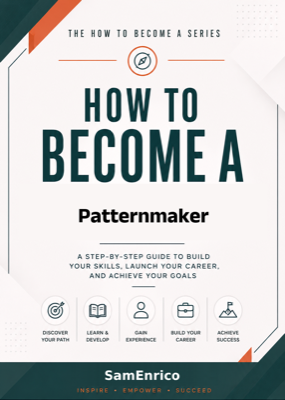
How to Become a Patternmaker Paperback
How to Become a Patternmaker
How to Become a Patternmaker
Formats
Free sample
Chapter 1: The Three Lies--–- The first lie you were told is that you need talent. The second lie is that you need expensive equipment. The third lie is the cruelest: that some people can just “see” how a flat piece of paper becomes a three-dimensional garment, and you are not one of them.None of this is true.Every professional patternmaker you admire — the ones whose garments wrap around the body like they were poured into place, whose sleeves never bind, whose collars never gape — started exactly where you are right now. They held a ruler and felt stupid. They cut a piece of paper, taped it back together, and stared at the result with the quiet horror of someone who has just wasted an entire afternoon.
They sewed a muslin test that looked nothing like the drawing in their head. And then they did it again.This book exists because patternmaking is not a mystical gift bestowed upon a lucky few. It is a language. It has rules, exceptions, patterns (pun intended), and a logic that can be learned by anyone who is willing to sit at a table, make a hundred small marks with a pencil, and notice what works and what fails. The top ten textbooks on this subject — from Helen Joseph-Armstrong’s industry bible to Tomoko Nakamichi’s sculptural explorations — all agree on one thing: mastery is the accumulation of small, correct repetitions, not a single flash of genius.Before you draft your first line, before you pick up a French curve or an awl, you need to unlearn what the sewing world has taught you.
Commercial patterns have lied to you. Sewing blogs have lied to you. Even well-meaning friends who say “you’re so talented” have lied to you, because that phrase suggests that your success or failure is baked into your DNA rather than sitting on the workbench, waiting for you to pick up a pencil.This chapter is the foundation of everything that follows. It will establish your physical workspace, your mental workspace, and — most importantly — your first set of victories. By the time you finish these pages, you will have drafted three basic blocks (slopers) that fit a standard dress form or your own measurements.
You will understand the difference between a tool that helps you see and a tool that gets in your way. And you will have learned the single most important habit of professional patternmaking: testing in muslin before cutting into your final fabric.Let’s begin with your workroom. Not the room you wish you had — the room you actually have.The Workroom You Actually Have (Not the One Pinterest Sold You)Patternmaking requires surprisingly little space. The mythology of the designer’s studio — high ceilings, a massive cutting table, northern light flooding through floor-to-ceiling windows — is just that: mythology. Some of the best patternmakers in New York and London work at foldable tables in shared studios.
Others work on a dining table that gets cleared before dinner. One patternmaker I interviewed for this book told me she drafted her first fifty blocks on a sheet of plywood laid across her bathtub because her apartment had no counter space.Here is what you actually need:A flat, stable surface at approximately the height of your wrist when your arms hang naturally at your sides. This prevents shoulder strain during long drafting sessions. A dining table works. A desk works.
A sheet of plywood on sawhorses works. What does not work is a surface that wobbles, has a lip or edge that interferes with your ruler, or…
This is the end of the free sample. Get the Paperback to keep going. Buy now
About this book
Details
- Author
- Kowalski Granville
- Publisher
- SamEnrico
- Language
- English
- ISBN
- 9781505778069
- Genre
- Non-Fiction, Informative, Educational
- Released
- 2026-06-02
- Pages (approx.)
- 140
- Available as
- eBook, Paperback, Audiobook

Read better in the ZLOADR app
Your eBooks on your phone or tablet. Sign in with your SamEnrico account and start reading.
More by Kowalski Granville
 Alcoholism and Wernicke KorsakoffKowalski Granville$11.99
 The Black Elk AccountKowalski Granville$11.99
 FMLA for Caregivers GuideKowalski Granville$11.99
 Public Commitment AccountabilityKowalski Granville$11.99
 Morning Reading Habit GuideKowalski Granville$11.99
 Affirmations For UncertaintyKowalski Granville$11.99
 Retinoid GuideKowalski Granville$11.99
 Probiotics For Brain HealthKowalski Granville$11.99
 The Spinning Jenny and the Threads of Progress: Arkwright's Textile RevolutionKowalski Granville$11.99
 The Lost Code of the Mayan MathematiciansKowalski Granville$11.99
 VAT Compliance Software GuideKowalski Granville$12.99
 B2B Sales Culture ComparisonKowalski Granville$12.99
You may also like
 Hong Kong Handover 1997Dunn Johnnie$11.99
 Zumba For Postnatal Recovery CourseNeal Christian$11.99
 Zumba for BeginnersLadner Nikia$11.99
 YouTube Comment Mining GuideHumes Pandora$12.99
 Worry Box MeditationCarlin Rudy$11.99
 Workplace Stress MeditationNguyen Lynn$11.99
 Workplace Stress and Sleep RepairHawley Ivory$11.99
 Workplace Perfectionism CureDelaney Jeffry$11.99
 Workplace Injustice Anger GuideWallen Isabelle$11.99
 Work Addiction and Burnout LinkGreenwood Ester$11.99
 Women in Yoga and WellnessBeattie Galina$11.99
 Women in Stand Up ComedyChun Evangeline$11.99