
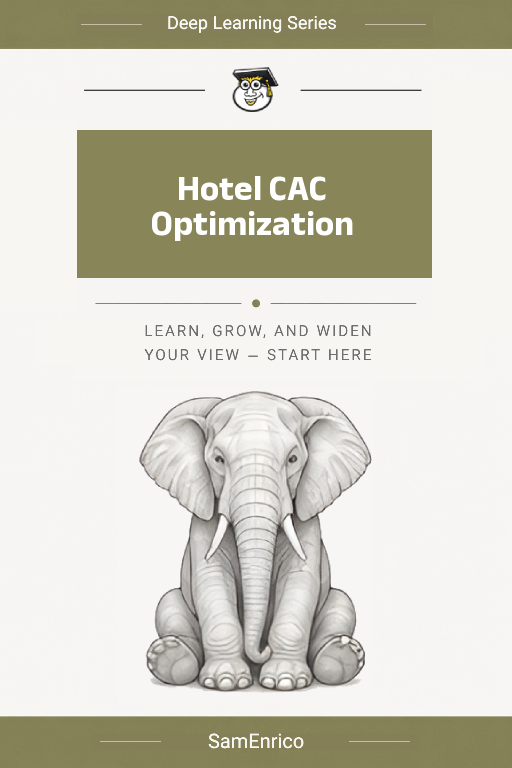
Hotel CAC Optimization eBook
Reduce guest acquisition costs through OTAs and di
Reduce guest acquisition costs through OTAs and direct booking.
Formats
Free sample
Chapter 1: The Commission Mirage...--The email arrived on a Tuesday afternoon, but the damage had been building for five years.I was sitting in the back office of a 200-room downtown hotel that I had been hired to turn around. The previous general manager had been fired for missing profit targets three quarters in a row, but on paper, the hotel looked successful. Occupancy was 89 percent—well above the market average of 72 percent. The average daily rate had climbed from 145to145 to 145to162 over two years. The hotel had won a Trip Advisor Travelers’ Choice award.
Everything looked fine. Except nothing was fine.The email was from the regional vice president. Attached was a single spreadsheet with two columns. The first column showed Gross Operating Profit Per Available Room—the industry standard for hotel profitability. The second column showed something I had never seen before: Net Profit Per Available Room after subtracting total distribution costs.
The gap between them was a canyon.I stared at the numbers for ten minutes, then pulled the hotel’s full commission reports from the previous twelve months. What I found made me physically lean back in my chair.We had paid Expedia, Booking.com, and the other online travel agencies 847,000incommissions.Thatwasmorethanwespentonhousekeepingpayroll.Morethanwespentonutilities,internet,andpropertytaxescombined.Morethanmyannualsalarybyafactorofthree.Andthat847,000 in commissions. That was more than we spent on housekeeping payroll. More than we spent on utilities, internet, and property taxes combined. More than my annual salary by a factor of three.
And that 847,000incommissions.Thatwasmorethanwespentonhousekeepingpayroll.Morethanwespentonutilities,internet,andpropertytaxescombined.Morethanmyannualsalarybyafactorofthree.Andthat847,000 did not include the hidden costs—the chargeback penalties, the rate parity compliance staff hours, the lost customer data that we could never recover, and the guests who booked once, loved the stay, but never returned because we had no way to email them.I called the regional VP and asked a simple question: “How did we not notice this?”His answer changed my entire career. “Because you were measuring the wrong thing,” he said. “Everyone measures occupancy. Everyone measures Rev PAR. Almost no one measures the only number that actually matters—what’s left after you pay to get the guest in the door.”That conversation was the beginning of a five-year journey that took me through forty hotels, thirty-seven technology vendors, and hundreds of conversations with hoteliers who were bleeding money without knowing it.
This book is the result of that journey. And it starts with a single uncomfortable truth that most hotel owners would prefer not to face.The Hotel Industry’s Silent Profit Killer The online travel agency revolution was supposed to be a partnership. In the early 2000s, Expedia and Booking.com presented themselves as marketing partners—digital billboards that would drive visibility, fill empty rooms, and introduce your hotel to travelers who would never have found you otherwise. The commission rates seemed reasonable at first. Ten percent.
Then twelve. Then fifteen. For many hotels today, the effective commission rate—including hidden fees, chargebacks, and forced parity compliance costs—exceeds twenty percent of every booking.Here is the problem that no OTA sales representative will ever mention during the contract renewal call. The “Billboard Effect”—the theory that listing your hotel on OTAs drives direct bookings because guests see your property, remember the name, and search for you directly—has been empirically debunked by multiple industry studies. A major hotel brand analyzed five years of data across 1,200 properties and found no statistically significant correlation between OTA visibility and incremental direct bookings.
The study, which was quietly circulated among revenue management directors and never published publicly, concluded that the Billboard Effect was “at best negligible and at worst a convenient fiction used to justify commission dependency.”What replaced the Billboard Effect was something far more insidious. Hotels became addicted to OTA bookings the way a casino patron becomes addicted to the slot machine. The bookings are easy. They arrive automatically. The guest pays the OTA, the OTA pays you after taking their cut, and the cycle repeats.
There is no marketing team required. No email campaigns to write. No website optimization to manage. Just a steady stream of reservations that flow into your PMS like water from a faucet.But every addiction has a cost. And the cost of OTA addiction is not just the visible commission line on your profit and loss statement.
It is the slow, cumulative erosion of your hotel’s most valuable asset: the direct relationship with your guest.The Anatomy of a $100 OTA Booking To understand why OTA commissions are a crisis rather than merely an expense, we need to understand the full economics of a single booking. Let us take a typical 100roomnightbookedthrough Expediaor Booking.com.Thestandardcommissionisfifteenpercent.Thatleaves100 room night booked through Expedia or Booking.com. The standard commission is fifteen percent. That leaves 100roomnightbookedthrough Expediaor Booking.com.Thestandardcommissionisfifteenpercent.Thatleaves85 for the hotel. But the real cost does not stop there.First, consider chargeback risk.
When a guest disputes a charge on their credit card—whether legitimately or fraudulently—the OTA passes the dispute back to the hotel. The hotel not only loses the revenue but also pays a chargeback fee, typically 25to25 to 25to50 per incident. Most hotels experience chargeback rates of one to three percent of OTA bookings. On a 100booking,thataddsaneffectivecostof100 booking, that adds an effective cost of 100booking,thataddsaneffectivecostof0.25 to $1.50 per booking.Second, consider rate parity compliance. Every major OTA contract includes a most-favored-nation clause, which requires that the hotel not offer a lower publicly available rate on any other channel, including its own website.
Enforcing this clause requires staff time. Revenue managers spend an average of five to ten hours per week monitoring rates across channels, checking for violations, and responding to OTA compliance inquiries. At a fully loaded salary cost of 40perhour,thatis40 per hour, that is 40perhour,thatis200 to 400perweek,or400 per week, or 400perweek,or10,000 to 20,000peryear.Spreadacrossahotel’sannualbookingvolume,thisaddsanother20,000 per year. Spread across a hotel’s annual booking volume, this adds another 20,000peryear.Spreadacrossahotel’sannualbookingvolume,thisaddsanother0.50 to $2.00 per OTA booking.Third, consider the lost customer ownership. This is the largest hidden cost by far.
When a guest books through an OTA, the OTA retains the guest’s email address, phone number, and booking history. The hotel receives only the guest’s name and a virtual credit card. You cannot email that guest. You cannot send them a birthday offer. You cannot invite them back for a seasonal promotion.
You cannot ask them to join your loyalty program. They are, for all future marketing purposes, invisible to you.The lifetime value of a direct booker is approximately three times higher than the lifetime value of an OTA booker. Direct bookers pay no commission on repeat stays, respond to pre-arrival upsell offers at higher rates, and generate more ancillary revenue. When you lose the ability to contact a guest after their first stay, you are not just losing the commission on that booking. You are losing the entire future revenue stream that guest represents.Table 1.1 shows the full economic breakdown of a 100OTAbookingversusa100 OTA booking versus a 100OTAbookingversusa100 direct booking over a two-year customer relationship.Cost Component OTA Booking Direct Booking Commission / processing fee$15.00$2.50Chargeback risk (estimated)$0.75$0.25Parity compliance (allocated)$1.00$0.00Repeat stay (second…
This is the end of the free sample. Get the eBook to keep going. Buy now
About this book
Details
- Author
- Stacy Timothy
- Publisher
- SamEnrico
- Language
- English
- Genre
- Non-Fiction, Startup Guide
- Released
- 2026-06-01
- Pages (approx.)
- 151
- Available as
- eBook, Audiobook

Read better in the ZLOADR app
Your eBooks on your phone or tablet. Sign in with your SamEnrico account and start reading.
More by Stacy Timothy
 Youth Sports Nonprofit Fraud CourseStacy Timothy$11.99
 Navigating Breakup ConversationsStacy Timothy$11.99
 Financial Savings of Quitting SmokingStacy Timothy$11.99
 Burnout Prevention Microbreaks GuideStacy Timothy$11.99
 The PCOS Sleep and Stress GuideStacy Timothy$11.99
 The Visionary Hands of David Adjaye: Sculpting the Skyline of the WorldStacy Timothy$11.99
 Understanding XerostomiaStacy Timothy$17.99
 User Testing for Digital NomadsStacy Timothy$12.99
 Prince Harry's Memoir: Spare Parts and Palace FalloutStacy Timothy$11.99
 How to Become a Gas-meter CheckerStacy Timothy$11.99
You may also like
 Hong Kong Handover 1997Dunn Johnnie$11.99
 Zumba For Postnatal Recovery CourseNeal Christian$11.99
 Zumba for BeginnersLadner Nikia$11.99
 YouTube Comment Mining GuideHumes Pandora$12.99
 Worry Box MeditationCarlin Rudy$11.99
 Workplace Stress MeditationNguyen Lynn$11.99
 Workplace Stress and Sleep RepairHawley Ivory$11.99
 Workplace Perfectionism CureDelaney Jeffry$11.99
 Workplace Injustice Anger GuideWallen Isabelle$11.99
 Work Addiction and Burnout LinkGreenwood Ester$11.99
 Women in Yoga and WellnessBeattie Galina$11.99
 Women in Stand Up ComedyChun Evangeline$11.99