
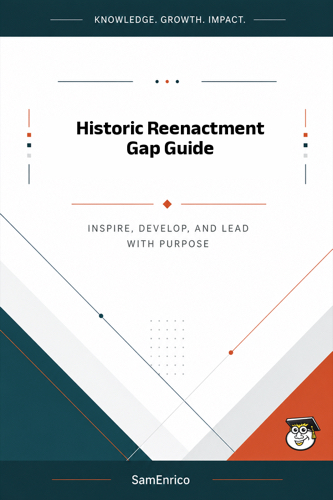
Non-FictionNon-Obvious CareerHistoryReenactment
Historic Reenactment Gap Guide
Connect living history as public speaking, researc
Connect living history as public speaking, research, and audience engagement.
Formats
About this book
Free sample
Chapter 1: The Voice Spectrum...--–- The first time I broke character in front of a visitor, I was trying to sew a button onto a waistcoat while explaining the logistics of the 1777 winter encampment. A ten-year-old girl looked up at me and asked, "Were you scared?" I froze. My script had prepared me for questions about rations, marching distances, and the caliber of musket balls. It had not prepared me for a child who wanted to know if the person inside the wool uniform had ever felt afraid. I looked at my hands.
They were shaking, but not from the cold. I said, "I don't know how to answer that without leaving who I am right now." The girl nodded and walked away. Her father gave me a look of polite disappointment. I had failed. But in that failure, I discovered the central lie of living history training: the belief that you must choose between being a person from the past and being an educator from the present.For decades, living history workshops, manuals, and mentor programs have fixated on a single, seemingly simple question: Should you speak in first-person or third-person?
The first-person purist argues that any break of character destroys the illusion. "I am a soldier," they insist. "I do not know about the future. I cannot answer questions about historical interpretation. I simply am." The third-person advocate counters that pure first-person is intellectually dishonest, that it prevents complex analysis, and that visitors deserve to know when we are speculating versus when we have evidence.
"This soldier would have experienced," they say. "Let me explain what the records show."Both sides are wrong. Not partially wrong, not wrong in certain contexts, but fundamentally, structurally, pedagogically wrong. The debate between first-person and third-person is a distraction of the highest order. It puts the cart before the horse.
It asks the wrong question entirely. The real question is not which voice to use. The real question is what argument you are trying to make, what emotion you are trying to evoke, and what relationship you are trying to build…
This is the end of the free sample. Get the eBook to keep going. Buy now
Contents
- Chapter 1
- Chapter 2
- Chapter 3
- Chapter 4
- Chapter 5
- Chapter 6
- Chapter 7
- Chapter 8
- Chapter 9
- Chapter 10
- Chapter 11
- Chapter 12
Details
- Author
- Zeller Meridith
- Publisher
- SamEnrico
- Language
- English
- Genre
- Non-Fiction, Non-Obvious Career, History, Reenactment
- Released
- 2026-06-09
- Pages (approx.)
- 123
- Available as
- eBook, Audiobook

Read better in the ZLOADR app
Your eBooks on your phone or tablet. Sign in with your SamEnrico account and start reading.
More by Zeller Meridith
 Social Anxiety Attention TrainingZeller Meridith$11.99
 Disappointment in Political OutcomeZeller Meridith$11.99
 Work Addiction and Sleep DeprivationZeller Meridith$11.99
 Feeling Worthy Without Doing GuideZeller Meridith$11.99
 Whispers in the Black Forest: The Beast of the TeutoburgZeller Meridith$11.99
 How to Start a Bureaux De Change Business (Beginners Guide)Zeller Meridith$11.99
 First 30 Days After Publishing ManualZeller Meridith$12.99
 Freight Carbon Accounting GuideZeller Meridith$12.99
 Cleaning Team LeaderZeller Meridith$11.99
 Understanding Lee–root–fenske SyndromeZeller Meridith$17.99
You may also like
 Hong Kong Handover 1997Dunn Johnnie$11.99
 Zumba For Postnatal Recovery CourseNeal Christian$11.99
 Zumba for BeginnersLadner Nikia$11.99
 YouTube Comment Mining GuideHumes Pandora$12.99
 Worry Box MeditationCarlin Rudy$11.99
 Workplace Stress MeditationNguyen Lynn$11.99
 Workplace Stress and Sleep RepairHawley Ivory$11.99
 Workplace Perfectionism CureDelaney Jeffry$11.99
 Workplace Injustice Anger GuideWallen Isabelle$11.99
 Work Addiction and Burnout LinkGreenwood Ester$11.99
 Women in Yoga and WellnessBeattie Galina$11.99
 Women in Stand Up ComedyChun Evangeline$11.99