
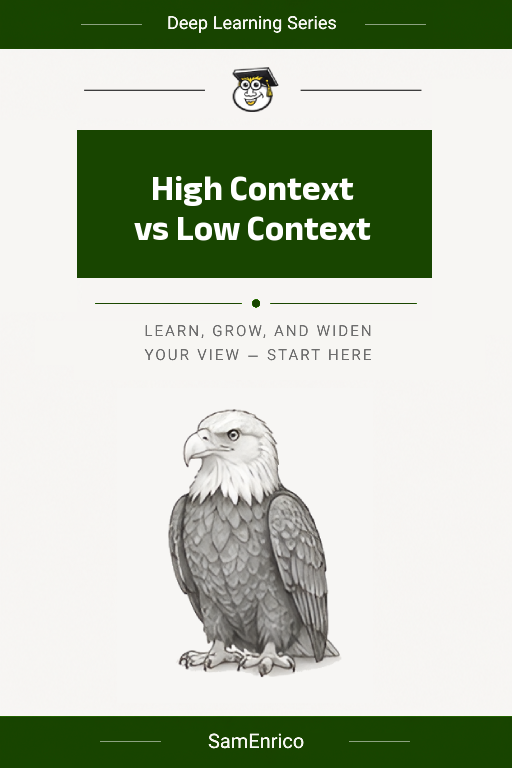
Non-FictionProfessional's Cheat SheetCommunication
High Context vs Low Context eBook
Adjust communication style for Japanese, Arabic, a
Adjust communication style for Japanese, Arabic, and Latin American mentees vs German, Dutch, US.
Formats
Free sample
Chapter 1: The Iceberg Lies...--–- On a Tuesday morning in Berlin, a German engineering mentor named Klaus opened a video call with his new mentee in Tokyo. The mentee, Yuki, had just completed her first major project proposal. Klaus reviewed it quickly, found three areas for improvement, and delivered his feedback in what he considered the most respectful and efficient manner possible. He said: “Yuki-san, points two, five, and seven need revision. The logic is inconsistent.
Please fix by Friday. Any questions?”Yuki paused. The silence lasted exactly four seconds. Then she said: “Thank you, Klaus-san. I will try my best.”Klaus took this as agreement.
He closed the call, checked the task off his mental list, and moved to his next meeting.Two weeks later, Klaus discovered that Yuki had not submitted the revisions. Worse, she had stopped working on the project entirely. When he asked why, she would not give a direct answer. Klaus became frustrated. He escalated the issue to her manager in Tokyo.
Within a month, Yuki had requested a transfer to a different team. Klaus was bewildered. He had been clear. He had been efficient. He had even used the honorific “-san.”On that same Tuesday morning, a Brazilian marketing mentee named Carlos sat in a São Paulo coffee shop with his Dutch mentor, Anouk.
Anouk had reviewed Carlos’s campaign strategy and found it promising but incomplete. In her characteristically direct style, she said: “Carlos, the budget section is a mess. The timeline is unrealistic. You need to redo this before Thursday. I don’t understand why you didn’t catch these errors yourself.”Carlos smiled, nodded, and said: “Of course, Anouk.
No problem. I will take care of it.”Anouk left the coffee shop satisfied. She had been honest. She had been helpful. She had treated Carlos like an equal, just as Dutch culture prescribed.Three weeks later, the campaign launched with the same budget errors and the same unrealistic timeline.
Anouk was furious. Carlos had stopped responding to her messages with his usual warmth. When she finally cornered him in a team meeting, he was polite but distant. Within two months, Carlos had asked to be reassigned to a Brazilian manager.Two mentors. Two mentees.
Four competent professionals. Zero bad intentions. And two catastrophic failures.The problem was not language. Klaus and Yuki both spoke fluent English. Anouk and Carlos both communicated daily in Portuguese and English without translation issues.The problem was not competence.
Yuki had top ratings from her previous Japanese manager. Carlos had won awards for his creative work in Latin American markets.The problem was not effort. Both mentors had prepared thoroughly. Both mentees had wanted to succeed.The problem was context.The $1.2 Trillion Blind Spot Klaus did not know that in Japanese communication culture, a direct “no” is almost unspeakable. When he asked “Any questions?” and Yuki fell silent, she was not agreeing.
She was trying to preserve his face—and her own—by avoiding the admission that she did not understand his linear, low-context feedback. Her silence meant: “I am confused, but I cannot say so directly because that would shame both of us.” Klaus heard agreement. Yuki meant distress.Anouk did not know that in Brazilian communication culture, direct criticism in a public setting—even a one-on-one coffee shop meeting—is perceived not as honesty but as a personal attack. When Carlos said “No problem,” he was not committing to the revisions. He was preserving the relationship by avoiding open conflict.
Anouk heard commitment. Carlos meant: “You have hurt me, but I will not show it because that would violate simpatía.”This book is about the gap between what we say and what is heard. It is about the hidden architecture of communication that operates beneath our awareness—until it fails. And it fails constantly.Edward T. Hall, the anthropologist who first named the distinction between high-context and low-context cultures in his 1976 book Beyond Culture, estimated that up to 90 percent of communication content is determined by context, not by words.
The words are the tip of the iceberg. Everything else—history, status, relationship, environment, shared assumptions, and unspoken rules—is the mass beneath the surface.Most cross-cultural training focuses on the tip. Learn a few phrases. Memorize a few taboos. Avoid a few gestures.
This is useful but superficial. It is like teaching someone to navigate icebergs by painting their ship a different color.This book focuses on the mass beneath. It is for mentors—leaders who guide, evaluate, and develop talent across cultural boundaries. Because mentorship amplifies every communication mismatch. When a peer misunderstands you, the cost is awkwardness.
When a mentor misunderstands you—or when you misunderstand a mentee—the cost can be a career, a project, or a relationship.The Core Mismatch: High-Context vs. Low-Context The distinction between high-context and low-context cultures is not about which cultures are “better” at communicating. It is about where meaning resides.In low-context cultures—primarily Northern Europe, North America, and Germany-speaking countries—meaning resides in explicit, coded messages. The speaker is responsible for being clear. “Say what you mean, mean what you say.” Written agreements are binding.
Directness is a sign of honesty and respect.In high-context cultures—most of Asia, the Middle East, Latin America, and Southern Europe—meaning resides in the situation, the relationship, and the shared history. The listener is responsible for understanding the unspoken. “Read the air” (kuuki o yomu in Japanese). The relationship is the contract. Indirectness is a sign of respect and social intelligence.Neither is wrong.
Both are rational adaptations to different social environments. Low-context cultures developed in settings where people needed to coordinate quickly with strangers—trading ports, frontier settlements, industrial cities. High-context cultures developed in settings where people lived and worked in stable, interdependent groups for generations—agricultural villages, clan-based societies, densely networked cities.The trouble begins when the two meet. Because each side assumes its own rules are universal.Klaus assumed that clarity meant directness. Yuki assumed that respect meant indirectness.
Anouk assumed that honesty meant bluntness. Carlos assumed that kindness meant harmony.These assumptions are not preferences. They are cognitive defaults, wired into our communication processing from childhood. Changing them requires not just learning new behaviors but unlearning old interpretations.The Mentorship Amplifier Why focus on mentorship specifically? Because mentorship contains four elements that are the most context-sensitive activities in professional life: power, feedback, praise, and criticism.Power changes the stakes of every interaction.
A misunderstood directive from a peer is annoying. A misunderstood directive from a mentor can derail a project or damage a career. The power differential means that HC mentees will be even more indirect (to avoid challenging authority) and LC mentees will be even more direct (because they assume authority welcomes challenge).Feedback is the transmission of evaluative judgment. In LC cultures, feedback is a gift—transparent, specific, actionable. In HC cultures, feedback is a threat—potentially shame-inducing, relationship-damaging, and best delivered indirectly or through intermediaries.Praise activates different motivational systems.
LC mentees want public, specific, data-backed praise that validates their individual contribution. HC mentees want private, relationship-focused praise that does not create jealousy or single them out…
This is the end of the free sample. Get the eBook to keep going. Buy now
About this book
Details
- Author
- Batiste Florene
- Publisher
- SamEnrico
- Language
- English
- Genre
- Non-Fiction, Professional's Cheat Sheet, Communication
- Released
- 2026-05-30
- Pages (approx.)
- 147
- Available as
- eBook, Audiobook

Read better in the ZLOADR app
Your eBooks on your phone or tablet. Sign in with your SamEnrico account and start reading.
More by Batiste Florene
 Morning Pages MethodBatiste Florene$11.99
 Therapy Active Listening GuideBatiste Florene$11.99
 Immigrant Dry Cleaning Chain SuccessBatiste Florene$11.99
 Wholesaling SEO For SellersBatiste Florene$11.99
 Mobility Work for Injury PreventionBatiste Florene$11.99
 Huston Dynasty - John HustonBatiste Florene$11.99
 Birthmark Childhood ShameBatiste Florene$11.99
 The Inheritance of RageBatiste Florene$11.99
 Data Broker Registration FinesBatiste Florene$11.99
 The Philosopher-Kings of Industry: Black Entrepreneurs Who Built EmpiresBatiste Florene$11.99
 Silent Wings: The Unseen War Over Nagorno-KarabakhBatiste Florene$11.99
 Rosetta's Comet Chase: Europe's Quest to Unlock the Origins of the Solar SystemBatiste Florene$11.99
You may also like
 Hong Kong Handover 1997Dunn Johnnie$11.99
 Zumba For Postnatal Recovery CourseNeal Christian$11.99
 Zumba for BeginnersLadner Nikia$11.99
 YouTube Comment Mining GuideHumes Pandora$12.99
 Worry Box MeditationCarlin Rudy$11.99
 Workplace Stress MeditationNguyen Lynn$11.99
 Workplace Stress and Sleep RepairHawley Ivory$11.99
 Workplace Perfectionism CureDelaney Jeffry$11.99
 Workplace Injustice Anger GuideWallen Isabelle$11.99
 Work Addiction and Burnout LinkGreenwood Ester$11.99
 Women in Yoga and WellnessBeattie Galina$11.99
 Women in Stand Up ComedyChun Evangeline$11.99