
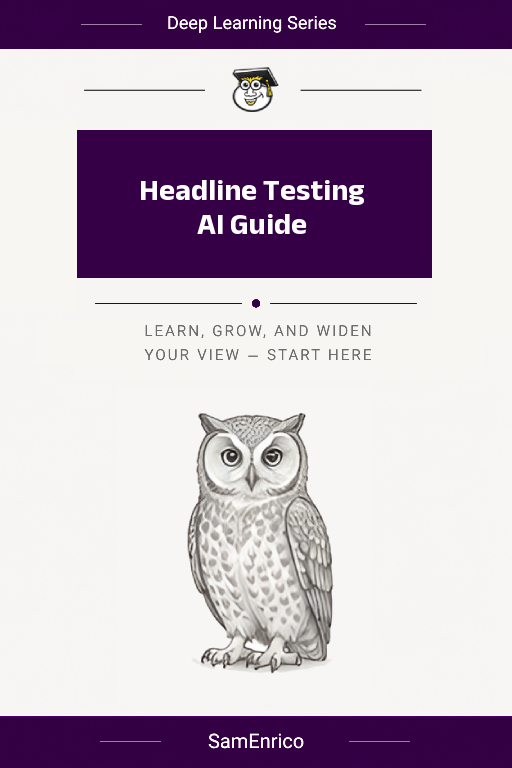
Non-FictionAI OperatorHeadline Testing
Headline Testing AI Guide eBook
Generate dozens of headline variations for A/B tes
Generate dozens of headline variations for A/B testing using generative AI prompt patterns.
Formats
Free sample
Chapter 1: The Vanilla AI Trap--–- In 2021, a mid-sized Saa S company called Recurly (not their real name, but the story is real) ran the same headline on their pricing page for eleven months. The headline was "Start Your Free Trial." It was clean. It was safe. It was killing them.Their conversion rate from visitor to trial user sat at 2.1%. Their leadership assumed the problem was the product, or the price, or the market.
They hired consultants. They redid their landing page layout. They changed button colors from green to blue to orange and back to green. Nothing moved the needle past 2.3%.Then a junior product manager named Elena did something that her boss called "a waste of time." She changed the headline to fourteen different variations and ran an A/B test. One variation read "See Plans & Pricing." Another read "Get Started for Free." A third read "Access Your 14-Day Trial."The winner?
"See Plans & Pricing." It lifted conversion to 3.8%—an 81% increase. No change to the product. No change to pricing. Just six words instead of four. That single change, projected over a year, was worth $4.2 million in additional revenue.Elena's boss stopped calling her experiments a waste of time.This chapter is about why that boss was wrong, why most marketers are still wrong today, and how a new villain—something I call the Vanilla AI Trap—is making the problem worse than ever before.
By the end of this chapter, you will understand why searching for the "perfect" headline is a fool's errand, why your intuition is lying to you, and why the AI tools you are using right now are probably sabotaging your own success.The Death of the "One Perfect Headline"For most of modern marketing history, we operated under a seductive assumption. The assumption was that somewhere, in the vast universe of possible word combinations, there existed a single perfect headline for every product, every audience, and every channel. The job of the marketer, according to this assumption, was to be creative enough, smart enough, or lucky enough to find that perfect headline.This assumption produced a certain kind of marketing culture. It was a culture of geniuses and gut feelings. It produced legendary stories like the one about David Ogilvy writing "At 60 miles an hour, the only thing you hear in the new Rolls-Royce is the ticking of the electric clock" and watching sales explode.
The lesson marketers took from stories like these was: be brilliant. Find the magic sentence. Then rest.There is just one problem with this assumption. It is almost entirely wrong.The truth, revealed by decades of controlled experiments across millions of websites and billions of ad impressions, is that there is no such thing as a universally perfect headline. There are only headlines that perform better or worse with specific audiences, at specific times, on specific devices, in specific contexts.
The same headline that doubles conversions on a desktop might kill them on mobile. The same headline that works for cold traffic from Facebook might confuse returning visitors from search.What exists instead is a distribution of possible performances. Some headlines will perform terribly. Most will perform adequately. A few will perform significantly better.
And critically, the difference between a terrible headline and a great headline is often just one or two words.Consider this real test result from a financial newsletter company. The control headline read: "Get Our Daily Market Insights." The variation read: "See What Wall Street Is Missing." Both headlines are grammatically fine. Both are professionally written. The second headline outperformed the first by 127%. The only substantive difference was the frame: "Get" versus "See," and "Insights" versus "What Wall Street Is Missing."This is the pattern that changes everything.
Small changes produce massive swings. And because small changes produce massive swings, the rational marketing strategy is not to search for the perfect headline once. The rational strategy is to generate dozens of variations, test them systematically, learn from the winners, and repeat the process forever.That is what this book will teach you to do, using generative AI as your headline generation engine. But before we get to the how, we need to confront the obstacle that is preventing most marketers from doing this today.Introducing the Villain: The Vanilla AI Trap In 2023, a marketing director at a DTC apparel brand asked Chat GPT to "write 10 headlines for a summer sale." The AI obliged instantly. It produced headlines like "Unlock Your Summer Wardrobe," "Discover the Season's Hottest Styles," "Revolutionize Your Look Today," and "Don't Miss Our Summer Essentials."The marketing director looked at these headlines, thought they seemed fine, and ran them in a Facebook ad test.
Every single one failed. The best-performing AI-generated headline had a click-through rate of 0.7%. The brand's manually written control headline—"40% Off Summer Favorites"—had a CTR of 2.1%.What happened? The marketing director fell into what I call the Vanilla AI Trap. The Vanilla AI Trap is the tendency of untrained, undirected generative AI to produce headlines that are grammatically correct, syntactically fluent, and almost entirely useless for actual conversion.
These headlines share a family resemblance: they are generic, they are high-arousal without being specific, they rely on a predictable vocabulary, and they fail in almost every A/B test against human-written controls that have any specificity whatsoever.The Vanilla AI Trap is seductive because the output looks good at a glance. The words are real words. The sentences are complete sentences. There are no typos. For a marketer who is tired, overworked, and desperate for a shortcut, a Chat GPT headline that reads "Unlock Your Potential" feels like a gift.
It feels like progress.It is not progress. It is a detour.To understand why the Vanilla AI Trap exists, we need to understand how large language models actually work. Generative AI models are trained on enormous datasets containing billions of pages of text from the public internet. That training data includes excellent writing and terrible writing, specific claims and vague generalities, brilliant marketing and lazy clickbait. The model learns to predict which word is most likely to follow which previous word based on statistical patterns in this training data.Here is the critical insight: the most statistically common headline patterns in the training data are not the most effective headline patterns in the real world.
They are the most abundant. And what is most abundant on the public internet? Generic, low-specificity, high-arousal marketing copy. The kind of copy that gets written quickly, published widely, and forgotten immediately.So when you type "write 10 headlines for X" into a vanilla AI prompt, the model reaches into its statistical memory and pulls out the most common patterns associated with "headlines." Those patterns are full of words like "Unlock," "Discover," "Revolutionize," "Unleash," and "Vital." Those words are the linguistic equivalent of beige paint. They are safe.
They are everywhere. And they convert terribly.A study from Yale SOM (which we will explore in detail in Chapter 2) found that AI-generated marketing content performed dramatically better when the AI was given a specific hypothesis about why a headline might work, rather than simply being asked to generate a headline. In other words, the…
This is the end of the free sample. Get the eBook to keep going. Buy now
About this book
Details
- Author
- Perreault Magdalen
- Publisher
- SamEnrico
- Language
- English
- Genre
- Non-Fiction, AI Operator, Headline Testing
- Released
- 2026-06-01
- Pages (approx.)
- 157
- Available as
- eBook, Audiobook

Read better in the ZLOADR app
Your eBooks on your phone or tablet. Sign in with your SamEnrico account and start reading.
More by Perreault Magdalen
 Blame Shifting Anger GuidePerreault Magdalen$11.99
 The Body Language for SalesPerreault Magdalen$11.99
 Social Fear Self HypnosisPerreault Magdalen$11.99
 LinkedIn Professional Validation AddictionPerreault Magdalen$11.99
 Immigrant Professional EsteemPerreault Magdalen$11.99
 The Diamond Heist of Hong Kong: A Kidnapper’s Gambit (1963)Perreault Magdalen$11.99
 How to Start a Centrifuge Parts (except Laboratory Type) Business (Beginners Guide)Perreault Magdalen$11.99
 Sustainable Private Equity GuidePerreault Magdalen$12.99
 Understanding Micromelic Dwarfism Fryns TypePerreault Magdalen$17.99
 The Habits of Highly Effective PeoplePerreault Magdalen$11.99
You may also like
 Hong Kong Handover 1997Dunn Johnnie$11.99
 Zumba For Postnatal Recovery CourseNeal Christian$11.99
 Zumba for BeginnersLadner Nikia$11.99
 YouTube Comment Mining GuideHumes Pandora$12.99
 Worry Box MeditationCarlin Rudy$11.99
 Workplace Stress MeditationNguyen Lynn$11.99
 Workplace Stress and Sleep RepairHawley Ivory$11.99
 Workplace Perfectionism CureDelaney Jeffry$11.99
 Workplace Injustice Anger GuideWallen Isabelle$11.99
 Work Addiction and Burnout LinkGreenwood Ester$11.99
 Women in Yoga and WellnessBeattie Galina$11.99
 Women in Stand Up ComedyChun Evangeline$11.99