
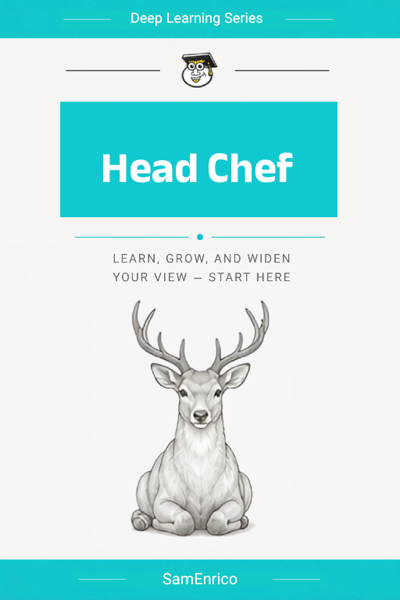
Head Chef eBook
A Coursebook on Head Chef
by Niles Buster
A Coursebook on Head Chef
Formats
Free sample
Chapter 1: The Loneliest Cook...--The first time I stood at the pass as a Head Chef, I threw up in the alley.Not because the food was bad. Not because the health department was lurking. Not because I had food poisoning from the family meal. I threw up because I had never been so terrified in my entire life. The tickets were printing.
The line cooks I had just been drinking with two nights ago were now looking at me for answers. The expo board was a wall of red and green and urgency. And I realized, in that moment of absolute clarity, that I had absolutely no idea what I was doing.I had been cooking for twelve years. Twelve years of sweating over hot ranges, perfecting my knife cuts, learning the difference between a brunoise and a julienne, memorizing mother sauces, staging at restaurants that required me to work ninety hours a week for no pay just for the privilege of learning from a famous chef. I had won cooking competitions.
I had been written up in the local food blog as "a rising talent to watch." I could cook circles around almost anyone in that kitchen. And none of it meant a damn thing when I was standing at the pass with thirty tickets hanging and a sous chef asking me if we should eighty-six the salmon because the last three orders had come back undercooked.Here is the truth that culinary school will never tell you, that cookbooks will never admit, that Instagram chefs will never post about: technical cooking skill does not automatically translate into leadership ability. In fact, being the best cook in the room often makes you a worse Head Chef, because you will try to do everything yourself. You will jump on the line when the sauté station falls behind, leaving the pass unattended. You will refire a dish yourself instead of coaching the commis who made the mistake.
You will work eighty-hour weeks and brag about it, not realizing that your inability to delegate is slowly destroying your body, your team, and your restaurant.This chapter is about the psychological foundation of the Head Chef. Before we talk about menu engineering, before we discuss hiring and firing and food cost percentages and HACCP plans, we have to talk about what is happening inside your head. Because if you do not get this right, nothing else matters. You can have the most beautiful menu in the city, the most efficient kitchen design, the most rigorous safety protocols, and none of it will save you if you are crumbling internally.The Loneliness of Command There is a moment in every new Head Chef's career when they realize that they are completely alone. It usually happens between the second and third month, after the honeymoon period has worn off and the real pressure has begun to settle in.
The owner is asking why food cost is up three percent. The general manager is complaining about ticket times. The sous chef is hinting that they deserve a raise. The line cooks are grumbling about the new scheduling system. And you are standing in the middle of all of it, and there is no one above you to ask for help.This is the loneliness of command.
It is not the same as being physically alone. You are surrounded by people all day. But you are the one who makes the final decisions. You are the one who takes the blame when things go wrong. You are the one who has to smile at a guest who just sent back a perfectly cooked steak because they "changed their mind about how they wanted it." You are the one who has to fire someone you genuinely like because they keep showing up late.
You are the one who has to look in the mirror at the end of a sixteen-hour day and ask yourself if you are doing any of this right.I remember a specific night about six months into my first Head Chef role. We had a catastrophic service. The printer jammed, so tickets started coming out in clumps of ten. The dishwasher called in sick, so the line cooks were rotating through the pit to keep up with the dishes. A server dropped an entire tray of entrees on the floor, and we had to refire seven dishes while the table watched.
By the end of the night, we had comped nearly a thousand dollars in food. The owner was furious. The GM was silent in that angry way that means they are calculating how much this cost them. And I walked into the walk-in cooler, closed the door, and just stood there in the cold for five minutes.I was not crying. I was not praying.
I was just standing there, feeling the weight of every decision I had made that night, every mistake I had failed to prevent, every fire I had failed to put out before it spread. And in that walk-in, I realized something that I have never forgotten: no one was coming to save me. I was the Head Chef. This was my kitchen. The buck stopped with me.That realization is terrifying.
But it is also liberating. Because once you accept that you are alone at the top, you stop waiting for someone else to fix things. You stop blaming the owner, the GM, the supplier, the weather. You start looking at the problems in front of you and asking yourself: what can I do about this? Not tomorrow.
Not after I complain to someone. Now.The loneliness of command never fully goes away. Even after twenty years as a Head Chef, you will still have moments where you feel like you are carrying a weight that no one else can see. But you learn to carry it. You learn to build systems that distribute the weight.
And most importantly, you learn to talk about it. The old-school chef mentality was to suffer in silence, to never admit weakness, to never ask for help. That mentality has destroyed more careers than any bad review ever did.The Two Egos: Pride and Arrogance Let us talk about ego. Because ego is the thing that gets you promoted to Head Chef, and ego is the thing that will destroy you if you do not learn to control it.There are two kinds of ego in a kitchen. The first is what I call healthy pride.
Healthy pride is the confidence that you have earned through years of hard work and continuous learning. It is the voice in your head that says, "I know how to cook this dish correctly because I have done it a thousand times." It is the calm assurance you feel when a new line cook asks you a question and you know the answer immediately. Healthy pride is essential for leadership. Without it, you would second-guess every decision, hesitate at the pass, and drain your team's confidence in your ability to lead.The second kind of ego is destructive arrogance. Destructive arrogance is the voice that says, "I am the only one who knows how to do…
This is the end of the free sample. Get the eBook to keep going. Buy now
About this book
Details
- Author
- Niles Buster
- Publisher
- SamEnrico
- Language
- English
- Genre
- Non-Fiction, Informative, Educational
- Released
- 2026-05-04
- Pages (approx.)
- 126
- Available as
- eBook, Audiobook

Read better in the ZLOADR app
Your eBooks on your phone or tablet. Sign in with your SamEnrico account and start reading.
More by Niles Buster
 The Chronic Pain Sleep MeditationNiles Buster$11.99
 Secret Garden RelaxationNiles Buster$11.99
 Safe Harbor 401k Plan GuideNiles Buster$11.99
 Loving Kindness for ChemotherapyNiles Buster$11.99
 Surrogacy Loss Support GuideNiles Buster$11.99
 The Shanghai Stock Scandal: How the Russian Mafia Corrupted Asia's MarketsNiles Buster$11.99
 Understanding Nephropathy Familial With HyperuricemiaNiles Buster$17.99
 A Beginners Guide to Gatka (Volume 1)Niles Buster$11.99
 Dollar Tree SWOT LibraryNiles Buster$12.99
 Excel for Health Economics ExamsNiles Buster$12.99