
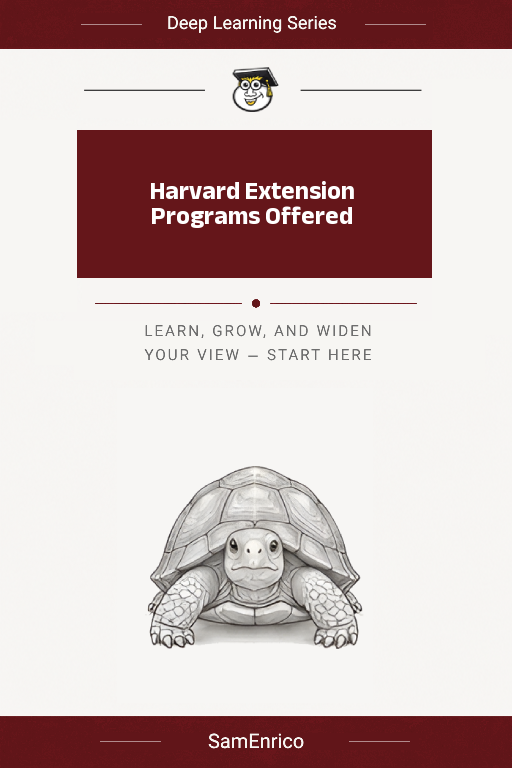
Non-FictionStudent's ShortcutPrograms
Harvard Extension Programs Offered eBook
Degree programs: Liberal Arts, Management, Finance
Degree programs: Liberal Arts, Management, Finance, Psychology, Sustainability, and Digital Media.
Formats
Free sample
Chapter 1: The Egalitarian Paradox--–- At a sun-drenched Harvard commencement in May, a forty-three-year-old single mother stands among seven thousand graduates wearing crimson robes. Her children cheer from the bleachers. Her elderly parents have flown in from Ohio. She didn't walk across this stage at twenty-two, because at twenty-two she was waiting tables and raising a toddler and wondering if college would ever be possible. For the past six years, she has taken two courses per semester, often logging into Zoom lectures at eleven o'clock at night after her children fell asleep.
She has written thirty-seven papers, completed a capstone project that saved her employer $400,000, and maintained a 3.8 GPA. Today, she receives a Harvard degree.A few rows away, a twenty-four-year-old who entered Harvard College as a first-year student sits with his classmates. He has never worked a full-time job. His parents paid most of his tuition. He took four years of in-person classes, lived in a dormitory, and joined a final club.
Today, he also receives a Harvard degree.Both diplomas bear the same university seal. Both graduates become members of the Harvard Alumni Association. Both can say, truthfully and without qualification, that they earned a degree from Harvard University.But only one of them will ever have to explain, to skeptical employers and doubtful relatives and curious strangers, whether their degree "really counts."This is the central paradox of the Harvard Extension School, and it is the subject of this book. Founded in 1910 with a radical mission to extend Harvard to those who could never otherwise attend, HES has spent 115 years operating as the university's most democratic institution—and its most contested one -3. It admits anyone who can prove they belong, charges a fraction of what other Harvard schools charge, and graduates students who, by any measure, have worked harder to earn their place than nearly anyone else on campus.
Yet it constantly faces questions about its legitimacy. Its graduates have to defend their degrees. Its name carries an asterisk in the minds of those who don't understand it.This chapter explains why that paradox exists, why it matters, and—most importantly—why you should ignore it.The Founding Vision: Harvard for Everyone The story of Harvard Extension School begins not at Harvard, but with a dying man named John Lowell Jr. In 1836, the Boston textile heir—a Harvard dropout who had spent his brief adulthood traveling the world and collecting books—drafted a will that would reshape American education -3. Lowell had grown sickly and would die within a year at age thirty-seven.
But before he did, he directed that half his fortune be used to provide free public lectures in Boston. The most popular courses, he stipulated, should cost nothing. Even the more advanced offerings, he wrote, should cost no more than "two bushels of wheat."This was not philanthropy as usual. In an era when universities served only the wealthy elite, Lowell's vision was explicitly democratic. He wanted working people—mechanics, shopgirls, factory laborers—to have access to the same knowledge that Harvard professors taught to the sons of privilege.The Lowell Institute, established according to his wishes, offered free public lectures for decades.
In 1900, a man named A. Lawrence Lowell—John Jr.'s cousin and a future Harvard president—took over the institute -3. He transformed its haphazard lecture series into a systematic program of adult education, persuading Harvard faculty to teach their regular courses again in the evenings.One of his institute students, writing in 1910, captured the spirit of the experiment: "Young and old, black and white, artisans and teachers, men and women—who had questioned the meaning of life, and the universe, were eager to compare their thoughts with the questioners of all time. It was an audience to challenge any professor's attention and respect" -3.That same year, Harvard's governing board authorized the formation of a Department of University Extension. Three years later, in 1913, the department awarded its first degrees to two students: John Coulson and Ellen Marie Greany -3.
A man and a woman. A name lost to history and a name that proved, from the very first commencement, that this new institution would not look like the rest of Harvard.For more than a century since, through world wars and economic depressions and seismic shifts in American higher education, that core mission has never wavered. The Harvard Extension School exists to extend Harvard to those who would otherwise never have access. It is, in the words of former dean Michael Shinagel, "the ultimate democratic experiment" -3.The Numbers That Defy the Ivy League Stereotype To understand how radical this experiment really is, consider the basic demographics of the Harvard Extension School.Each academic year, HES serves more than 13,000 students, approximately 4,000 of whom are candidates for bachelor's or master's degrees -3. The rest enroll in individual courses or certificate programs, sampling Harvard education without committing to a full degree.The average age of a degree candidate is in the mid-thirties.
Among ALM (master's degree) students, seventy-four percent work full-time while pursuing their degrees -6. Among ALB (bachelor's degree) candidates, fifty-seven percent work full-time -6. These are not students who can quit their jobs, move to Cambridge, and spend two years in a classroom. They are professionals, parents, caregivers, veterans, and career-changers who have built entire lives that they cannot simply press pause on.Sixty-four percent of HES students are women -2. Twenty-four percent live outside the United States -2.
In any given semester, you might find a software engineer in Seattle attending a virtual lecture alongside a banker in Singapore, a teacher in Nairobi, and a military spouse stationed in Germany. The time zones alone would make a traditional university administrator weep.The typical ALB student takes one to two courses per semester and graduates in approximately six years -6. The typical ALM student takes one course per semester and graduates in approximately four years -6. This slow, steady pace is not a bug. It is the central feature of an institution designed for people who cannot pause their lives.Eighty-three percent of ALB students who start the program eventually graduate -6.
Seventy-seven percent of ALM students do the same -6. These are astonishingly high completion rates for any university, let alone for a part-time adult population.To put these numbers in perspective: the Harvard College student body of 6,700 undergraduates -10—the ones who live in dorms, eat in dining halls, and spend four uninterrupted years on campus—is actually smaller than the Harvard Extension School's degree-seeking population. HES degree candidates alone number approximately 4,500 -10. Add certificate seekers and non-degree students, and HES dwarfs every other school on campus.Yet you rarely hear about them. Harvard Magazine, the university's alumni publication, has described HES as "overlooked or totally ignored" in university histories, "even those that are otherwise exhaustive" -3.
The school exists in a strange shadow space: too big to be invisible, too unconventional to be celebrated, too successful to be dismissed, and too controversial to be embraced without qualification.The Stigma and the Asterisk So why does the paradox persist? Why must a Harvard Extension School graduate defend their degree while a Harvard College graduate does not?The answer lies…
This is the end of the free sample. Get the eBook to keep going. Buy now
About this book
Details
- Author
- Goldberg Shirly
- Publisher
- SamEnrico
- Language
- English
- Genre
- Non-Fiction, Student's Shortcut, Programs
- Released
- 2026-05-29
- Pages (approx.)
- 151
- Available as
- eBook, Audiobook

Read better in the ZLOADR app
Your eBooks on your phone or tablet. Sign in with your SamEnrico account and start reading.
More by Goldberg Shirly
 Berberine Metabolic GuideGoldberg Shirly$11.99
 Tension Headache and Vitamin DeficienciesGoldberg Shirly$11.99
 Bahadur Shah Zafar Last MughalGoldberg Shirly$11.99
 The Anger Anonymous ParentGoldberg Shirly$11.99
 Cultural Assertiveness AdaptationGoldberg Shirly$11.99
 ABCDE For Sales TeamsGoldberg Shirly$11.99
 Dunning Kruger Workplace GuideGoldberg Shirly$11.99
 Emotion Science ResearchGoldberg Shirly$11.99
 Power Dynamics in GesturesGoldberg Shirly$11.99
 Zaha Hadid: Breaking the Glass Ceiling of Architecture (1980s-1990s)Goldberg Shirly$11.99
 The Vanishing Codex: The Lost Library of Alexandria’s Final SecretGoldberg Shirly$11.99
 Love Letters in the Attic: The Secret Correspondence of Princess Diana and Prince CharlesGoldberg Shirly$11.99
You may also like
 Hong Kong Handover 1997Dunn Johnnie$11.99
 Zumba For Postnatal Recovery CourseNeal Christian$11.99
 Zumba for BeginnersLadner Nikia$11.99
 YouTube Comment Mining GuideHumes Pandora$12.99
 Worry Box MeditationCarlin Rudy$11.99
 Workplace Stress MeditationNguyen Lynn$11.99
 Workplace Stress and Sleep RepairHawley Ivory$11.99
 Workplace Perfectionism CureDelaney Jeffry$11.99
 Workplace Injustice Anger GuideWallen Isabelle$11.99
 Work Addiction and Burnout LinkGreenwood Ester$11.99
 Women in Yoga and WellnessBeattie Galina$11.99
 Women in Stand Up ComedyChun Evangeline$11.99