
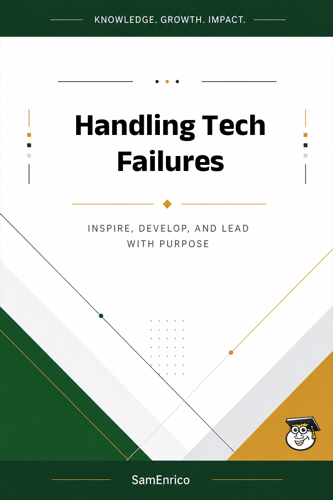
Free sample
Chapter 1: The Success Paradox...-- Every catastrophic technology failure I have ever investigated began not with a crash, not with a bug, and not with a sleepy engineer fat-fingering a command. It began with a celebration. The champagne had barely dried on the conference room table when the pager went off. This is the first and most uncomfortable truth about handling tech failures: success is not the opposite of failure. Success is its most reliable breeding ground.The companies that suffer the most spectacular infrastructure collapses are rarely the struggling startups with duct-taped architectures and skeleton crews.
Those companies expect to break. They are paranoid, vigilant, and accustomed to chaos. No, the truly devastating failures—the ones that make headlines, cost millions, and end careers—happen at companies that have already won. Market leaders. Unicorns.
The Saa S darlings that just closed their Series B. The e-commerce giants preparing for their biggest holiday season. These companies fail not despite doing everything right, but precisely because they did everything right for so long.This chapter introduces the central paradox that will echo through every subsequent page of this book. To handle tech failures, you must first understand why success makes you vulnerable. You must learn to see the blind spots that prosperity creates.
And you must accept a deeply uncomfortable idea: your greatest strength as an organization—your ability to satisfy customers, ship features, and grow revenue—is also the force that is quietly undermining your infrastructure, one "small, reasonable decision" at a time.The Graveyard of the Successful Let us begin with a thought experiment. Imagine two technology companies.Company A is a three-year-old startup. It has twelve engineers, a monolithic Rails application, and a database running on a single server. Their deployment process involves a bash script that one of the founders wrote at 2 AM three years ago and nobody has touched since. They have no formal on-call rotation.
When things break, whoever happens to be awake fixes them. Their error logs are a chaotic mess. Their CEO describes their infrastructure as "held together with duct tape and prayer."Company B is a market leader with five hundred engineers. They have a sophisticated Kubernetes cluster spanning three cloud regions. They have dedicated SRE teams, chaos engineering Game Days, and a post-mortem culture that their CTO proudly describes as "world-class." Their SLIs are measured to five nines.
Their on-call rotations are staffed by senior engineers with fifteen years of experience. Their CEO recently gave a keynote about "engineering excellence."Which company is more likely to suffer a catastrophic, business-threatening infrastructure failure?If you answered Company A, you have fallen into the same trap that claims thousands of successful companies every year. The data tells a different story. Company A will have many small failures. Their site will go down on a Tuesday afternoon because someone forgot to renew an SSL certificate.
A deployment will fail because the bash script had a typo. A customer will be annoyed. But Company A will almost never experience the kind of cascading, unrecoverable, multi-day meltdown that destroys customer trust and makes front-page news. Why? Because Company A knows it is fragile.
They are paranoid. They test every change twice. They have nothing to lose and everything to prove.Company B, however, is sitting on a ticking time bomb. Their very sophistication has created a false sense of security. Their success has bred complacency.
Their "world-class" systems are so complex that no single person understands them entirely. Their last major refactor was eighteen months ago, but nobody remembers because they have been too busy shipping features. Their on-call engineers are exhausted but have stopped complaining because "that's just how it is." And most dangerously, when someone suggests a major architectural overhaul, they are met with a polite but firm: "We've always done it this way."This is the graveyard of the successful. It is littered with the corpses of once-great technology companies: Nokia, Blockbuster, My Space, Yahoo, and hundreds of less famous names that died not because they were incompetent, but because their competence in one area blinded them to their fragility in another.The Innovator's Dilemma for Infrastructure The late Clayton Christensen, in his seminal work The Innovator's Dilemma, observed a puzzling pattern across dozens of industries. Again and again, market-leading companies failed not because they made bad decisions, but because they made good decisions—decisions that their most profitable customers loved, that boosted their stock price, and that their boards enthusiastically approved.
These decisions were so obviously correct in the short term that no rational executive would have made a different choice. And yet, those same decisions systematically destroyed the company's ability to compete in the long term.Christensen was writing about product innovation. He was describing how established companies ignore disruptive technologies because those technologies initially serve smaller, less profitable markets. But the same dynamic applies, with brutal precision, to infrastructure and technical debt.Consider the following scenario, which I have witnessed in various forms at more than a dozen technology companies. A fast-growing Saa S company, let us call them "Stream Max," has built a successful video encoding pipeline.
It works perfectly for their first ten thousand customers. The architecture is a elegant monolith—a single, well-understood codebase that a new engineer can fully comprehend in two weeks. Deployments are simple. Debugging is straightforward. The on-call engineer can actually sleep through the night.Then Stream Max grows.
They acquire their hundred-thousandth customer. The monolith begins to strain. Response times creep upward. The database connection pool maxes out during peak hours. The engineering team, now fifty people strong, cannot all work on the same codebase without stepping on each other's toes.
The CTO faces a decision.Option One: Refactor the monolith into a set of microservices. This will require six months of dedicated work, during which almost no new features will ship. The sales team will hate this. The CEO, who just promised a major new feature to the company's largest customer, will hate this. The board, which is watching the quarterly growth numbers, will hate this.Option Two: Add another layer of caching.
Throw more servers at the problem. Tune the connection pool. Kick the can down the road.Every rational incentive pushes the CTO toward Option Two. The CEO asks: "Can we just make it work for now?" The sales team pleads: "We promised that feature." The engineers themselves, tired of the pressure, say: "We can optimize our way out of this."And so Stream Max chooses Option Two. Not because they are bad engineers.
Not because their CTO is incompetent. But because they are successful, and success demands features, growth, and quarterly results. The technical debt is not ignored; it is strategically deferred. And for a while, this works. The caching helps.
The extra servers absorb the load. Stream Max grows to a million customers.But the debt compounds. Each "temporary" optimization becomes permanent. Each workaround becomes a dependency. The system becomes what engineers call "brittle"—it works perfectly under normal conditions, but any unexpected shock causes it to shatter.
A database connection times out. The retry logic kicks in. The retries overwhelm the caching layer. The caching layer fails…
This is the end of the free sample. Get the eBook to keep going. Buy now
About this book
Details
- Author
- Keegan Valene
- Publisher
- SamEnrico
- Language
- English
- Genre
- Non-Fiction, Self-Help / Technology
- Released
- 2026-06-06
- Pages (approx.)
- 145
- Available as
- eBook, Audiobook

Read better in the ZLOADR app
Your eBooks on your phone or tablet. Sign in with your SamEnrico account and start reading.
More by Keegan Valene
 Fiverr Promoted Gigs ROI CalculatorKeegan Valene$11.99
 NamUs Unidentified Remains PhotographyKeegan Valene$11.99
 The Self Hypnosis ScriptbookKeegan Valene$11.99
 Refugee To RestaurateurKeegan Valene$11.99
 The Rescripting Timeline ShiftKeegan Valene$11.99
 Kegel Exercise GuideKeegan Valene$11.99
 Resilience for StudentsKeegan Valene$11.99
 Ymir's Breath: How the First Giant Shaped the Nine RealmsKeegan Valene$11.99
 The Clash of the Titans: Freddie Mercury and Bruce Dickinson – The Rivalry That Rocked the UKKeegan Valene$11.99
 Growing CastanopsisKeegan Valene$11.99
 A Collector's Handbook to the Singer Vogue IKeegan Valene$11.99
 Franchise International HR GuideKeegan Valene$12.99
You may also like
 Hong Kong Handover 1997Dunn Johnnie$11.99
 Zumba For Postnatal Recovery CourseNeal Christian$11.99
 Zumba for BeginnersLadner Nikia$11.99
 YouTube Comment Mining GuideHumes Pandora$12.99
 Worry Box MeditationCarlin Rudy$11.99
 Workplace Stress MeditationNguyen Lynn$11.99
 Workplace Stress and Sleep RepairHawley Ivory$11.99
 Workplace Perfectionism CureDelaney Jeffry$11.99
 Workplace Injustice Anger GuideWallen Isabelle$11.99
 Work Addiction and Burnout LinkGreenwood Ester$11.99
 Women in Yoga and WellnessBeattie Galina$11.99
 Women in Stand Up ComedyChun Evangeline$11.99