
Non-FictionSelf-HelpGentle Movement
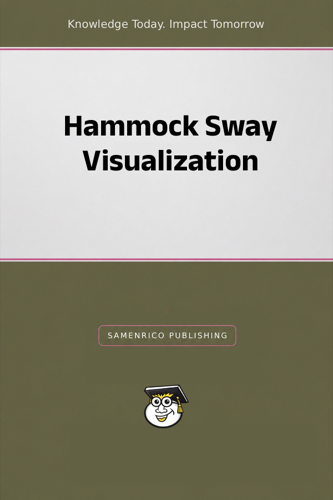
Hammock Sway Visualization eBook
Gently rock in a hammock between palm trees under
Gently rock in a hammock between palm trees under blue sky.
Formats
Free sample
Chapter 1: The Forgotten Frequency–- Long before you could walk, before you could speak, before you could even hold up your own head, you knew how to sway.You knew it in the dark, warm hammock of your mother's womb, where every step she took rocked you into a gentle, rhythmic oscillation. You knew it in her arms as she paced the floor at 2 AM, your cries softening with each repetitive swing. You knew it in the cradle, the rocking chair, the gentle bounce of a car moving over a slow road. Your nervous system was built for this motion. It is not a preference or a cultural habit.
It is a biological inheritance, etched into your brainstem over hundreds of millions of years of evolution.And somewhere along the path to adulthood, you lost it.You traded the sway for the sprint. You traded the rock for the rush. You traded the gentle, predictable arc of a hammock for the jolting, start-stop chaos of notifications, deadlines, traffic, and endless screen scrolling. Your nervous system, still wired for the rhythm of the womb, now finds itself trapped in a world of linear acceleration. No wonder you feel exhausted.
No wonder your thoughts race. No wonder you lie down at night and your brain refuses to follow.This chapter is about reclaiming what you never should have lost. It is about understanding, at the deepest level of your neurobiology, why a gentle sway between two palm trees under a blue sky is not an escape from life—it is a return to your most fundamental state of calm.The Hidden Sense You Were Never Taught About Let us begin with a simple question: What happens inside your body when you rock?Most people assume that rocking feels good because it is associated with childhood comfort or lazy summer afternoons. But the truth is far more ancient and far more mechanical. The answer lies in a small, fluid-filled structure deep inside your inner ear called the vestibular system.Unlike your five familiar senses (sight, hearing, touch, taste, smell), the vestibular sense operates almost entirely below the threshold of conscious awareness.
You do not feel yourself feeling it. You simply experience the world as stable, balanced, and oriented. That is the vestibular system doing its invisible work.The vestibular system is your body's gyroscope. It detects motion, balance, and spatial orientation. When you move your head, fluid shifts inside three semicircular canals, sending signals to your brainstem about exactly how you are moving—direction, speed, acceleration, and deceleration.
These signals then travel along neural pathways to the cerebellum (which coordinates movement), the hypothalamus (which regulates stress hormones), and the limbic system (which processes emotion).Here is what matters for the hammock sway: the vestibular system is directly wired to the parasympathetic nervous system—the branch of your autonomic nervous system responsible for rest, digestion, healing, and calm. When you experience slow, repetitive, low-frequency motion (between 0.1 and 0.5 Hertz, or roughly one complete back-and-forth swing every two to ten seconds), your vestibular system sends a powerful signal to your brainstem that says: Safety. Predictability. No threat.In response, your parasympathetic nervous system activates the vagus nerve, the longest cranial nerve in your body, which winds from your brainstem down through your neck, chest, and abdomen, touching your heart, lungs, and digestive tract. When the vagus nerve is stimulated, your heart rate slows.
Your blood pressure drops. Your breathing deepens. Your digestive system activates. Your cortisol levels—the primary stress hormone—begin to fall.This is not meditation. This is not positive thinking.
This is hardwired biology.Dr. Stephen Porges, the creator of Polyvagal Theory (and a key influence behind The Body Keeps the Score), has shown that the mammalian nervous system has evolved to detect safety through three channels: facial expression (warmth), vocal tone (softness), and vestibular rhythm (slow, repetitive motion). A hammock sway ticks the third box with extraordinary precision.The Goldilocks Zone of Motion Let us get more specific. Research on human motion preference has identified a narrow window of oscillation that the nervous system finds deeply regulating: 0.1 to 0.5 Hertz.To put that in everyday terms: a complete back-and-forth swing of a hammock typically takes between two and ten seconds. A two-second swing (0.5 Hz) is a gentle, noticeable rock.
A ten-second swing (0.1 Hz) is a barely perceptible drift, almost like floating on slow water. Both fall within the therapeutic range.Why this range? Because it mirrors the body's own natural rhythms. Your resting heart rate is roughly 0.8 to 1.2 Hertz (60–72 beats per minute). Your breathing at rest is roughly 0.2 to 0.3 Hertz (12–18 breaths per minute).
The hammock sway at 0.1–0.5 Hz sits between these two rhythms, creating a gentle entrainment effect where the heart, lungs, and vestibular system begin to synchronize.This synchronization is measurable. Studies using electroencephalography (EEG) have shown that during slow, repetitive rocking, the brain shifts from beta waves (13–30 Hz, associated with active thinking, anxiety, and hyperarousal) toward theta waves (4–8 Hz, associated with deep relaxation, hypnagogic imagery, memory consolidation, and creativity).Theta waves are the brain's twilight state. They occur in the moments just before sleep, during vivid daydreaming, and during deep, effortless meditation. They are also the state in which the brain is most receptive to new ideas, most capable of emotional processing, and most efficient at clearing metabolic waste through the glymphatic system (the brain's cleaning mechanism, which activates during deep rest).In other words: when you sway in a hammock—even an imagined one—you are not just relaxing. You are changing your brain state at a measurable, electrical level.The Stillness Trap Here is a confession that most mindfulness books will not make: still meditation is hard for many people.Sitting on a cushion, spine straight, eyes closed, trying to watch your breath while ignoring the itch on your nose and the to-do list screaming in your skull—this is not relaxing for everyone.
For some, it is activating. For people with trauma histories, anxiety disorders, or simply busy minds, forced stillness can feel like imprisonment. The body wants to move. The nervous system wants rhythm. And yet the dominant meditation culture has, for centuries, prioritized motionlessness as the highest ideal.The hammock sway offers an alternative.Instead of fighting your body's desire for movement, you work with it.
The sway becomes your anchor, not the breath alone. You do not have to ignore distractions because the motion itself gives your brain something to track—a simple, predictable, soothing rhythm that requires no effort to maintain. This is the difference between focused attention (effortful, exhausting, frustrating for beginners) and effortless engagement (the state of being gently held by a rhythm larger than yourself).Think of it this way: have you ever fallen asleep in a moving car? Rocked a baby to sleep? Sat in a rocking chair on a quiet porch and lost an hour without noticing?
That is effortless engagement. That is the hammock sway.You do not have to try to relax. You only have to allow the rhythm to carry you.The Two Modes of Practice Before we go any further, you need to understand a framework that will govern every practice in this book. Throughout Hammock Sway…
This is the end of the free sample. Get the eBook to keep going. Buy now
About this book
Details
- Author
- Lackey Tonette
- Publisher
- SamEnrico
- Language
- English
- Genre
- Non-Fiction, Self-Help, Gentle Movement
- Released
- 2026-06-08
- Pages (approx.)
- 123
- Available as
- eBook, Audiobook

Read better in the ZLOADR app
Your eBooks on your phone or tablet. Sign in with your SamEnrico account and start reading.
More by Lackey Tonette
 Trance Induction ScriptsLackey Tonette$11.99
 Failure Exposure Therapy CourseLackey Tonette$11.99
 De Minimis Shipment RuleLackey Tonette$11.99
 The Metta for Parenting TeensLackey Tonette$11.99
 Tangaroa’s Wrath: The Great Wave That Swallowed the SkyLackey Tonette$11.99
 How to Become a Plumbing Assembler-installerLackey Tonette$11.99
 Furniture Shopping GuideLackey Tonette$12.99
 Non Resident LLC for Real EstateLackey Tonette$12.99
 Indochino Shop SalespersonLackey Tonette$11.99
 Understanding Recurrent Peripheral Facial PalsyLackey Tonette$17.99
You may also like
 Hong Kong Handover 1997Dunn Johnnie$11.99
 Zumba For Postnatal Recovery CourseNeal Christian$11.99
 Zumba for BeginnersLadner Nikia$11.99
 YouTube Comment Mining GuideHumes Pandora$12.99
 Worry Box MeditationCarlin Rudy$11.99
 Workplace Stress MeditationNguyen Lynn$11.99
 Workplace Stress and Sleep RepairHawley Ivory$11.99
 Workplace Perfectionism CureDelaney Jeffry$11.99
 Workplace Injustice Anger GuideWallen Isabelle$11.99
 Work Addiction and Burnout LinkGreenwood Ester$11.99
 Women in Yoga and WellnessBeattie Galina$11.99
 Women in Stand Up ComedyChun Evangeline$11.99