
Non-FictionSelf-HelpVisualizationGuided Imagery
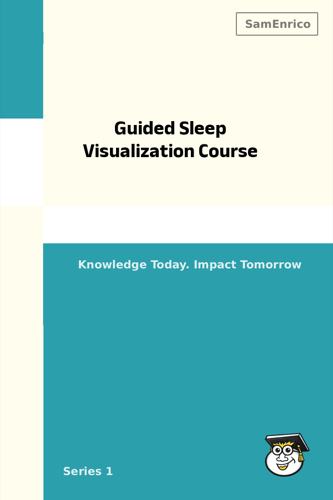
Guided Sleep Visualization Course eBook
Picture a peaceful forest, beach, or meadow to dri
Picture a peaceful forest, beach, or meadow to drift into deep rest.
Formats
Free sample
Chapter 1: The Visual Pivot--–- You are reading this because you are tired. Not just the ordinary tiredness that a cup of coffee can solve, but the bone-deep exhaustion of someone who has tried everything. You have silenced your phone an hour before bed. You have bought the weighted blanket, the blackout curtains, the lavender pillow spray. You have counted sheep until you wanted to file a formal complaint against the shepherd.
And still, at 2:47 AM, you find yourself staring at the ceiling, your mind racing through tomorrow's to-do list, last week's awkward conversation, and a vague worry about something you cannot even name.This chapter is not about what you are doing wrong. It is about what your brain is doing right—and how to gently redirect it.The Cruelest Paradox Let us begin with a confession. Every sleep book you have ever read told you to relax. To let go. To stop trying.
And you tried to follow that advice. You tried to relax. You tried to stop trying. And the trying itself became the problem.This is the cruelest paradox of insomnia: the more effort you apply to falling asleep, the more awake you become.There is a neurological reason for this. Your brain is not broken.
It is actually working exactly as it evolved to work. The problem is that it cannot distinguish between a genuine threat (a predator outside your cave) and a modern worry (an email you should not have sent). To your ancient nervous system, a racing thought about a deadline feels exactly like a racing heartbeat before danger. And your brain's response to danger is to keep you alert.So when you lie in bed thinking, "I need to fall asleep or tomorrow will be a disaster," your brain hears, "Danger. Stay awake.
Protect the body." You are asking your sleep system to activate while simultaneously feeding it alarm signals. It is like trying to extinguish a fire by throwing gasoline on it while yelling at the flames to calm down.This is not your fault. No one taught you how your brain actually falls asleep.Competitive Neuroplasticity: The Science of One Thought at a Time Here is the truth that changes everything. Your brain cannot hold two different kinds of thoughts at full strength simultaneously. This is called competitive neuroplasticity—a fancy way of saying that neural networks compete for your attention.When you generate anxious, language-based thoughts—"What if I don't sleep?
I have that meeting at 9 AM. Why is my heart beating so fast?"—you are activating your brain's default mode network. This network is excellent for planning, problem-solving, and worrying. It is terrible for sleep.When you generate vivid, sensory-based imagery—the feel of moss under your bare feet, the sound of waves receding from shore, the smell of rain on dry earth—you are activating a completely different set of neural pathways. These are your sensory and imagination networks.
And here is the key: these two networks cannot dominate at the same time. One suppresses the other.This means you have a choice. Not a choice about whether thoughts arise—they will always arise—but a choice about which neural network you feed.Think of your brain as a crowded room with two radios. One radio plays anxious talk radio: planning, analyzing, criticizing, worrying. The other radio plays ambient sensory music: images, sounds, textures, smells.
You cannot turn off the talk radio completely. But you can turn up the volume on the other station. And when the music gets loud enough, the talking becomes background noise. It is still there, technically, but you can no longer hear the words.The Alpha Switch: Your Brain's Gearshift To understand how visualization works, you need a basic map of your brain's electrical activity. Brain waves are measured in cycles per second, or hertz.
The higher the number, the more alert and active your brain.Gamma waves (30–100 Hz) are for intense focus and problem-solving. You do not want these at bedtime.Beta waves (12–30 Hz) are for normal waking consciousness, active thinking, and anxiety. Most insomniacs are stuck in high-beta well past midnight.Alpha waves (8–12 Hz) are the bridge. This is relaxed wakefulness—the feeling of closing your eyes on a quiet afternoon, not quite awake, not quite asleep. Alpha is where visualization begins.Theta waves (4–8 Hz) are the doorway to sleep.
This is the hypnagogic state, that floating, dreamlike space where images drift across your mind without your control. You are still technically awake, but your body is deeply relaxed.Delta waves (0.5–4 Hz) are deep, dreamless sleep. This is where restoration happens.Here is what most sleep books get wrong. They tell you to "relax" as if relaxation is a single state. It is not.
You cannot jump directly from high-beta anxiety to delta sleep. That is like trying to go from a sprint to unconsciousness without slowing down. You will trip.The Alpha Switch is the deliberate act of shifting from beta to alpha by engaging your sensory imagination. Visualization is not a distraction. It is a gearshift.
You cannot throw the car into reverse while driving forward. You must pass through neutral. Alpha is neutral.The Forest, Beach, Meadow Triangle Now we arrive at the three landscapes that will become your home for the rest of this book. These are not random choices. They are neurologically strategic.The Forest evokes ancestral shelter.
For hundreds of thousands of years, humans who slept in forests survived. The closed canopy overhead creates a sense of containment. The soft floor of moss and needles provides comfort. The muffled sounds of wind through branches tell your ancient brain: you are hidden. Nothing can see you.
You are safe.The Beach evokes ancestral rhythm. The human body is built on cycles—heartbeat, breath, circadian rhythm. The waves provide an external rhythm that your nervous system can entrain to. You do not have to calm yourself down. The tide does it for you.The Meadow evokes ancestral openness.
For those who feel trapped or claustrophobic, the meadow provides a different kind of safety: the safety of seeing everything. There are no predators hiding behind trees because there are no trees. The starry sky above reminds you that you are small, your problems are smaller, and sleep is not a battle—it is a surrender.Each of these landscapes will be explored in depth in later chapters. For now, understand that they are tools. You do not need to like all of them.
You need only one that feels like home.But here is something most books will not tell you: these landscapes exist on a spectrum of activity. The Forest requires active imagination—walking, moving, doing. The Beach is semi-active—watching, waiting, releasing. The Meadow is passive—lying still, observing, receiving.Later in this book, you will take a diagnostic quiz to determine which landscape suits your specific nervous system. Some people need the structure of the Forest.
Others find active visualization exhausting and need the stillness of the Meadow. Neither is better. They are just different prescriptions for different brains.The Mental Postcard Test Before we go any further, let us find out how your imagination…
This is the end of the free sample. Get the eBook to keep going. Buy now
About this book
Details
- Author
- Callaway Brooks
- Publisher
- SamEnrico
- Language
- English
- Genre
- Non-Fiction, Self-Help, Visualization, Guided Imagery
- Released
- 2026-06-11
- Pages (approx.)
- 136
- Available as
- eBook, Audiobook

Read better in the ZLOADR app
Your eBooks on your phone or tablet. Sign in with your SamEnrico account and start reading.
More by Callaway Brooks
 The Nas Illmatic JourneyCallaway Brooks$11.99
 Active Empathy WorkbookCallaway Brooks$11.99
 Weekly Meal Prep for TrackingCallaway Brooks$11.99
 Don't Wear Flip FlopsCallaway Brooks$11.99
 The Lioness of the South: Queen Nzinga's War of Diplomacy and SteelCallaway Brooks$11.99
 Learn to Play the AssotorCallaway Brooks$11.99
 Hurricane Commercial InsuranceCallaway Brooks$12.99
 Startup Subscription BillingCallaway Brooks$12.99
 School DirectorCallaway Brooks$11.99
 How to Start a Desserts With a Milk Base Business (Beginners Guide)Callaway Brooks$11.99
You may also like
 Hong Kong Handover 1997Dunn Johnnie$11.99
 Zumba For Postnatal Recovery CourseNeal Christian$11.99
 Zumba for BeginnersLadner Nikia$11.99
 YouTube Comment Mining GuideHumes Pandora$12.99
 Worry Box MeditationCarlin Rudy$11.99
 Workplace Stress MeditationNguyen Lynn$11.99
 Workplace Stress and Sleep RepairHawley Ivory$11.99
 Workplace Perfectionism CureDelaney Jeffry$11.99
 Workplace Injustice Anger GuideWallen Isabelle$11.99
 Work Addiction and Burnout LinkGreenwood Ester$11.99
 Women in Yoga and WellnessBeattie Galina$11.99
 Women in Stand Up ComedyChun Evangeline$11.99