
Non-FictionInformativeEducational
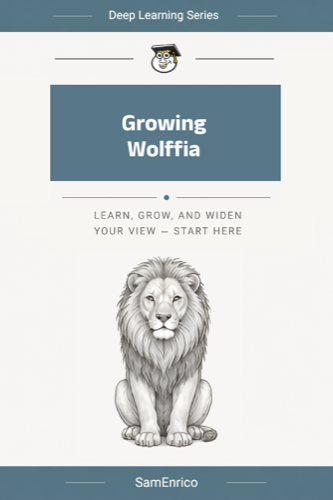
Growing Wolffia eBook
This publication, published by SamEnrico, covers G
This publication, published by SamEnrico, covers Growing Wolffia
Formats
Free sample
Chapter 1: The Protein Promise...–- On a humid morning in the rice paddies of northern Thailand, a farmer does something that would seem absurd to most Western agriculturalists. She wades into ankle-deep water, not to check on her rice seedlings, but to skim a green film off the surface using a fine mesh net. The film is not algae, though it looks like it. It is not duckweed, though it is related. It is Wolffia, known locally as khai-nam—water eggs—and she has been harvesting it daily for decades.
She will rinse it, drain it, and mix it into a spicy soup for her family's lunch. She does not know that this tiny plant contains more protein per square foot than soybeans. She does not know that it doubles in mass every twenty-four hours. She does not know that it could feed the world. She only knows that it is free, it is abundant, and it has kept her family healthy through droughts, floods, and economic crises that have destroyed conventional farms around her.This book is an attempt to bring that knowledge—the knowledge that a poor farmer in Southeast Asia has carried for generations—into your kitchen, your greenhouse, or your backyard.
Because Wolffia is not a miracle. Miracles are passive things that happen to you. Wolffia is a tool. It is a crop. It is a technology, in the original sense of the word: a systematic way of transforming the natural world to meet human needs.
And like any tool, it rewards those who learn to use it well.The central argument of this chapter, and of this entire book, is that Wolffia represents the most efficient, accessible, and sustainable source of plant protein available to the home grower. Not the most efficient in some theoretical laboratory sense, but the most efficient in your home, with your budget, under your constraints. A mason jar on a windowsill can produce enough protein to supplement a single person's diet. A shallow tray under an LED light can produce enough to feed a family. A lined pond in a backyard can produce enough to supply a neighborhood.
This is not speculation; it is arithmetic. And once you understand the arithmetic, you will never look at a glass of water the same way again.The Numbers That Should Not Be Possible Let us begin with a direct comparison between Wolffia and the protein crops you already know. We will use soybeans as our benchmark because soy is the most efficient conventional plant protein source, the standard against which all other plant proteins are measured. The numbers that follow come from peer-reviewed agricultural research, primarily from studies conducted at Wageningen University in the Netherlands, the University of California Davis, and the Asian Institute of Technology in Thailand. They are not optimistic guesses.
They are measured realities.Yield per acre per year. A soybean field in the American Midwest produces approximately fifty bushels per acre under good conditions. Each bushel weighs sixty pounds. Of that sixty pounds, approximately thirty-five percent is protein. Do the math: fifty bushels times sixty pounds equals three thousand pounds of soybeans per acre.
Thirty-five percent protein equals one thousand fifty pounds of protein per acre per year. A Wolffia system, assuming a conservative doubling time of forty-eight hours and a harvest regimen that removes fifty percent of the mat daily, produces approximately seven hundred grams of fresh Wolffia per square meter per week at moderate density. One acre is approximately four thousand square meters. Seven hundred grams per square meter per week equals two million eight hundred thousand grams—approximately six thousand one hundred pounds—per week. Multiply by fifty-two weeks, and you arrive at approximately three hundred seventeen thousand pounds of fresh Wolffia per acre per year.
Fresh Wolffia is approximately ninety percent water, meaning the dry matter yield is approximately thirty-one thousand seven hundred pounds per acre per year. At twenty-five percent protein dry weight, that equals approximately seven thousand nine hundred pounds of protein per acre per year.Seven thousand nine hundred pounds from Wolffia, compared to one thousand fifty pounds from soybeans. Wolffia produces roughly seven and a half times more protein per acre per year than the most efficient conventional protein crop. And this calculation assumes a conservative forty-eight hour doubling time. At twenty-four hours, the numbers double again.Water efficiency.
Soybeans require approximately two hundred fifty gallons of water per pound of protein produced, accounting for rainfall and irrigation. Beef requires approximately eighteen hundred gallons. Wolffia requires approximately twenty gallons per pound of protein, because the water in a Wolffia system is enclosed and recirculated, lost only through evaporation and water changes. The farmer in Thailand is not irrigating her Wolffia; she is simply maintaining the water level in the same pond that has been there for generations. You will do the same: top off evaporation losses, change the water every week or two, and pour the old water onto your garden, where it serves as fertilizer.Land use.
A single square meter of Wolffia surface area, harvested daily at fifty percent removal, can feed one person's daily protein needs if Wolffia is the sole protein source. More realistically, integrated with other foods, two square meters can provide a substantial protein supplement for a family of four. A two square meter system fits on a folding table. It can be stacked vertically, with three tiers on a single shelf unit, producing the equivalent of six square meters of surface area in a footprint of two square meters. A closet in a typical apartment can hold enough Wolffia to feed a household.The Protein Quality Question Protein quantity is only half the story.
The other half is protein quality—specifically, the amino acid profile. Proteins are chains of smaller molecules called amino acids. Humans require twenty different amino acids to build the proteins our bodies need. Of those twenty, nine are considered "essential" because our bodies cannot synthesize them; we must obtain them from food.Wolffia's amino acid profile is remarkably complete for a plant protein. It contains all nine essential amino acids, which is unusual.
Most plant proteins are missing or deficient in at least one essential amino acid. Grains are typically low in lysine. Legumes are typically low in methionine. Wolffia is low in methionine as well—this is its primary nutritional limitation—but it contains enough of every other essential amino acid to be considered a high-quality protein source.The practical implication is simple: combine Wolffia with a methionine-rich food, and you have complete protein. Methionine is abundant in grains (rice, wheat, oats), nuts (walnuts, almonds, Brazil nuts), and seeds (sesame, sunflower, pumpkin).
A bowl of rice with Wolffia stirred in. A smoothie made with Wolffia and a spoonful of almond butter. Oatmeal topped with dried Wolffia powder. These are not complicated culinary feats; they are everyday meals, slightly modified.For those following plant-based diets, Wolffia offers an additional advantage: it contains detectable amounts of vitamin B12. True vitamin B12 is almost entirely absent from plant foods, which is why vegans are advised to supplement.
Wolffia's B12 content varies dramatically depending on growing conditions—specifically, whether the water contains B12-producing bacteria—but multiple studies have confirmed that…
This is the end of the free sample. Get the eBook to keep going. Buy now
About this book
Details
- Author
- Etheridge Veda
- Publisher
- SamEnrico
- Language
- English
- Genre
- Non-Fiction, Informative, Educational
- Released
- 2026-05-07
- Pages (approx.)
- 154
- Available as
- eBook, Audiobook

Read better in the ZLOADR app
Your eBooks on your phone or tablet. Sign in with your SamEnrico account and start reading.
More by Etheridge Veda
 Confidentiality ClausesEtheridge Veda$11.99
 Confidence Without ArroganceEtheridge Veda$11.99
 The Infinity Pool ViewEtheridge Veda$11.99
 Micronutrients For Mood Balance GuideEtheridge Veda$11.99
 The Pediatric Oncologist StressEtheridge Veda$11.99
 My Infamous LifeEtheridge Veda$11.99
 The Eulogy Speaker GuideEtheridge Veda$11.99
 Time Blocking For ExerciseEtheridge Veda$11.99
 Breath and Pelvic Floor GuideEtheridge Veda$11.99
 The Vanishing of the Phantom Ship: A Century-Long MysteryEtheridge Veda$11.99
 The Phantom of Verdun: The Ghostly Echoes of the TrenchesEtheridge Veda$11.99
 Into the Fire: The Women Who Mapped the Earth’s Volcanic HeartEtheridge Veda$11.99
You may also like
 Hong Kong Handover 1997Dunn Johnnie$11.99
 Zumba For Postnatal Recovery CourseNeal Christian$11.99
 Zumba for BeginnersLadner Nikia$11.99
 YouTube Comment Mining GuideHumes Pandora$12.99
 Worry Box MeditationCarlin Rudy$11.99
 Workplace Stress MeditationNguyen Lynn$11.99
 Workplace Stress and Sleep RepairHawley Ivory$11.99
 Workplace Perfectionism CureDelaney Jeffry$11.99
 Workplace Injustice Anger GuideWallen Isabelle$11.99
 Work Addiction and Burnout LinkGreenwood Ester$11.99
 Women in Yoga and WellnessBeattie Galina$11.99
 Women in Stand Up ComedyChun Evangeline$11.99