
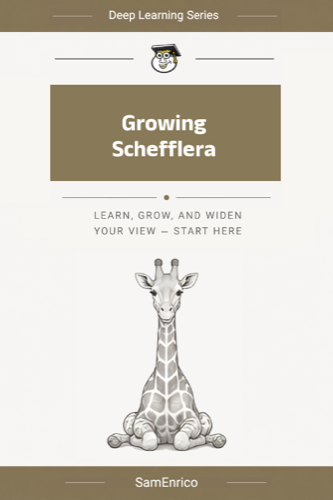
Non-FictionInformativeEducational
Growing Schefflera eBook
This publication, published by SamEnrico, covers G
by Dix Rebbecca
This publication, published by SamEnrico, covers Growing Schefflera
Formats
Free sample
Chapter 1: The Survivor’s Secret--–- Every plant parent remembers the one that got away. The fern that turned to dust despite daily misting. The succulent that melted into brown mush. The fiddle-leaf fig that dropped every single leaf within a month, standing bare as a accusation. For many, these losses add up to a single conclusion: “I don’t have a green thumb.” But here is the truth that the plant industry doesn’t want you to hear: most houseplants are not designed for normal human homes.
They are bred for greenhouses, grown in perfect humidity, and shipped to you already stressed. The problem is rarely you. The problem is the plant.Enter the Schefflera. Known colloquially as the Umbrella Tree or Dwarf Umbrella Plant, this tropical native has earned a reputation that sounds almost mythical among houseplant enthusiasts: it is genuinely hard to kill. Not “hard to kill if you have perfect conditions.” Not “hard to kill if you remember to water on a precise schedule.” Actually, genuinely, stubbornly hard to kill.
This chapter reveals why the Schefflera is different, what makes it resilient, and how understanding its secret can transform you from a plant mourner into a confident grower.The Myth of the Green Thumb The concept of a “green thumb” is one of the most enduring and damaging myths in the gardening world. It suggests that some people possess an innate, almost magical ability to keep plants alive while others are doomed to failure. This is nonsense. What we call a green thumb is simply the accumulated knowledge of what plants actually need versus what we assume they need.Most houseplants fail for one of three reasons: overwatering, insufficient light, or a mismatch between the plant’s natural habitat and the home environment. The Schefflera is uniquely forgiving of all three.
It originates from the tropical rainforests of Taiwan, Hainan, and Australia’s Queensland region, where it grows as an understory plant and a canopy climber. In the wild, it experiences dramatic shifts: heavy monsoon rains followed by dry spells, dappled sunlight filtering through taller trees, and occasional physical damage from falling branches or animals. Over millions of years, it evolved not to avoid these stresses but to survive them.That evolutionary history is your advantage. A Schefflera doesn’t expect perfection. It expects disruption.
And when you provide basic care, it rewards you with vigorous growth, striking umbrella-shaped leaves, and a longevity that can span decades. There are documented Schefflera houseplants that have been passed down through three generations of the same family. That is not luck. That is design.Anatomy of a Survivor: Why the Umbrella Works Before you can grow a Schefflera well, you need to understand what you are looking at. The plant’s most distinctive feature is its leaf structure: long petioles (leaf stems) radiating from a central point, with five to twelve oval leaflets arranged like the ribs of an umbrella.
Each leaflet is glossy, leathery to the touch, and coated with a thin waxy cuticle. This wax is not decorative; it is a survival adaptation that reduces water loss, making the plant more drought-tolerant than thin-leaved species like ferns or calatheas.The leaflets are arranged in a spiral around the stem, a pattern called alternate phyllotaxy. This ensures that each leaf receives maximum light exposure without shading the ones below it. In low-light conditions, the plant will stretch, increasing the distance between leaf nodes (a process called etiolation) to reach for available light. In high light, it stays compact and bushy.
This flexibility means the same plant can adapt to a north-facing bedroom or a bright living room – though extreme ends of the spectrum will affect its appearance.Below the soil, the Schefflera has another secret: a root system that tolerates both drought and occasional flooding. Unlike orchids or succulents, which have very specific root requirements, Schefflera roots can survive dry periods by going dormant and can endure wet periods by using specialized air channels (aerenchyma) that transport oxygen to submerged roots. This does not mean you should drown your plant, but it does mean that a single overwatering or a missed week of watering will not kill it. That margin of error is precisely what makes this plant ideal for beginners and busy people alike.The Two Giants: Understanding the Main Species Most books treat all Scheffleras the same. That is a mistake.
While care requirements overlap significantly, the two dominant species in cultivation have different growth habits, space needs, and long-term care considerations. Knowing which you have – or which you want – will shape everything from pot selection to pruning strategy.Schefflera actinophylla (The Tall Umbrella Tree) is the larger of the two. In its native Australia and New Guinea, it reaches 40 feet or more. Indoors, with proper care and pruning, it typically tops out at 6 to 10 feet – still a statement plant that demands ceiling height. Its leaves are larger and more spread out, with seven to sixteen leaflets per stem.
The growth rate is moderate to fast: under ideal conditions, you can expect 12 to 24 inches of new growth per year. This species wants to become a tree. Left unpruned, it will develop a single woody trunk and a canopy of leaves at the top, exactly like an indoor tree. The cultivar ‘Amate’ is a particularly popular selection of this species, bred for even greater pest resistance and tolerance of lower light conditions.Schefflera arboricola (The Dwarf Umbrella Plant) is the more common houseplant, especially in smaller spaces. It stays naturally compact, reaching 3 to 6 feet indoors.
Its leaflets are smaller, more numerous (seven to nine per stem), and often variegated with cream or yellow margins in cultivars like ‘Gold Capella’ and ‘Green Gold’. The growth rate is slower – 6 to 12 inches per year – and it is much more amenable to pruning and shaping. This is the species used for bonsai, braided trunks, and desktop specimens. It also tolerates lower light than its taller cousin, though variegated forms need more light to maintain their color (a nuance we will explore fully in Chapter 3).Here is a quick comparison for clarity:Feature S. actinophylla (Tall)S.
arboricola (Dwarf)Typical indoor height6-10 feet3-6 feet Annual growth rate12-24 inches6-12 inches Leaflet count per stem7-167-9Leaflet size Large (4-8 inches)Small (2-4 inches)Pruning needs Frequent to control height Moderate, mainly for shape Best for Statement trees, high ceilings Desktops, shelves, bonsai Most big-box stores sell Dwarf varieties almost exclusively because they are easier to ship and fit on retail shelves. If you bought a small Schefflera in a 4-inch or 6-inch pot, you almost certainly have S. arboricola. If you bought a plant already several feet tall with a thick trunk, you likely have S. actinophylla.
But here is the liberating truth: for 95% of care tasks – watering, soil, temperature, humidity, and basic troubleshooting – the two species are identical. The differences matter only for long-term space planning, pruning intensity, and propagation cutting lengths (which we will cover in Chapter 7).Beyond Species: Cultivars That Change the Game Plant breeders have selected and propagated specific Schefflera varieties with enhanced traits. Knowing these can save you years of…
This is the end of the free sample. Get the eBook to keep going. Buy now
About this book
Details
- Author
- Dix Rebbecca
- Publisher
- SamEnrico
- Language
- English
- Genre
- Non-Fiction, Informative, Educational
- Released
- 2026-06-02
- Pages (approx.)
- 144
- Available as
- eBook, Audiobook

Read better in the ZLOADR app
Your eBooks on your phone or tablet. Sign in with your SamEnrico account and start reading.
More by Dix Rebbecca
 Bipolar Parenting GuidebookDix Rebbecca$11.99
 Addressing Blended Family IssuesDix Rebbecca$11.99
 Solution Validation Survey GuideDix Rebbecca$11.99
 Colombian Green Tax GuideDix Rebbecca$11.99
 Intermittent Fasting FAQDix Rebbecca$11.99
 Caffeine Management for StudentsDix Rebbecca$11.99
 The Negative Thought StopperDix Rebbecca$11.99
 TM for LawyersDix Rebbecca$11.99
 HGH And MicrobiomeDix Rebbecca$11.99
 The Last Unknown Tribes: Unveiling New Guinea's Hidden WorldsDix Rebbecca$11.99
 The Ballad of the Greenbrier Ghost: A Love That Defies DeathDix Rebbecca$11.99
 Inanna and the Descent: A Love That Crossed the UnderworldDix Rebbecca$11.99
You may also like
 Hong Kong Handover 1997Dunn Johnnie$11.99
 Zumba For Postnatal Recovery CourseNeal Christian$11.99
 Zumba for BeginnersLadner Nikia$11.99
 YouTube Comment Mining GuideHumes Pandora$12.99
 Worry Box MeditationCarlin Rudy$11.99
 Workplace Stress MeditationNguyen Lynn$11.99
 Workplace Stress and Sleep RepairHawley Ivory$11.99
 Workplace Perfectionism CureDelaney Jeffry$11.99
 Workplace Injustice Anger GuideWallen Isabelle$11.99
 Work Addiction and Burnout LinkGreenwood Ester$11.99
 Women in Yoga and WellnessBeattie Galina$11.99
 Women in Stand Up ComedyChun Evangeline$11.99