
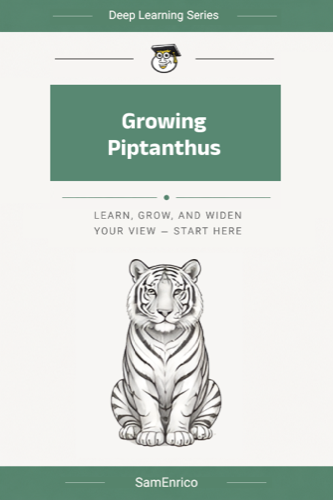
Non-FictionInformativeEducational
Growing Piptanthus Audiobook
This publication, published by SamEnrico, covers G
This publication, published by SamEnrico, covers Growing Piptanthus
Formats
Free sample
Chapter 1: The February Miracle...--–- It is a gray Tuesday in late February. The temperature hovers just above freezing. Rain slicks the pavement. Your garden—if you can still call it that—is a study in melancholy: brown mud, black sticks, and the kind of damp cold that seeps into bones and stays there. You have not seen a flower in four months.
The hydrangeas are skeletons. The roses are thorny sticks. The evergreens are… green, which is fine, but green is not gold.And then, across the garden, you see it.A single shrub, no taller than your waist, is covered in racemes of pure, brilliant yellow. The flowers hang like small lanterns, each one a pea-flower shape in a shade so vivid it seems to glow against the gray sky. You walk closer, drawn by something you cannot name.
The air around the plant smells like vanilla and honey, sweet but not cloying, warm despite the cold. You touch a leaf—it is leathery, evergreen, and when you turn it over, the underside is silver, catching the weak light and holding it. The plant is alive in a way that everything else in February is not.That plant is Piptanthus. And this chapter is about why you need it.I wrote this book because I had that moment. I was a skeptical gardener, burned by too many "easy" shrubs that died, too many "hardy" perennials that melted in the first frost, too many nurseries selling dreams that turned into compost.
I did not believe a plant could flower in February, stay evergreen through winter, smell like a bakery, and ask for almost nothing in return. I was wrong.Piptanthus—known commonly as the Nepal Laburnum or Evergreen Laburnum, though I call it the Golden Bell for reasons that will become obvious—is not a new plant. It has been growing in the shadow of the Himalayas for millennia, discovered by Western botanists in the nineteenth century, and quietly cultivated by collectors ever since. But it has never had its moment. It has never been the plant that garden centers push in spring, never been the subject of glossy magazine spreads, never been the "must-have" shrub of the year.
That is a shame. And it is also an opportunity.This chapter dismantles the myth that Piptanthus is difficult, finicky, or only for experts. I will walk you through exactly…
This is the end of the free sample. Get the Audiobook to keep going. Buy now
About this book
Details
- Author
- Couture Evonne
- Publisher
- SamEnrico
- Language
- English
- Genre
- Non-Fiction, Informative, Educational
- Released
- 2026-06-02
- Pages (approx.)
- 151
- Available as
- eBook, Audiobook

Listen in the VoxFlicks app
Audiobooks and audio dramas wherever you go. Sign in with your SamEnrico account and press play.
More by Couture Evonne
 Parent Imposter Syndrome GuideCouture Evonne$11.99
 The Vatican Counter SiegeCouture Evonne$11.99
 Odebrecht Braskem Enforcement LogCouture Evonne$11.99
 Contract Abstraction Ethics GuideCouture Evonne$11.99
 Diarrhea Success StoriesCouture Evonne$11.99
 Indigenous Spiritual Ecology GuideCouture Evonne$11.99
 Carpool Management GuideCouture Evonne$11.99
 Self Talk For Political GriefCouture Evonne$11.99
 Drunk Person ListeningCouture Evonne$11.99
 The Vanishing Billion: The Untold Story of the Missing Malaysian Flight 370Couture Evonne$11.99
 The Serpent's Crown: The Fall of Queen Tiye and the Amarna ConspiracyCouture Evonne$11.99
 The Last Broadcast: The Night the World Watched Apollo 11 LandCouture Evonne$11.99
You may also like
 Hong Kong Handover 1997Dunn Johnnie$11.99
 Zumba For Postnatal Recovery CourseNeal Christian$11.99
 Zumba for BeginnersLadner Nikia$11.99
 YouTube Comment Mining GuideHumes Pandora$12.99
 Worry Box MeditationCarlin Rudy$11.99
 Workplace Stress MeditationNguyen Lynn$11.99
 Workplace Stress and Sleep RepairHawley Ivory$11.99
 Workplace Perfectionism CureDelaney Jeffry$11.99
 Workplace Injustice Anger GuideWallen Isabelle$11.99
 Work Addiction and Burnout LinkGreenwood Ester$11.99
 Women in Yoga and WellnessBeattie Galina$11.99
 Women in Stand Up ComedyChun Evangeline$11.99