
Non-FictionInformativeEducational
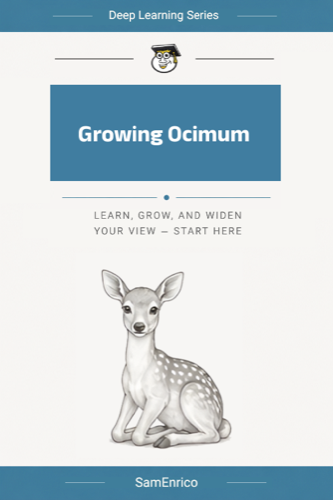
Growing Ocimum
This publication, published by SamEnrico, covers G
by Ramey Elvie
This publication, published by SamEnrico, covers Growing Ocimum
Formats
About this book
Free sample
Chapter 1: The Sacred Leaf...--– The first time I held a basil seedling in my hands, I had no idea I was touching a plant that had been worshipped as a goddess, used as a royal perfume, and fought over by empires. The soil was cool and damp against my palm, the tiny pair of true leaves no larger than a mosquito’s wing, and yet this unassuming herb carried within its cells a story that stretched back thousands of years. That is the paradox of Ocimum—the genus that includes sweet basil, holy basil, lemon basil, and African basil. It is simultaneously the most humble kitchen staple and one of the most revered botanical entities in human history.This book is not merely a how-to manual for growing basil. It is an invitation to understand a plant that has walked alongside humanity from the spice routes of antiquity to the refrigerated shelves of modern supermarkets.
By the time you finish these pages, you will know not only how to germinate a seed and prune a branch, but also why this particular genus has captured our collective imagination, our palates, and our pharmacopoeias.The Genus That Refuses to Be Simple Let us begin with a confession: the taxonomy of Ocimum is a mess. Botanists have argued for centuries over how many species exist, how to distinguish them, and whether certain varieties deserve species status at all. At last count, the genus contains somewhere between 35 and 150 species, depending on which taxonomist you ask. This confusion arises because Ocimum species hybridize easily in the wild and in cultivation, producing a continuous spectrum of forms that blur traditional species boundaries.What we can say with confidence is that all Ocimum species share certain characteristics. They are members of the Lamiaceae family—the mint family—and therefore possess square stems, opposite leaves, and the characteristic two-lipped flowers of their relatives.
They produce aromatic oils in glandular trichomes, the tiny hair-like structures visible on leaf surfaces under magnification. And they are almost all native to the tropical and subtropical regions of Africa, Asia, and Central…
This is the end of the free sample. Get the eBook to keep going. Buy now
Contents
- Chapter 1
- Chapter 2
- Chapter 3
- Chapter 4
- Chapter 5
- Chapter 6
- Chapter 7
- Chapter 8
- Chapter 9
- Chapter 10
- Chapter 11
- Chapter 12
Details
- Author
- Ramey Elvie
- Publisher
- SamEnrico
- Language
- English
- Genre
- Non-Fiction, Informative, Educational
- Released
- 2026-05-09
- Pages (approx.)
- 144
- Available as
- eBook, Audiobook

Read better in the ZLOADR app
Your eBooks on your phone or tablet. Sign in with your SamEnrico account and start reading.
More by Ramey Elvie
 Messner Gasherbrum SoloRamey Elvie$11.99
 Overcoming Workaholism in ExecutivesRamey Elvie$11.99
 The Interruption RetrospectiveRamey Elvie$11.99
 The EQ for Chefs GuideRamey Elvie$11.99
 Menachem Mendel SchneersonRamey Elvie$11.99
 Chiropractic for VertigoRamey Elvie$11.99
 Self Hypnosis For Writing FlowRamey Elvie$11.99
 Twelve Step Prison OutreachRamey Elvie$11.99
 Line of Credit ManagementRamey Elvie$11.99
 The Last Broadcast: How a Radio Show Saved Lives During 9/11Ramey Elvie$11.99
 The Sky Dancer of Takao: Japan's Forgotten Winged PioneerRamey Elvie$11.99
 Paddling the Frozen Frontier: The Antarctic Kayak OdysseyRamey Elvie$11.99
You may also like
 Hong Kong Handover 1997Dunn Johnnie$11.99
 Zumba For Postnatal Recovery CourseNeal Christian$11.99
 Zumba for BeginnersLadner Nikia$11.99
 YouTube Comment Mining GuideHumes Pandora$12.99
 Worry Box MeditationCarlin Rudy$11.99
 Workplace Stress MeditationNguyen Lynn$11.99
 Workplace Stress and Sleep RepairHawley Ivory$11.99
 Workplace Perfectionism CureDelaney Jeffry$11.99
 Workplace Injustice Anger GuideWallen Isabelle$11.99
 Work Addiction and Burnout LinkGreenwood Ester$11.99
 Women in Yoga and WellnessBeattie Galina$11.99
 Women in Stand Up ComedyChun Evangeline$11.99