
Non-FictionInformativeEducational
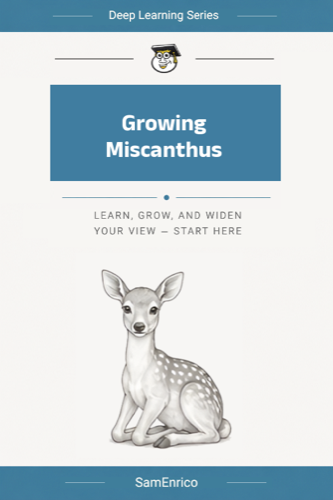
Growing Miscanthus
This publication, published by SamEnrico, covers G
This publication, published by SamEnrico, covers Growing Miscanthus
Formats
About this book
Free sample
Chapter 1: The $20 Billion Grass...--Nobody talks about miscanthus at the county fair. You will see prize-winning pumpkins, blue-ribbon pies, and arguments about the price of corn. You will hear farmers complain about diesel costs, fertilizer prices, and the latest trade war. But you will almost never hear anyone mention the giant grass that could be earning them more money per acre than soybeans, with half the work and a fraction of the chemicals.That silence is not an accident. It is also not a sign that miscanthus is unimportant.
On the contrary, the lack of conversation around this crop is one of the greatest opportunities in modern agriculture. While commodity farmers battle each other over pennies per bushel, a small but growing number of landowners have discovered a perennial crop that delivers reliable income for fifteen to twenty years from a single planting. Some of them are earning carbon credit checks that arrive in the mail each spring, separate from and in addition to their biomass revenue. Others have turned rocky hillsides and flood-prone bottomlands—ground their neighbors called worthless—into steady, bankable cash flow.This chapter is not a botanical lecture. It is not a history lesson for its own sake.
This chapter exists to answer a single question that should be at the front of your mind before you invest a single dollar in rhizomes, fuel, or labor: Why miscanthus, and why now?The answer has three parts, each more compelling than the last. The first part is about money—real, calculable, per-acre returns that compete with or exceed traditional row crops under the right conditions. The second part is about timing: converging trends in energy markets, carbon accounting, and agricultural policy that have created a perfect moment for perennial biomass crops. The third part is about legacy: the chance to leave your land healthier than you found it, with deeper topsoil, cleaner water, and a habitat for wildlife that annual monocultures cannot support.Let us begin with the money, because farmers do not plant crops for poetry.The Unspoken Economics of Low-Input Perennials Consider two adjacent farms in the upper Midwest…
This is the end of the free sample. Get the eBook to keep going. Buy now
Contents
- Chapter 1
- Chapter 2
- Chapter 3
- Chapter 4
- Chapter 5
- Chapter 6
- Chapter 7
- Chapter 8
- Chapter 9
- Chapter 10
- Chapter 11
- Chapter 12
Details
- Author
- Galbraith Cleo
- Publisher
- SamEnrico
- Language
- English
- Genre
- Non-Fiction, Informative, Educational
- Released
- 2026-05-11
- Pages (approx.)
- 139
- Available as
- eBook, Audiobook

Read better in the ZLOADR app
Your eBooks on your phone or tablet. Sign in with your SamEnrico account and start reading.
More by Galbraith Cleo
 Self Esteem for Unpaid InternsGalbraith Cleo$11.99
 House Recurring Dream MeaningsGalbraith Cleo$11.99
 Self Hypnosis for WorryGalbraith Cleo$11.99
 Aging With Purpose WorkbookGalbraith Cleo$11.99
 Healthcare Difficult TalksGalbraith Cleo$11.99
 Antwerp Heist Movie DealGalbraith Cleo$11.99
 The Proptech Capital OutlookGalbraith Cleo$11.99
 The Exhaustion Reset GuideGalbraith Cleo$11.99
 The Campsite Not DisturbedGalbraith Cleo$11.99
 Whispers in the Hypnosphere: The Dream Code of the Ancient EgyptiansGalbraith Cleo$11.99
 Tamerlane's Shadow: The Conqueror Who Shaped the World (1370-1405)Galbraith Cleo$11.99
 Embers of Deception: The Great Chicago Fire ConspiracyGalbraith Cleo$11.99
You may also like
 Hong Kong Handover 1997Dunn Johnnie$11.99
 Zumba For Postnatal Recovery CourseNeal Christian$11.99
 Zumba for BeginnersLadner Nikia$11.99
 YouTube Comment Mining GuideHumes Pandora$12.99
 Worry Box MeditationCarlin Rudy$11.99
 Workplace Stress MeditationNguyen Lynn$11.99
 Workplace Stress and Sleep RepairHawley Ivory$11.99
 Workplace Perfectionism CureDelaney Jeffry$11.99
 Workplace Injustice Anger GuideWallen Isabelle$11.99
 Work Addiction and Burnout LinkGreenwood Ester$11.99
 Women in Yoga and WellnessBeattie Galina$11.99
 Women in Stand Up ComedyChun Evangeline$11.99