
Non-FictionInformativeEducational
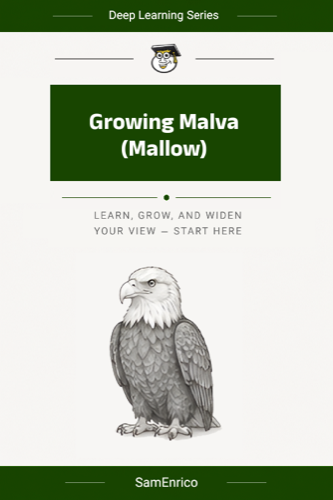
Growing Malva (Mallow)
This publication, published by SamEnrico, covers G
by Greco Rayna
This publication, published by SamEnrico, covers Growing Malva (Mallow)
Formats
About this book
Free sample
Chapter 1: Beyond the Weed Patch...--–- On a humid July morning, I watched a seasoned gardener yank a two-foot-tall mallow from her vegetable bed, muttering about "that damn invasive stuff" as she tossed it onto a compost pile. What she didn't realize was that she had just discarded a plant that could have soothed her persistent summer cough, thickened her evening stew, and provided nectar for the very bees pollinating her tomatoes. That moment—the casual destruction of something useful due to mistaken identity—is precisely why this book exists.For most gardeners, the word "mallow" conjures images of a scrappy, hard-to-kill weed that springs up in driveway cracks and lawn edges. And they are not entirely wrong. One member of the Malva genus, Malva neglecta, has earned its reputation as a persistent nuisance.
But to reduce an entire genus of over 150 species to a single weedy representative is like judging the entire mint family by a patch of ground ivy—a mistake that closes the door on culinary, medicinal, and ornamental possibilities that have sustained human cultures for millennia.This chapter serves as your taxonomic passport to the world of Malva. By the time you finish these pages, you will be able to distinguish at a glance between the weed you should pull, the flower you should plant, and the herb you should harvest. You will understand why one mallow is a garden centerpiece while another is a lawn invader, and you will have a clear decision-making framework for choosing which species belongs in your specific garden context. No confusion. No contradiction.
Just clarity.The Great Mallow Misconception The confusion surrounding mallows begins with a simple botanical fact: they all look somewhat alike. Most members of the Malvaceae family produce round to kidney-shaped leaves with softly hairy surfaces, five-petaled flowers that range from white to deep magenta, and the distinctive flattened seed pods that children call "cheeses" because they resemble tiny wheels of cheese. These shared characteristics make casual identification difficult, and over time, gardeners began treating all mallows as interchangeable—and therefore all mallows as weeds.But this is like…
This is the end of the free sample. Get the eBook to keep going. Buy now
Contents
- Chapter 1
- Chapter 2
- Chapter 3
- Chapter 4
- Chapter 5
- Chapter 6
- Chapter 7
- Chapter 8
- Chapter 9
- Chapter 10
- Chapter 11
- Chapter 12
Details
- Author
- Greco Rayna
- Publisher
- SamEnrico
- Language
- English
- Genre
- Non-Fiction, Informative, Educational
- Released
- 2026-05-25
- Pages (approx.)
- 153
- Available as
- eBook, Audiobook

Read better in the ZLOADR app
Your eBooks on your phone or tablet. Sign in with your SamEnrico account and start reading.
More by Greco Rayna
 Creative Block for ADHDGreco Rayna$11.99
 Active Listening For Trauma SurvivorsGreco Rayna$11.99
 Tennis Injury Prevention GuideGreco Rayna$11.99
 Construction Zone Anger FixGreco Rayna$11.99
 Immigrant Liquor Store To DistributorGreco Rayna$11.99
 Wholesaling CRM Selection GuideGreco Rayna$11.99
 The Shame-Based ParentGreco Rayna$11.99
 Counting Breaths Meditation GuideGreco Rayna$11.99
 Assertiveness At The DentistGreco Rayna$11.99
 The Frozen Hell of Karelia: Finland's Winter War of Survival (1939-1940)Greco Rayna$11.99
 Silent Skies: The Untold Story of the 2014 Malaysia Airlines MH17 DisasterGreco Rayna$11.99
 Echoes of the Velvet Underground: How Lou Reed’s Raw Genius Redefined RockGreco Rayna$11.99
You may also like
 Hong Kong Handover 1997Dunn Johnnie$11.99
 Zumba For Postnatal Recovery CourseNeal Christian$11.99
 Zumba for BeginnersLadner Nikia$11.99
 YouTube Comment Mining GuideHumes Pandora$12.99
 Worry Box MeditationCarlin Rudy$11.99
 Workplace Stress MeditationNguyen Lynn$11.99
 Workplace Stress and Sleep RepairHawley Ivory$11.99
 Workplace Perfectionism CureDelaney Jeffry$11.99
 Workplace Injustice Anger GuideWallen Isabelle$11.99
 Work Addiction and Burnout LinkGreenwood Ester$11.99
 Women in Yoga and WellnessBeattie Galina$11.99
 Women in Stand Up ComedyChun Evangeline$11.99