

Non-FictionInformativeEducational
Growing Dichroa eBook
This publication, published by SamEnrico, covers G
This publication, published by SamEnrico, covers Growing Dichroa
Formats
Free sample
Chapter 1: The Blue Paradox...--Walking through the Jawaharlal Nehru Botanical Garden in Kerala, India, a visiting American gardener once stopped dead in her tracks. Amidst the familiar rhododendrons and camellias, she spotted a shrub that seemed impossible—glossy, deep green leaves that shimmered in the humid air, clusters of starry blue flowers that looked exactly like hydrangeas, and, most astonishingly, metallic blue berries that appeared to have been painted by a jeweler. She touched a leaf. It was real. She touched a berry.
It was firm and glossy. She looked for a plant tag and found none. For the next twenty minutes, she photographed every angle, then spent the next two years trying to identify what she had seen.That gardener was me. And the plant that stopped me cold was Dichroa febrifuga.I tell you this story not because my journey matters, but because yours is about to begin the same way. You will encounter Dichroa somewhere unexpected—a botanical garden, a specialist nursery, a friend's woodland garden—and you will experience what I can only call the Blue Paradox: the simultaneous certainty that you are looking at a hydrangea and the undeniable evidence that you are not.The flowers say hydrangea.
The shape, the clusters, the way the petals arrange themselves into lacy domes—all of it whispers Hydrangea. But hydrangeas do not have glossy, evergreen leaves that persist through winter. Hydrangeas do not produce berries that look like polished lapis lazuli beads. And hydrangeas most certainly do not remain standing as green, flowering, berrying shrubs while their deciduous cousins stand naked and brown beside them.This is the paradox that makes Dichroa the garden's best-kept secret. And this chapter is where we unravel it.What Exactly Is Dichroa?Let us begin with the botanically precise answer, then translate it into gardener's language.Dichroa is a genus of flowering shrubs in the family Hydrangeaceae—the hydrangea family.
It shares this family with Hydrangea (the familiar mopheads and lacecaps), Deutzia, Philadelphus (mock orange), and Carpenteria. Within this family, Dichroa sits close enough to Hydrangea that taxonomists have repeatedly argued about whether the two genera should be merged. In fact, you will still find Dichroa febrifuga listed as Hydrangea febrifuga in older botanical texts and some nurseries. That is not a mistake so much as a fossil of an unresolved debate.But for the gardener, the distinction matters enormously.The genus name Dichroa comes from the Greek words di (two) and chroa (color), referring to the plant's ability to produce flowers and berries of different colors simultaneously. The species name febrifuga means "fever-expelling," a direct reference to its medicinal history, which we will explore later in this chapter.
Versicolor, the other common species, means "changing color," acknowledging its tendency to shift between blue, purple, pink, and white depending on soil chemistry.There are approximately twelve recognized species of Dichroa, but only two are widely available to home gardeners: D. febrifuga and D. versicolor. A handful of cultivars exist, most notably 'Summer Skies', which is deciduous rather than evergreen. (If you are reading this book because you want an evergreen shrub, avoid 'Summer Skies' and stick with the species.)Here is what you need to know upfront about the plant's physical characteristics:Size and Growth Habit: In its native habitat, Dichroa can reach 2 to 4 meters (6 to 13 feet) tall and nearly as wide.
In cultivation, it typically stays on the smaller end of that range—about 6 to 8 feet—unless you live in a subtropical climate with year-round warmth and moisture. The growth habit is upright but not rigid, with branches that arch slightly outward. This gives mature specimens a rounded, full shape that works equally well as a specimen plant or as part of a mixed border.Leaves: The foliage is Dichroa's first giveaway that you are not dealing with a common hydrangea. Leaves are opposite (arranged in pairs along the stem), elliptic to lance-shaped, and range from 5 to 20 centimeters (2 to 8 inches) long. The edges are serrated.
The surface is dark, glossy green on top and lighter green underneath. New growth often emerges with a reddish or bronze tint before maturing to deep green. And crucially—this is the feature that drives many gardeners to seek out Dichroa—the leaves persist through winter. In USDA Zones 8 through 10, your Dichroa will remain fully evergreen. In Zone 7, it may drop some leaves during the coldest winters but will retain enough to provide winter interest.Flowers: The flowers appear in summer, typically June through August depending on your climate.
They are arranged in terminal clusters (corymbs) that measure 8 to 15 centimeters (3 to 6 inches) across. Each individual flower is small—about 1 centimeter—but the clusters contain dozens of flowers, creating a showy display. The petals are typically blue to purple-blue in acidic soil, shifting to pink, lilac, or even white in neutral or alkaline conditions. Unlike hydrangeas, where the showy parts are sterile sepals, Dichroa flowers are all fertile. Each flower has 4 to 6 petals, 10 to 20 stamens, and a central ovary that will eventually become the berry.Berries: This is where Dichroa truly distinguishes itself.
After pollination, the flowers give way to small, fleshy berries that ripen to a stunning metallic blue. These berries are spherical, about 6 to 8 millimeters in diameter, and grow in tight clusters that replace the flowers. They persist on the plant for months—often from late summer through winter—providing color long after most shrubs have gone dormant. The blue is unlike anything else in the garden: deep, saturated, with a subtle sheen that catches light. In my years of growing Dichroa, I have had visitors ask if I painted the berries.
I have not. They are natural.A word of caution: The berries are attractive, but they are not edible. In fact, all parts of Dichroa contain alkaloids that can be toxic if consumed. This plant is strictly ornamental. We will discuss safety in more detail below.Where Dichroa Comes From: The Himalayan Connection Understanding a plant's native habitat is the single most useful thing you can do before growing it.
A plant is not a set of arbitrary requirements. It is a product of millions of years of evolution in a specific place. If you can recreate that place—or at least approximate it—the plant will thrive. Fight against it, and you will spend your gardening life frustrated.Dichroa is native to a broad arc of Asia stretching from the eastern Himalayas through southern China, Taiwan, and into Southeast Asia. Its range includes Nepal, Bhutan, northeastern India, Myanmar, Thailand, Laos, Vietnam, and the Chinese provinces of Yunnan, Sichuan, Guizhou, Guangxi, and Fujian.Within this range, Dichroa grows as an understory shrub in montane forests—that is, forests at medium to high elevations, typically between 500 and 2,500 meters (1,600 to 8,200 feet) above sea level.
These forests are characterized by several consistent features:Cool, moist air. The elevation means temperatures are moderate, rarely extreme. Summer days might reach 25°C (77°F), but nights cool down significantly. The air holds moisture year-round, either from monsoon rains or from cloud cover that lingers in the mountains.Dappled light. As an understory plant, Dichroa grows beneath a canopy of taller trees—oaks, rhododendrons, magnolias, and conifers.
It never receives full, direct sun for the entire day. Instead, it gets filtered light, morning sun, or brief periods…
This is the end of the free sample. Get the eBook to keep going. Buy now
About this book
Details
- Author
- Darnell Raven
- Publisher
- SamEnrico
- Language
- English
- Genre
- Non-Fiction, Informative, Educational
- Released
- 2026-06-02
- Pages (approx.)
- 146
- Available as
- eBook, Audiobook

Read better in the ZLOADR app
Your eBooks on your phone or tablet. Sign in with your SamEnrico account and start reading.
More by Darnell Raven
 Italian American Roots ReunitedDarnell Raven$11.99
 Research Proposal for HumanitiesDarnell Raven$11.99
 Sector HandbookDarnell Raven$11.99
 Seated Body Scan Meditation GuideDarnell Raven$11.99
 Self Esteem for Retired ProfessionalsDarnell Raven$11.99
 Routine Lock In HypnosisDarnell Raven$11.99
 People Pleasing Childhood RootsDarnell Raven$11.99
 Cannabis Tapering GuideDarnell Raven$11.99
 The Visionary Grid: L'Enfant and the Birth of Washington, D.C.Darnell Raven$11.99
 The Silk and Gold Empire: The Visionary Entrepreneurs of the Swahili CoastDarnell Raven$11.99
 Crypto Wallet SecurityDarnell Raven$11.99
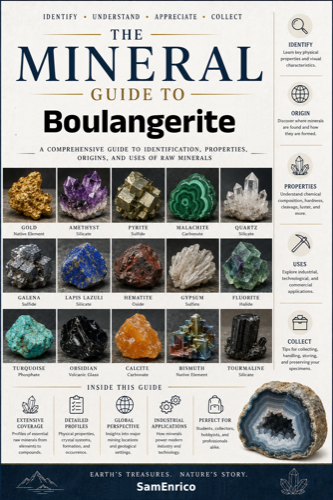 The Mineral Guide to BoulangeriteDarnell Raven$11.99
You may also like
 Hong Kong Handover 1997Dunn Johnnie$11.99
 Zumba For Postnatal Recovery CourseNeal Christian$11.99
 Zumba for BeginnersLadner Nikia$11.99
 YouTube Comment Mining GuideHumes Pandora$12.99
 Worry Box MeditationCarlin Rudy$11.99
 Workplace Stress MeditationNguyen Lynn$11.99
 Workplace Stress and Sleep RepairHawley Ivory$11.99
 Workplace Perfectionism CureDelaney Jeffry$11.99
 Workplace Injustice Anger GuideWallen Isabelle$11.99
 Work Addiction and Burnout LinkGreenwood Ester$11.99
 Women in Yoga and WellnessBeattie Galina$11.99
 Women in Stand Up ComedyChun Evangeline$11.99