
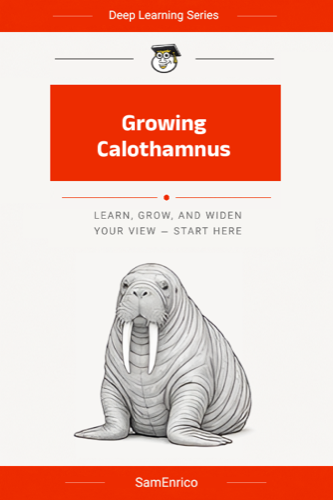
Non-FictionInformativeEducational
Growing Calothamnus eBook
This publication, published by SamEnrico, covers G
This publication, published by SamEnrico, covers Growing Calothamnus
Formats
Free sample
Chapter 1: The Other Bottlebrush--Every garden has its wallflowers—those plants that deserve a starring role but get cast as extras, overshadowed by flashier, more famous relatives. In the world of Australian native shrubs, Calothamnus is the ultimate wallflower. Gardeners know Callistemon, the classic bottlebrush with its cylindrical blooms that explode like red fireworks across suburbs everywhere. But ask those same gardeners about Calothamnus—pronounced kal-oh-THAM-nus—and you will likely receive a blank stare followed by, "Is that some kind of disease?" It is not a disease. It is, in fact, something far more interesting: the one-sided bottlebrush, a genus of Western Australian shrubs that may well be the toughest, most rewarding, and most misunderstood plant you have never grown.This book exists because Calothamnus deserves better.
It deserves a champion. And after decades of growing, killing, resurrecting, propagating, and obsessing over these remarkable plants, I am ready to make the case that Calothamnus should be as common in drought-tolerant gardens as lavender is in cottage gardens. By the time you finish this chapter, you will understand why this overlooked genus is not just a substitute for the common bottlebrush but an improvement upon it in nearly every way that matters to the modern, waterwise gardener.Let us begin with the name itself, because names carry baggage. Calothamnus comes from the Greek kalos (beautiful) and thamnos (shrub). Beautiful shrub.
A fitting description, yet one that undersells the plant's true character. This is not a delicate beauty that demands coddling. It is a survivor, a strategist, an evolutionary masterpiece shaped by millions of years in one of the planet's harshest environments. To understand Calothamnus, you must first understand where it comes from and what it has endured to become the plant sitting in a nursery pot, waiting for you to take it home.The Crucible of South-West Australia Eight hundred kilometers south of the equator, along the southwestern corner of Australia, lies one of the world's thirty-six biodiversity hotspots—a region so rich in unique plant life that botanists have spent centuries cataloging it and still find new species every year. This is the Southwest Australian Floristic Region, home to over eight thousand plant species, nearly half of which exist nowhere else on Earth.
Among these botanical treasures, Calothamnus evolved, diversified, and learned to thrive in conditions that would kill most garden plants within a single summer.What makes this region so punishing? Three things: ancient soil, relentless sun, and a Mediterranean climate that delivers most of its annual rainfall in a few wet winter months before slamming the door shut on precipitation for the rest of the year. The soils here are among the oldest and most nutrient-depleted on the planet. Weathering over millions of years has leached away nearly all available phosphorus, leaving a substrate that is effectively plant starvation rations. Add to this summer temperatures that regularly exceed 40 degrees Celsius (104 degrees Fahrenheit), and you begin to understand the crucible that forged Calothamnus.The plants that survived here did not do so by accident.
They adapted. They evolved mechanisms to extract every possible advantage from the meager resources available. They learned to grow in poor soil, to flower with minimal water, to protect their foliage from scorching sun, and to reproduce even when conditions seemed insurmountable. Calothamnus did all of these things and more. And here is the remarkable truth: those adaptations that allowed it to survive in the wild also make it an almost perfect plant for the modern home gardener—especially one who is tired of watering, fertilizing, and coddaging a garden through increasingly hot, dry summers.What Makes Calothamnus Different: The One-Sided Flower If you look at a Callistemon flower, you will see a cylindrical brush of stamens radiating in all directions—hence the name "bottlebrush." It is a lovely, symmetrical display.
Calothamnus flowers are different, and that difference is the key to understanding the entire genus. Instead of an explosion of stamens in every direction, Calothamnus produces a cluster of stamens that emerge from a single split in the woody floral tube, creating what looks like a claw or a comb. The stamens are arranged on one side of the flower only. Hence the common name: one-sided bottlebrush.Why would a plant evolve such an asymmetrical flower? The answer lies in the birds that pollinate it.
Western Australia is home to a remarkable group of honeyeaters—small, energetic birds with long, curved beaks perfectly designed for probing flowers. The one-sided structure of Calothamnus flowers creates a specific landing trajectory: a honeyeater approaches from the side, inserts its beak into the split, and in doing so, brushes its head against the pollen-bearing anthers. The bird flies to another flower, and the pollen is transferred. This is not guesswork; it is precision engineering refined over millennia.The claw formation has another advantage that matters to gardeners. Because the flowers are not radially symmetrical, they create visual interest from multiple angles.
A Calothamnus shrub in full bloom looks different depending on where you stand. From one side, you see a solid mass of color; from another, you see the architectural structure of the individual flowers. This is not a plant that reveals all its secrets at once. It invites closer inspection. It rewards attention.The Leaves: Needles That Work Run your fingers along a Calothamnus branch, and you will feel why the leaves are described as "acicular"—needle-like.
These are not soft, broad leaves that lose water through transpiration. They are narrow, often sharp, and coated with a waxy cuticle that locks moisture inside. Under a microscope, you would see that the leaves also have sunken stomata—the pores through which plants exchange gases—further reducing water loss. Every aspect of the leaf structure has been optimized for water conservation.This needle-like foliage serves another purpose: deterrence. Most herbivores find the sharp, tough leaves unappetizing.
Kangaroos and wallabies generally pass Calothamnus by. Rabbits think twice. Deer, in gardens where they are a problem, tend to avoid these plants once they have sampled a few and discovered the unpleasant texture. For gardeners tired of watching their shrubs get nibbled down to stubs, this is no small advantage.The foliage color varies by species and growing conditions. Most Calothamnus have deep green to grey-green needles.
Some, like Calothamnus hirsutus, have a soft, hairy coating that gives the foliage a smoky, silvery appearance. Others flush reddish in response to cold or drought stress—a survival mechanism that is also surprisingly beautiful. Do not be alarmed if your plant turns slightly red during a dry spell; it is not dying but adapting.The Woody Capsules: Serotiny and Survival Perhaps the most remarkable feature of Calothamnus—and the one that reveals the most about its evolutionary history—is its seed capsule. After flowering, the plant produces small, woody capsules that remain attached to the branches for years. These capsules are serotinous, meaning they retain their seeds until something triggers their release.
In the wild, that trigger is typically fire or the death of the branch.Think about what this means. The plant holds its seeds in reserve, sometimes for a decade or more, waiting for the right moment to release them. When a bushfire sweeps…
This is the end of the free sample. Get the eBook to keep going. Buy now
About this book
Details
- Author
- Kincaid Isobel
- Publisher
- SamEnrico
- Language
- English
- Genre
- Non-Fiction, Informative, Educational
- Released
- 2026-05-06
- Pages (approx.)
- 138
- Available as
- eBook, Audiobook

Read better in the ZLOADR app
Your eBooks on your phone or tablet. Sign in with your SamEnrico account and start reading.
More by Kincaid Isobel
 Venezuelan Dentist In ChileKincaid Isobel$11.99
 Time Blocking for Apple CalendarKincaid Isobel$11.99
 Political Anger Cognitive ShiftsKincaid Isobel$11.99
 Atomic Habits For Habit Tune UpKincaid Isobel$11.99
 Body Scan Addiction RecoveryKincaid Isobel$11.99
 Himalayan High Pass ExpeditionKincaid Isobel$11.99
 Slow Loss StrategyKincaid Isobel$11.99
 Mnemonic Town Map SystemKincaid Isobel$11.99
 Titian's Venetian Splendor: Painting the Soul of EuropeKincaid Isobel$11.99
 How to Produce an AlkaliKincaid Isobel$11.99
 Student Accommodation TurkeyKincaid Isobel$12.99
 International Franchise Tax GuideKincaid Isobel$12.99
You may also like
 Hong Kong Handover 1997Dunn Johnnie$11.99
 Zumba For Postnatal Recovery CourseNeal Christian$11.99
 Zumba for BeginnersLadner Nikia$11.99
 YouTube Comment Mining GuideHumes Pandora$12.99
 Worry Box MeditationCarlin Rudy$11.99
 Workplace Stress MeditationNguyen Lynn$11.99
 Workplace Stress and Sleep RepairHawley Ivory$11.99
 Workplace Perfectionism CureDelaney Jeffry$11.99
 Workplace Injustice Anger GuideWallen Isabelle$11.99
 Work Addiction and Burnout LinkGreenwood Ester$11.99
 Women in Yoga and WellnessBeattie Galina$11.99
 Women in Stand Up ComedyChun Evangeline$11.99