
Non-FictionInformativeEducational
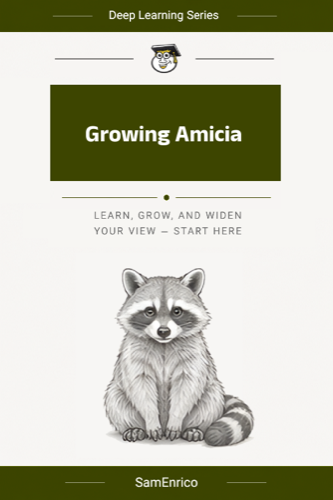
Growing Amicia eBook
This publication, published by SamEnrico, covers G
This publication, published by SamEnrico, covers Growing Amicia
Formats
Free sample
Chapter 1: The Peacock’s Invitation...--The first time you see an Amicia zygomeris in full summer regalia, you might mistake it for a mirage. There, standing in a border of ordinary shrubs and perennials, is a plant that seems to have wandered out of a tropical dream—yet it thrives in a climate that sees frost by November. Its leaves fold like the tail feathers of a resting peacock. Its stipules flutter like velvet butterflies pinned to green stems. And in the slanting light of an autumn afternoon, its yellow-and-purple flowers glow as if lit from within.This is not a plant for the gardener who wants tidy rows of predictable blooms.
This is not a plant for the impatient, the inattentive, or the faint of heart. This is a plant for the obsessed—the collector who measures success not in square footage of manicured lawn but in the quiet triumph of coaxing a rare beauty through its first winter. This is a plant for you, if you are reading these words and already feel a flicker of recognition.I wrote this book because I had to. Not because anyone commissioned it, not because the market demanded it, but because I spent five years killing Amicia before I learned to grow it, and in that time I found no single source that told me the truth. I found blog posts that contradicted one another.
I found forum threads that ended in silence after someone’s plant turned black and died. I found nursery tags with cheerful instructions—“full sun, well-drained soil”—that omitted the critical details that separate triumph from compost.This book is the one I wished I had on the night I stood in my unheated greenhouse with a flashlight, trying to decide whether the shriveled stem in front of me was dormant or dead.Why This Plant? Why Now?Let me answer the question you are already asking yourself: why devote an entire book to a single, obscure shrub from the mountains of Mexico?The short answer is that Amicia zygomeris is a gateway drug. Not to harder horticulture—though that will happen—but to a different way of gardening altogether. Once you have grown a plant that requires you to understand microclimates, to read soil moisture by touch, to anticipate the first frost like a sailor watches a barometer, you will never garden the same way again.
Amicia teaches you to see.The longer answer is that we are living through a golden age of plant discovery and dissemination. Fifty years ago, a shrub like this would have been confined to botanical gardens and the greenhouses of the wealthy. Today, seeds and cuttings circulate through online forums, plant swaps, and specialty nurseries. A gardener in Ohio can grow the same plant that a gardener in Cornwall or Oregon struggles to keep alive. This democratization of rare plants is one of the great untold stories of modern horticulture, and Amicia sits at its center as a perfect emblem: challenging enough to be interesting, achievable enough to be worth the effort.But there is a third answer, more personal.
I grow Amicia because it reminds me that beauty is not always easy. We live in an age of instant gratification, of same-day delivery and one-click purchases. Gardening offers a corrective to that impatience, but even gardening has been streamlined into “proven winners” and “low-maintenance” varieties. There is nothing wrong with those plants—I grow many of them myself—but they do not ask anything of us. Amicia asks.It asks you to notice when the wind shifts.
It asks you to check the soil with your fingers instead of a timer. It asks you to delay pruning until you are certain which wood is dead and which is merely sleeping. In return, it gives you something that no Proven Winner can: the knowledge that you earned this. The flowers in September are not a purchase; they are a conversation between you and a living thing that trusted you to keep it alive through the dark months.That is why this book exists. And that is why you are reading it.A Brief History of an Unlikely Traveler To understand Amicia zygomeris, you must first understand where it came from.
The genus Amicia contains seven recognized species, all native to the highlands of Mexico and Central America. But zygomeris is the star—the only member of its family to have escaped botanical gardens and found its way into the hands of collectors. It was first described in 1838 by the German botanist Diederich Franz Leonhard von Schlechtendal, working from specimens collected in the cloud forests of Veracruz. For more than a century, it remained a curiosity, pressed into herbarium sheets and sketched in botanical monographs that gathered dust.How did it cross the ocean? The records are fragmentary, but the most plausible account traces its introduction to the late Victorian plant hunters who scoured Mexico for orchids, bromeliads, and anything else that would fetch a price at the Chelsea Flower Show.
Unlike many of those treasures, Amicia proved surprisingly adaptable—not to the English winter, but to the English greenhouse. For decades, it lived as a conservatory plant, admired for its foliage but dismissed as too tender for outdoor cultivation.Then, sometime in the 1980s, gardeners began experimenting. They discovered that Amicia planted against a south-facing wall, with sharp drainage and a deep winter mulch, could survive temperatures well below freezing. The top growth would die back, true, but the roots would push up new shoots in spring with surprising vigor. A plant that had been labeled “greenhouse only” suddenly became possible for anyone with a sheltered garden and a willingness to take risks.Today, Amicia zygomeris is still rare—you will not find it at the big-box garden centers—but it is no longer unobtainable.
Specialist nurseries carry it. Online seed exchanges list it. And a small but passionate community of growers trades tips, cuttings, and photographs across continents. This book is my contribution to that community: a comprehensive guide written not by a botanist or a commercial grower, but by a gardener who has made every mistake and lived to tell the tale.What This Book Is (And Is Not)Before we go any further, let me be clear about what you are holding.This book is a monograph—a single-subject deep dive into the cultivation, care, and appreciation of Amicia zygomeris. It is not a general gardening guide.
I will not teach you how to start a compost pile or sharpen your pruning shears, except where those tasks intersect directly with the needs of this plant. There are hundreds of excellent books on those subjects; this is not one of them.This book is opinionated. I have tried plants in ways that failed, and I have found methods that succeed. Where the evidence is ambiguous, I will tell you so. Where I am recommending a specific technique because it has worked for me and dozens of other growers, I will present it as a recommendation, not a commandment.
Your garden is different from mine—different soil, different climate, different microclimates hidden in the corners of your property. What works…
This is the end of the free sample. Get the eBook to keep going. Buy now
About this book
Details
- Author
- Bradley Mable
- Publisher
- SamEnrico
- Language
- English
- Genre
- Non-Fiction, Informative, Educational
- Released
- 2026-05-11
- Pages (approx.)
- 149
- Available as
- eBook, Audiobook

Read better in the ZLOADR app
Your eBooks on your phone or tablet. Sign in with your SamEnrico account and start reading.
More by Bradley Mable
 Addressing A Colleague's HygieneBradley Mable$11.99
 Twelve Step Accessibility for DisabledBradley Mable$11.99
 Corporate Communications to Nonprofit PRBradley Mable$11.99
 Goal Reward System GuideBradley Mable$11.99
 Tim Minchin BioBradley Mable$11.99
 Teen Suicide Loss SupportBradley Mable$11.99
 Sibling Grief After Parent LossBradley Mable$11.99
 Negotiating Signing BonusBradley Mable$11.99
 The Grandeur of Gaudí: Architect of DreamsBradley Mable$11.99
 Kalinga’s Blood: Ashoka’s Last StandBradley Mable$11.99
 How to Produce a World of CommodoreBradley Mable$11.99
 How to Produce Metallized FilmBradley Mable$11.99
You may also like
 Hong Kong Handover 1997Dunn Johnnie$11.99
 Zumba For Postnatal Recovery CourseNeal Christian$11.99
 Zumba for BeginnersLadner Nikia$11.99
 YouTube Comment Mining GuideHumes Pandora$12.99
 Worry Box MeditationCarlin Rudy$11.99
 Workplace Stress MeditationNguyen Lynn$11.99
 Workplace Stress and Sleep RepairHawley Ivory$11.99
 Workplace Perfectionism CureDelaney Jeffry$11.99
 Workplace Injustice Anger GuideWallen Isabelle$11.99
 Work Addiction and Burnout LinkGreenwood Ester$11.99
 Women in Yoga and WellnessBeattie Galina$11.99
 Women in Stand Up ComedyChun Evangeline$11.99