
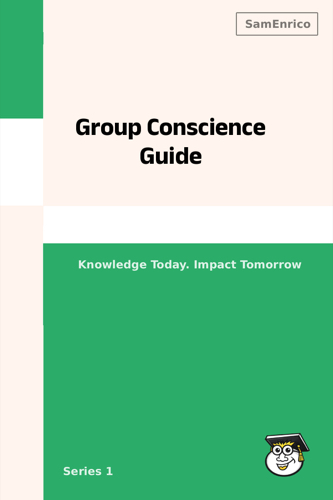
Group Conscience Guide eBook
Navigates business meetings and group decisions.
Navigates business meetings and group decisions.
Formats
Free sample
Chapter 1: The Hidden Tax--Every organization pays a hidden tax. It does not appear on any balance sheet. No auditor has ever flagged it. No shareholder has ever voted on it. And yet, it consumes more value than rent, more energy than payroll, and more time than compliance.
This tax is levied not by governments, but by our own collective dysfunction. It is the tax of meetings that produce no decisions, decisions that produce no action, and actions that produce no results. It is the tax of brilliant people leaving conferences rooms feeling exhausted, empty, and silently certain that the hour they just surrendered to a calendar invitation could have been better spent doing literally anything else.I have seen this tax collected in the boardrooms of Silicon Valley unicorns and the back offices of Midwestern manufacturers. I have watched it drain the life from nonprofit volunteers who genuinely want to change the world but cannot escape the gravitational pull of pointless discussion. I have heard the exhaustion in the voices of nurses, engineers, teachers, and executives—all of them trapped in the same dysfunctional cycle: gather, talk, nod, adjourn, forget, repeat.The purpose of this chapter is to name what you have likely felt but perhaps never articulated.
The purpose is to convince you that the problem is not you, not your team, and not your organization's specific quirks. The problem is the default operating system of human collaboration. And the good news—the reason you are holding this book—is that a better operating system exists.The Conference Room Autopsy Let me describe a scene. I have witnessed this exact scene more than three hundred times across five continents. The details vary, but the architecture never changes.It is 10:02 AM.
The meeting was scheduled for 10:00. Two people are still trickling in, laptops under their arms, apologizing for being "double-booked." The facilitator—usually the most senior person in the room, though no one has explicitly assigned the role—begins without a clear opening ritual. "Alright everyone, let's get started. We've got a lot to cover."The agenda, if one exists, is hidden in an email from five days ago that no one has reopened. The first item is labeled "Q4 planning." Someone projects a spreadsheet with seventeen tabs onto a wall-mounted screen.
The numbers are small. The person in the back cannot read them. No one mentions this.The CEO speaks first. She offers an opinion about the direction of Q4, couched in the language of open inquiry. "I'm just throwing this out there," she says, "but I think we need to be more aggressive on the East Coast." Her words hang in the air.
The regional manager for the East Coast, who has data suggesting that the market there is softening, shifts in his seat. He could speak. He knows he should speak. But the CEO is his boss's boss. He glances at his boss, who is nodding thoughtfully.
The moment for dissent passes.A junior product manager has an idea. It is a genuinely novel idea, one that challenges a core assumption about the company's customer base. She raises her hand tentatively. The CEO acknowledges her with a tight smile. She speaks for forty-five seconds.
When she finishes, there is a pause—not the productive pause of reflection, but the awkward pause of people wondering whether anyone will engage. No one does. The discussion moves on. The junior product manager learns a lesson: novel ideas are not welcomed here. She will not speak again for the rest of the meeting.At 10:47 AM, someone mentions a customer complaint.
The group spirals into a forty-five-minute debate about a single angry email, even though the customer represents less than one percent of revenue. The debate is circular. The same three points are made by the same three people, in the same order, with the same rising frustration. The facilitator does not intervene because the facilitator is also the CEO, and the CEO does not see herself as a facilitator but as a participant who happens to be leading.At 11:45 AM, someone glances at the clock. The meeting was scheduled to end at 11:00.
The last three agenda items are abandoned with a vague promise to "circle back via email." The CEO summarizes: "I think we're aligned on the East Coast push. Let's get a deck together by Friday." No one says that they are not aligned. No one mentions that the East Coast data does not support the push. The junior product manager's novel idea is forgotten entirely.The meeting ends. Twelve people return to their desks, carrying the hidden tax.
They have surrendered ninety minutes of collective time—eighteen person-hours—in exchange for a decision that will need to be unmade in six months, an innovation that was stillborn, and a shared sense that this is simply how work works.It is not how work has to work.The Real Cost of Bad Meetings Let me be precise about the magnitude of the hidden tax. In 2019, before the pandemic disrupted every assumption about how we gather, the consulting firm Doodle published a comprehensive study of meeting effectiveness across Fortune 500 companies. The findings were devastating: the average professional spends 4.5 hours per week in meetings, and of that time, approximately 2.5 hours is rated as "wasted" by the attendees themselves. That is not a rounding error. That is fifty-five percent of all meeting time producing no value.Extrapolate these numbers to the entire US workforce.
Approximately 70 million people work in managerial, professional, and administrative roles—the roles most likely to involve regular meetings. If each of those people wastes 2.5 hours per week at an average loaded salary cost of $60 per hour, the weekly cost of bad meetings exceeds $10 billion. Annually, that sum exceeds $500 billion. To put that number in perspective: it is roughly the entire GDP of Sweden. It is three times the annual budget of the US Department of Education.
It is enough money to give every homeless person in America stable housing for a decade.These numbers are almost too large to comprehend. They invite disbelief. And yet, they are actually conservative. They do not account for the opportunity cost of what those people could have been doing instead—the customers they could have served, the problems they could have solved, the innovations they could have generated. They do not account for the emotional tax of spending your life in rooms that make you feel small, unheard, or irrelevant.
They do not account for the people who leave organizations not because of salary or title, but because they cannot bear one more meeting where their voice does not matter.The hidden tax is real. It is massive. And it is almost entirely invisible to the people who collect it, because they have never experienced an alternative.The Myth of the Born Facilitator When I ask managers why their meetings are dysfunctional, I hear a common refrain: "I'm just not a natural facilitator." This confession carries an implicit assumption: that effective facilitation is a talent, a gift, a personality trait bestowed upon a lucky few and denied to the rest. Some people are born with the magic touch. The rest of us muddle through.This is…
This is the end of the free sample. Get the eBook to keep going. Buy now
About this book
Details
- Author
- Trujillo Waltraud
- Publisher
- SamEnrico
- Language
- English
- Genre
- Non-Fiction, Self-Help, Group Conscience
- Released
- 2026-06-06
- Pages (approx.)
- 137
- Available as
- eBook, Audiobook

Read better in the ZLOADR app
Your eBooks on your phone or tablet. Sign in with your SamEnrico account and start reading.
More by Trujillo Waltraud
 Strength Training For CyclistsTrujillo Waltraud$11.99
 Salmonella Outbreak Recall LogTrujillo Waltraud$11.99
 Eating Disorder Recovery EsteemTrujillo Waltraud$11.99
 Weight Change Relationship GuideTrujillo Waltraud$11.99
 Mindfulness for Beginners with TraumaTrujillo Waltraud$11.99Mindfulness for Beginners with TraumaTrujillo Waltraud$11.99
 AI Deck TranslationTrujillo Waltraud$11.99
 Dream Talk With KidsTrujillo Waltraud$11.99
 Bargaining With God GuideTrujillo Waltraud$11.99
 Fire and Oars: The Byzantine Dromon vs. the Viking LongshipTrujillo Waltraud$11.99
 The Plastic Whisperer: How One Man Turned Trash into TreasureTrujillo Waltraud$11.99
 Understanding Acrofacial Dysostosis, Nager TypeTrujillo Waltraud$17.99