
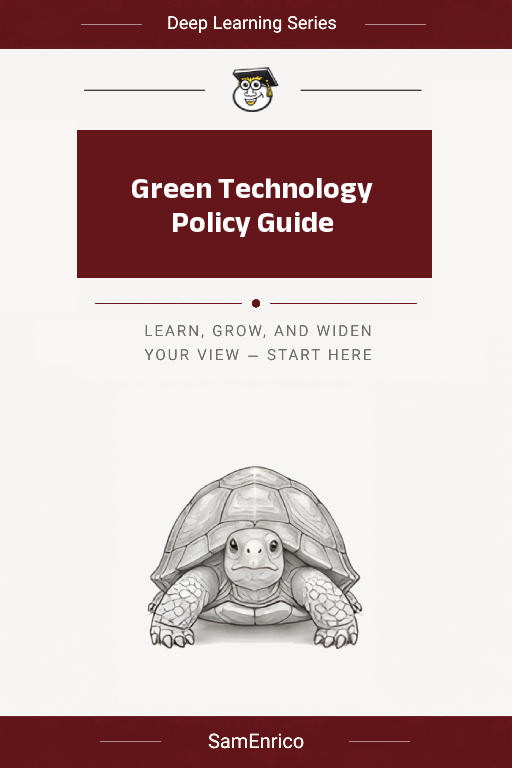
Non-FictionForecast & OutlookClimate Policy
Green Technology Policy Guide
Discover carbon pricing, renewable mandates, and t
by Barba Fidel
Discover carbon pricing, renewable mandates, and technology-neutral incentives shaping sector growth.
Formats
About this book
Free sample
Chapter 1: The Valley of Death--–- In 2017, a small startup called Boston Metal had a working prototype. Their technology—a molten oxide electrolysis cell—could produce steel with zero carbon emissions. No blast furnace. No coke. No CO2.
Just electricity, iron ore, and oxygen as the only byproduct. The science was sound. The lab tests were promising. The climate implications were staggering: steel production accounts for roughly 7 percent of global CO2 emissions, more than the entire nation of India. If Boston Metal succeeded, they would eliminate nearly three billion tons of CO2 annually.No venture capital firm funded them.Not because the technology was flawed.
Not because the team was inexperienced. Not because the market was small—the global steel market is over $1 trillion. Boston Metal fell into what engineers and policy makers call the "valley of death," and it is the single most important concept in green technology policy.The valley of death is the gap between a prototype that works in a laboratory and a product that works at commercial scale. In the lab, you can run an electrolysis cell for 100 hours. At commercial scale, it must run for 100,000 hours.
In the lab, you can use ultrapure feedstocks and have a postdoctoral fellow babysit the equipment. At commercial scale, you need industrial-grade reliability, supply chains, maintenance crews, and—most critically—a customer willing to pay for the first million tons of production.Boston Metal eventually raised $300 million from Bill Gates's Breakthrough Energy Ventures, Arcelor Mittal, and other strategic investors. But notice who funded them: not traditional venture capital, which demands returns in five to seven years, but mission-driven investors willing to wait a decade or more. The valley of death exists because society needs zero-carbon solutions in twenty years (to meet 2050 net-zero targets), but private capital demands returns in five. These timelines do not align.
They have never aligned. And pretending that markets will somehow fix this mismatch is not just naive—it is dangerous.This chapter dismantles the myth that market forces alone will drive sufficient green technology development. It introduces the valley of death as the central obstacle…
This is the end of the free sample. Get the eBook to keep going. Buy now
Contents
- Chapter 1
- Chapter 2
- Chapter 3
- Chapter 4
- Chapter 5
- Chapter 6
- Chapter 7
- Chapter 8
- Chapter 9
- Chapter 10
- Chapter 11
- Chapter 12
Details
- Author
- Barba Fidel
- Publisher
- SamEnrico
- Language
- English
- Genre
- Non-Fiction, Forecast & Outlook, Climate Policy
- Released
- 2026-05-29
- Pages (approx.)
- 153
- Available as
- eBook, Audiobook

Read better in the ZLOADR app
Your eBooks on your phone or tablet. Sign in with your SamEnrico account and start reading.
More by Barba Fidel
 Caregiver Career Gap GuideBarba Fidel$11.99
 The Gut Brain Sleep ConnectionBarba Fidel$11.99
 Resentment After Divorce WorkbookBarba Fidel$11.99
 Body Language for DiplomatsBarba Fidel$11.99
 The Gambling Addiction and Depression GuideBarba Fidel$11.99
 Beanie Babies: The Furious Rise and Fall of a Collectible EmpireBarba Fidel$11.99
 Demand Pattern Auto Learner GuideBarba Fidel$12.99
 Understanding Landy–donnai SyndromeBarba Fidel$17.99
 Boutique SupervisorBarba Fidel$11.99
 How to Start a Stock Car Racing Team BusinessBarba Fidel$11.99
You may also like
 Hong Kong Handover 1997Dunn Johnnie$11.99
 Zumba For Postnatal Recovery CourseNeal Christian$11.99
 Zumba for BeginnersLadner Nikia$11.99
 YouTube Comment Mining GuideHumes Pandora$12.99
 Worry Box MeditationCarlin Rudy$11.99
 Workplace Stress MeditationNguyen Lynn$11.99
 Workplace Stress and Sleep RepairHawley Ivory$11.99
 Workplace Perfectionism CureDelaney Jeffry$11.99
 Workplace Injustice Anger GuideWallen Isabelle$11.99
 Work Addiction and Burnout LinkGreenwood Ester$11.99
 Women in Yoga and WellnessBeattie Galina$11.99
 Women in Stand Up ComedyChun Evangeline$11.99