
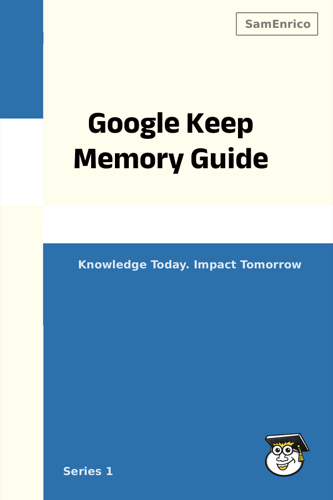
Google Keep Memory Guide eBook
Capture notes, lists, and voice reminders with thi
Capture notes, lists, and voice reminders with this practical digital memory tool.
Formats
Free sample
Chapter 1: The Leaky Bucket--You have already forgotten something today. Not your keys or your phone—something smaller. An idea that arrived in the shower, fully formed and brilliant, now gone. A kind thing you meant to text a friend, lost somewhere between the thought and your thumb. A task your boss asked for “when you have a second,” which you translated in your head to “never.” By the time you finish reading this page, you will forget two more things.
That is not a guess. It is neuroscience.The problem is not that you are lazy, distracted, or undisciplined. The problem is that your brain is a biological machine designed for survival on the savanna, not for managing a calendar full of meetings, a grocery list, three project deadlines, a child’s permission slip, and a brilliant business idea that arrived at 2 AM. Your ancestors needed to remember where the river was and which berries were poisonous. They did not need to remember to buy almond milk, reply to an email from accounting, pick up dry cleaning, and brainstorm a name for that new side hustle—all before lunch.Your brain is leaking.
And willpower cannot patch the hole.The Forgetting Curve: Your Brain Is Not Broken, It’s Working Perfectly In 1885, a German psychologist named Hermann Ebbinghaus did something both tedious and brilliant. He taught himself hundreds of nonsense syllables—meaningless three-letter combinations like “ZOF” and “WUX”—and then tested himself at regular intervals to see how much he had forgotten and when. The result was the Forgetting Curve, one of the most replicated findings in the history of psychology.Here is what Ebbinghaus discovered: within one hour of learning something new, we forget nearly 50 percent of it. Within 24 hours, that number climbs to 70 percent. Within one week, unless we have actively reviewed the information, we remember only about 10 percent of what we originally learned.Let that land.
You lose half of every new piece of information within the time it takes to watch a single episode of a television show. You lose more than two-thirds of it by the next morning. This is not a bug in your brain’s software. It is a feature. Your brain is constantly pruning information that seems irrelevant to your immediate survival.
The problem is that your brain’s definition of “immediately relevant” evolved fifty thousand years ago. A deadline three weeks from now does not register as a survival threat. A brilliant idea for a business you have not started yet does not trigger a dopamine response. Your brain looks at that information and says, “Not urgent. Not dangerous.
Delete.”This is why sticky notes fail. This is why “I’ll remember that” is a lie you tell yourself with complete sincerity every single day. This is why you have stood in the grocery aisle, staring blankly at the shelves, knowing there was something you came for but unable to retrieve it from the fog of your own memory.The Forgetting Curve is not a personal failing. It is universal. It affects everyone from Nobel laureates to kindergarteners.
The difference between people who seem to “have a good memory” and everyone else is not superior biology. It is superior systems.The Myth of the “Good Memory”When people say someone has a “good memory,” they usually mean one of two things. Either the person has a remarkable ability to recall specific facts on demand (the friend who remembers every detail of a conversation from three years ago) or the person rarely forgets to do what they said they would do (the colleague who never misses a deadline). These look like the same skill, but they are not.The first kind—factual recall—is largely genetic and resistant to training. Some people are born with stronger hippocampal function.
Good for them. The rest of us cannot will ourselves into that category any more than we can will ourselves taller.The second kind—task completion and responsibility—has almost nothing to do with memory. It has everything to do with external systems. The colleague who never misses a deadline does not have a better brain. They have a better calendar.
The parent who never forgets to pack the school permission slip does not have a stronger hippocampus. They have a reliable place where permission slips go the moment they come out of the backpack.This distinction is liberating. It means you do not need to become a different person. You do not need to “train your brain” with expensive apps or memory games. You need a system.
You need an External Memory System—a place outside your skull where information lives so your brain does not have to carry it.What Is an External Memory System?An External Memory System is any tool or set of tools that reliably stores, organizes, and retrieves information on your behalf. The oldest external memory system is cave painting. Then came writing. Then the filing cabinet. Then the digital database.
The principle has not changed: put information somewhere trustworthy so you can stop holding it in your head.The best external memory systems share three characteristics:First, they are fast. If it takes longer to log a thought than to think it, you will not use the system. Speed is not a luxury; it is the difference between a habit and a good intention.Second, they are searchable. Information you cannot find might as well not exist. A system that requires you to remember where you put something—which folder, which notebook, which date—has failed.
A system that lets you find anything by typing a word or two has succeeded.Third, they are everywhere. Your memory does not only fail you when you are sitting at your desk. It fails you in the shower, in the car, at the grocery store, in the middle of a conversation. Your external memory system must be available on every device you carry, in every location you inhabit, at every moment a thought arrives.Physical paper fails on all three counts. It is slow (find a pen, find the notebook, write legibly).
It is not searchable (you cannot Ctrl+F a paper notebook). It is not everywhere (the notebook is either in your bag or it is not; there is no third option). Paper is better than nothing, but only barely.Most digital tools fail too. Evernote is powerful but heavy. Apple Notes is fine if you use only Apple devices.
Microsoft One Note is excellent for work but awkward for personal use. What you need is something light, fast, cross-platform, and deeply integrated with the rest of your digital life.What you need is Google Keep.Why Google Keep? A Honest Comparison Let me be clear about what Google Keep is and what it is not. Keep is not Evernote. Evernote is a digital filing cabinet designed to store thousands of long-form notes with rich formatting, attachments, and complex notebooks.
Keep is a digital index card designed to capture quick thoughts, lists, and reminders. Evernote is for storage. Keep is for capture.Keep is not Notion. Notion is a database and project management tool that can become a personal wiki…
This is the end of the free sample. Get the eBook to keep going. Buy now
About this book
Details
- Author
- Werner Tomika
- Publisher
- SamEnrico
- Language
- English
- Genre
- Non-Fiction, Self-Help, Note Taking Apps
- Released
- 2026-06-06
- Pages (approx.)
- 144
- Available as
- eBook, Audiobook

Read better in the ZLOADR app
Your eBooks on your phone or tablet. Sign in with your SamEnrico account and start reading.
More by Werner Tomika
 Mattress and Pillow MeditationWerner Tomika$11.99
 The Governor's Pardon FilesWerner Tomika$11.99
 TM for Evening Wind DownWerner Tomika$11.99
 Sleep Apnea Support GroupsWerner Tomika$11.99
 Cultural Empathy Development GuideWerner Tomika$11.99
 Methanobrevibacter InterpretationWerner Tomika$11.99
 Pomodoro For MeditationWerner Tomika$11.99
 Lee Spike JointWerner Tomika$11.99
 The Iron Architects of Great Zimbabwe: Engineering Marvels of Stone and ShadowWerner Tomika$11.99
 The Last Broadcast: The Night the DJs Played Through the ApocalypseWerner Tomika$11.99
 Hernán Cortés: The Conqueror Who Defied Kings and GodsWerner Tomika$11.99
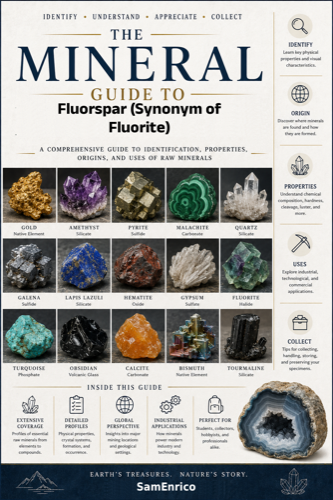 The Mineral Guide to Fluorspar (Synonym of Fluorite)Werner Tomika$11.99