
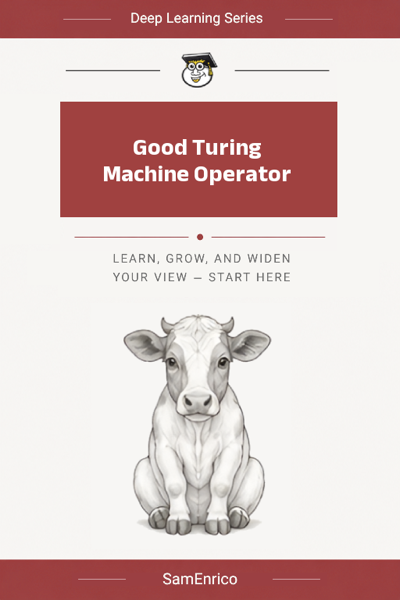
Good Turing Machine Operator
A Coursebook on Good Turing Machine Operator
A Coursebook on Good Turing Machine Operator
Formats
About this book
Free sample
Chapter 1: The Ghost in the Console...--–- The first thing you must understand about a Turing machine is that it has no soul. No intuition. No sense of when it has been spinning its wheels too long. The machine will happily follow an infinite loop until the magnetic drum wears smooth or the vacuum tubes glow white-hot. It will not stop because it is tired, or bored, or because the answer is obviously never coming.
The machine has only one virtue: it does exactly what you tell it to do, nothing more and nothing less. This makes it both the most reliable and the most dangerous tool ever devised by human hands.The year is 1952. You are standing in a room the size of a modest kitchen, surrounded by twenty-seven relay cabinets that hum at a frequency just below human hearing. The air smells of hot metal, ozone from the cooling fans, and the faint acrid tang of heated Bakelite. Before you is a console: a sloped metal panel perhaps three feet wide, covered in switches, neon lamps, and a row of cathode ray tubes that glow a soft green.
This is the Ferranti Mark I, the world's first commercially available stored-program computer. And you are about to become its operator.Your title will be "Turing Machine Operator," though nobody in 1952 uses that phrase. They say "computer" – meaning the human who computes – or "operator" or "the girl" (most operators are women, a legacy of the wartime code-breaking colossi). But the abstract machine that lives inside these cabinets is Turing's machine, exactly as he described it in his 1936 paper "On Computable Numbers." There is an infinite tape (implemented as a spinning magnetic drum holding 4,096 twenty-bit words). There is a read/write head (the playback and record heads that float a hair's breadth above the drum's surface).
There is a finite state machine (the control circuitry that interprets instructions). And there is a human operator – you – who decides when the machine has done enough.This chapter is about the anatomy of that machine. Not the abstract mathematics – we will…
This is the end of the free sample. Get the eBook to keep going. Buy now
Contents
- Chapter 1
- Chapter 2
- Chapter 3
- Chapter 4
- Chapter 5
- Chapter 6
- Chapter 7
- Chapter 8
- Chapter 9
- Chapter 10
- Chapter 11
- Chapter 12
Details
- Author
- Hadden Nannie
- Publisher
- SamEnrico
- Language
- English
- Genre
- Non-Fiction, Informative, Educational
- Released
- 2026-06-02
- Pages (approx.)
- 148
- Available as
- eBook, Audiobook

Read better in the ZLOADR app
Your eBooks on your phone or tablet. Sign in with your SamEnrico account and start reading.
More by Hadden Nannie
 NVC Trainer Certification GuideHadden Nannie$11.99
 Teen Confidence Builder WorkbookHadden Nannie$11.99
 Canva Brand Identity for Cleaning ServicesHadden Nannie$11.99
 The Labeling and Mislabeling AngerHadden Nannie$11.99
 The Silk & Gold Runway: How African Designers Defied Colonial Fashion in the 19th CenturyHadden Nannie$11.99
 Learn to Play the WhistleHadden Nannie$11.99
 AI for Multi-Echelon InventoryHadden Nannie$12.99
 How to Start a Carburettors and Such for All Internal Combustion Engines Business (Beginners Guide)Hadden Nannie$11.99