
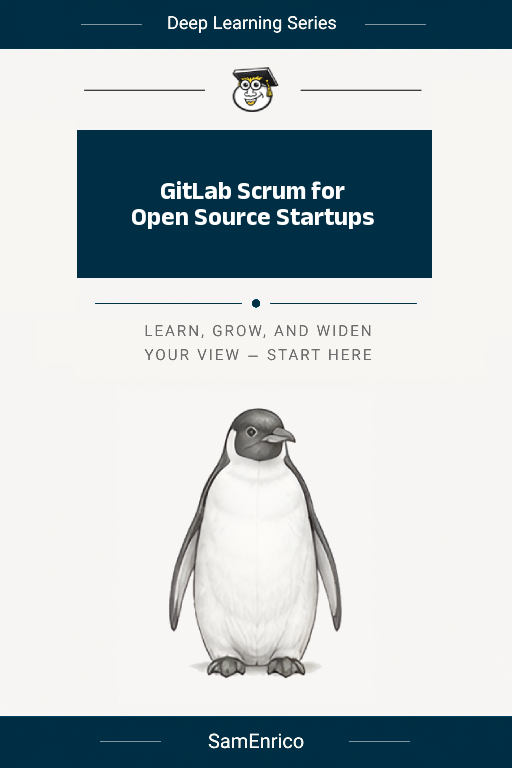
GitLab Scrum for Open Source Startups eBook
Run scrum with public issue trackers using GitLab'
by Lantz Rob
Run scrum with public issue trackers using GitLab's open core model, managing community contributions alongside internal sprints for startup products.
Formats
Free sample
Chapter 1: The $100M Graveyard--–- The first time I saw a startup die from transparency, I was sitting in a boarded-up We Work in downtown San Francisco. The founder, let's call him Derek, had just finished explaining his "perfect Agile implementation" to me. Two-week sprints. Velocity charts. A beautifully manicured JIRA instance that would make any Scrum trainer weep with joy.
His team of 28 engineers had shipped consistently for eighteen months. By every internal metric, Derek was winning.But his company was three weeks from bankruptcy.The problem wasn't his code. The problem wasn't his team. The problem was sitting in a private Slack channel, buried in a folder marked "Q3 Strategy" – his product roadmap. Derek had kept it locked away like a state secret, revealing only morsels to customers who signed non-disclosure agreements and upgraded to the Enterprise plan.
He thought he was being clever. He thought he was creating leverage.What he'd actually created was a tomb.Six months earlier, a two-person open-source project had emerged from nowhere. They had no funding, no sales team, no marketing budget. What they had was a public issue tracker. Every bug, every feature request, every half-baked idea – it was all visible.
Customers who couldn't get Derek's attention flocked to this upstart. They didn't just report bugs; they fixed them. They didn't just request features; they coded them. By the time Derek's team finished their "perfect" internal sprint, the open-source competitor had already merged twenty-three community contributions and shipped four features Derek's customers had been begging for.The startup died. The open-source project lived.
And Derek learned the hard lesson that this book exists to teach you: Hidden roadmaps are a death sentence for modern Saa S startups.The Great Illusion of Private Agile Let me be brutally honest with you. I've consulted for over eighty startups in the past decade. I've seen the full spectrum – from companies that raised nine figures to those that failed before their first paying customer. And in that time, I've identified a single metric that predicts success better than funding, better than team pedigree, better than market size.Public issue tracker activity.That's it. Not velocity.
Not story points. Not burndown charts. The single strongest predictor of long-term survival for a B2B Saa S startup is whether your issue tracker is publicly readable.I know how insane that sounds. I've had CTOs scream at me across conference tables. "You want us to show our competitors our roadmap?
You want customers to see our bugs? Are you out of your mind?"Let me answer that question with another question: How's that working for you?The Myth of Competitive Secrecy The argument for private roadmaps goes something like this: "If we show our plans, competitors will copy us. We need to keep our secret sauce hidden until launch."This sounds reasonable. It is also, in my experience watching hundreds of startups, completely wrong for three reasons.First, your competitors already know what you're building. Not because they have spies (though sometimes they do), but because your customers are talking.
Every frustrated support ticket, every sales call where a prospect says "we need X," every public complaint on Twitter – that's all signal. If you have paying customers, your competitors can infer your roadmap with frightening accuracy just by watching where your customers hurt.Second, your "secret sauce" isn't that secret. I've never seen a startup fail because a competitor copied their feature before they launched. I have seen hundreds of startups fail because they built the wrong feature, or built it poorly, or built it six months after customers needed it. Speed and fit beat secrecy every single time.Third, and most importantly, you're missing the upside.
When you hide your roadmap, you lose the single most valuable resource on earth: your users' brainpower.The Open Source Paradox Here's something that will make your head hurt. The most valuable companies in software – Google, Microsoft, Amazon – all run on open source. Linux powers the internet. Kubernetes runs the cloud. Git Lab itself is built on thousands of open-source dependencies.And yet, most startups still treat their own code and roadmap like nuclear launch codes.The paradox is this: The companies that succeed are the ones that realize their proprietary advantage isn't the code.
It's not even the features. It's the network of contributors who care enough to make the product better.Git Lab understood this earlier than almost anyone. When they started, they could have kept everything closed. They had a working product. They had paying customers.
But instead, they made a bet that would define their trajectory: they opened everything. Not just the code – the roadmap, the handbook, the internal discussions, the mistakes.That bet turned Git Lab into a $10 billion company.The Dual Flywheel: Why Transparency Creates Velocity Let me introduce you to the core framework of this book. I call it the Dual Flywheel, and it's the engine that powers every successful open-core startup I've ever studied.Flywheel One: The Community Contribution Loop Here's how most startups think about open source: "We'll put some code on Git Hub and maybe someone will fix a typo."That's like saying "I'll put a car in my driveway and maybe someone will drive it to work for me."The real community contribution loop has four stages:Discovery – A developer encounters your product. Maybe they're evaluating it for work. Maybe they saw a Hacker News post.
Maybe a friend recommended it. At this moment, they have zero loyalty and infinite skepticism.Examination – They look at your issue tracker. Is it active? Are bugs being fixed? Are community members being treated with respect?
In less than sixty seconds, they've decided if you're worth their time.Contribution – They find something that bothers them. A typo in the docs. A bug that's been sitting for three weeks. A feature they desperately need for their own project. They fix it, or they propose a solution.Reward – Their merge request gets reviewed.
Maybe it's merged. Maybe they get a comment. Maybe – if you're doing it right – they get public credit, a faster review next time, and the feeling that they've made something better.Then the loop repeats. The developer comes back. They bring friends.
They become advocates.This is the flywheel. It doesn't cost you money. It doesn't require a sales team. It just requires that you remove the friction.Flywheel Two: The Internal Agile Loop Meanwhile, your internal team is running its own loop:Grooming – Your product manager looks at the backlog, prioritizes what matters, and prepares for the sprint.Sprinting – Your developers build. Two weeks of focused, uninterrupted work on the most important things.Review – You demo what you've built, get feedback, and adjust.Deploy – Code ships to production.
Customers get value.This is classic Scrum. It works. But here's what most people miss: These two flywheels are not separate.Where Startups Go Wrong The disaster I described at the beginning of this chapter – Derek's startup, the one that went bankrupt – happened because he ran these flywheels in series.His internal team would sprint for two weeks. Then they'd look at community contributions. Then they'd sprint again.
This created a terrible rhythm. Community members would open merge requests and wait fourteen days for a response. By the…
This is the end of the free sample. Get the eBook to keep going. Buy now
About this book
Details
- Author
- Lantz Rob
- Publisher
- SamEnrico
- Language
- English
- Genre
- Non-Fiction, Startup Guide
- Released
- 2026-05-27
- Pages (approx.)
- 135
- Available as
- eBook, Audiobook

Read better in the ZLOADR app
Your eBooks on your phone or tablet. Sign in with your SamEnrico account and start reading.
More by Lantz Rob
 Motocross Self Hypnosis GuideLantz Rob$11.99
 Accountability Partner MorningLantz Rob$11.99
 Emotional Safety GuideLantz Rob$11.99
 Burn Master ReferenceLantz Rob$11.99
 Mute Unfollow Block GuideLantz Rob$11.99
 The Vitamin K GuideLantz Rob$11.99
 Workaholic Anxiety GuideLantz Rob$11.99
 Persuasion For JournalistsLantz Rob$11.99
 The Prescription for Death: Colombia's Express Kidnapping EpidemicLantz Rob$11.99
 Armada: The Storm That Saved EnglandLantz Rob$11.99
 How to Produce Flags, Banners and AccessoriesLantz Rob$11.99
 How to Produce Saxophone Ligatures and CapsLantz Rob$11.99
You may also like
 MongoDB Kanban for Database StartupsZamora Loyd$12.99
 Zoom Kanban for Video StartupsBlair Ida$12.99
 Venture Debt Vs Equity RecapHermann Alba$12.99
 Venture Debt Revenue Based GuideCalloway Sidney$12.99
 Venture Debt Lien Types ExplainedSherrill Marci$12.99
 Venture Debt Interest Rate HedgingRockwell Sherly$12.99
 Venture Debt Intercreditor GuidePomeroy Bernarda$12.99
 Venture Debt for Women FoundersChilders Soon$12.99
 Venture Debt for Hardware StartupsGarris Deonna$12.99
 Venture Debt For Hardware GuideWithers Damian$12.99
 Venture Debt for Climate TechElston Ahmed$12.99
 Venture Debt for Clean TechKearns Candance$12.99