
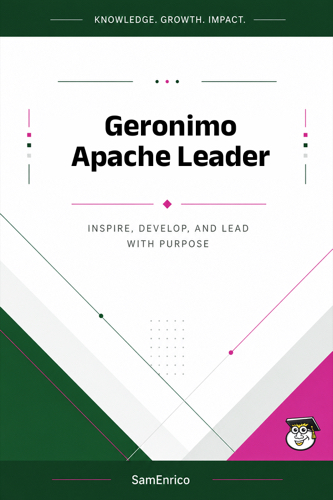
Free sample
Chapter 1: The Willow Branch...--The boy who would become the most feared guerrilla warrior in North American history was not born a warrior. He was not born with a gift for violence, nor did he inherit a crown of leadership. Goyahkla—"One Who Yawns"—entered the world in the late 1820s somewhere along the Gila River, in what is now southwestern New Mexico, and the only thing remarkable about his birth was how utterly unremarkable it was. The Bedonkohe band of the Chiricahua Apache numbered no more than a few hundred souls. They were hunters, foragers, and raiders, living in a landscape that tolerated no weakness.
The mountains of the Gila region are cruel to the soft. They rise in jagged teeth of volcanic rock, cut by canyons that turn to ovens in summer and ice chutes in winter. Water is a secret, hidden in springs known only to those who have walked the same trails for generations. Food is a gamble, won by the arrow or lost to the drought. In this world, childhood was not a time of innocence.
It was a time of apprenticeship.The Apache did not send their children to school. There were no textbooks, no lectures, no certificates of completion. Instead, learning was woven into the fabric of every waking moment. By the time Goyahkla could walk, he was learning to run. By the time he could hold a stick, he was learning to hunt.
The elders of the band did not believe in protecting children from hardship. They believed in exposing them to it early, in small, survivable doses, so that when the true test came—and it always came—the child would not break. This was the Apache way, and it produced some of the most formidable human beings ever to walk the continent.The Secret of the Willow Branch There is a story told among the Chiricahua elders, passed down through generations that were nearly wiped from the earth, about a lesson Goyahkla learned when he was perhaps six years old. His grandfather, Mahko, was teaching him to make arrows. It was meticulous work: straightening the shaft, hafting the point, fletching the feathers with pine resin and sinew.
Goyahkla grew impatient. He wanted to hunt. He wanted to run. He wanted to do anything but sit still and tie feathers to a stick.Mahko noticed the boy's restlessness and said nothing. Instead, he stood up, walked to a nearby stream, and broke a willow branch from a tree growing on the bank.
He handed the branch to Goyahkla and told him to hold it straight out in front of himself. The boy did. Then Mahko took the branch and bent it until the tip touched the base. The wood groaned but did not break. Mahko released it, and the branch snapped back to straight, quivering with stored energy.Mahko then broke a dead branch from the ground.
It was brittle, grey, and dry. He bent it, and it snapped in half with a sharp crack. He threw the broken pieces into the stream. He looked at Goyahkla and said: "You must be like the living willow, not the dead branch. The willow bends in the storm, and when the storm passes, it stands again.
The dead branch refuses to bend, so it breaks. The world will try to break you, Grandson. Do not refuse to bend. Bend, and then snap back."This lesson—the Secret of the Willow Branch—became the foundation of Goyahkla's life. It was not about toughness in the way that white settlers understood toughness.
It was not about clenching your jaw and taking the blow. It was about flexibility, adaptability, and the stubborn refusal to stay bent. The willow bends, but it does not stay bent. It returns to its original shape, unchanged by the storm. This is resilience, and resilience is not the absence of fear or pain.
Resilience is the ability to absorb the blow, yield to it just enough to survive, and then return to yourself when the danger passes.The Brutal Apprenticeship of the Apache Child The lesson of the willow branch was not an abstract philosophy. It was a survival manual written in the language of daily life. Apache children were expected to contribute to the band's survival from the age of four or five. Boys were given small bows, sized for their strength, and told to hunt lizards. This was not play.
It was training. A lizard is fast, alert, and small. To hit a lizard with a child-sized bow, the boy had to learn stealth, patience, and marksmanship. He had to learn to control his breathing, to hold the bow steady, to release at the exact moment between the lizard's movements. If he succeeded, the lizard was roasted and eaten.
If he failed, he went hungry. The lesson was immediate and unforgiving: your skill determines your survival.Girls learned equally demanding skills. They learned to gather mesquite beans, agave hearts, and cactus fruits. They learned to grind corn on a metate for hours without stopping. They learned to cure hides, sew moccasins, and pack a horse for a rapid departure.
In Apache society, there was no division between "combat" and "non-combat" roles in the modern sense. Everyone was a fighter when the moment came. Everyone was a survivor.By the age of eight, Goyahkla was running distances that would exhaust a modern marathon runner. The Apache could sustain a mile-eating trot for twelve to fifteen hours a day. They did not march; they floated across the landscape, conserving energy, placing each foot with deliberate silence.
Goyahkla learned to run barefoot over rock and cactus, to read the ground for the signs of enemy passage, to recognize the difference between the track of a US cavalry horse (shod with iron) and a Mexican rurales horse (often unshod or wearing a different pattern of shoe). These were not esoteric skills. They were the difference between life and death.The Map in the Mind Perhaps the most astonishing skill Goyahkla developed in these early years was his ability to hold a mental map of staggering complexity. The Chiricahua homeland—the Gila, the Sierra Madre, the Chiricahua Mountains themselves—is a labyrinth of canyons, ridges, and hidden water sources. A stranger could wander in circles for weeks and die of thirst within sight of a spring he could not find.
Goyahkla, by the time he was a teenager, knew every spring, every cave, every pass, and every ambush point within a hundred-mile radius. He could be dropped into any canyon in the region and, after a moment of orientation, point to the nearest water source, the nearest escape route, and the nearest location where a horse could be hidden.This mental map was not a gift. It was built, rock by rock, step by step, over years of walking with his elders. His uncles would take him on hunting trips and deliberately lose him, forcing him to find his way back to camp using only the sun, the stars, and the lay of the land. They would hide his water bag and make him locate a spring from the direction of the birds or the…
This is the end of the free sample. Get the eBook to keep going. Buy now
About this book
Details
- Author
- Curley Catalina
- Publisher
- SamEnrico
- Language
- English
- Genre
- Non-Fiction, Biography / Indigenous Rights
- Released
- 2026-06-06
- Pages (approx.)
- 118
- Available as
- eBook, Audiobook

Read better in the ZLOADR app
Your eBooks on your phone or tablet. Sign in with your SamEnrico account and start reading.
More by Curley Catalina
 Asbestos Disturbance PreventionCurley Catalina$11.99
 Remote Work Eye Strain GuideCurley Catalina$11.99
 Parent Birthday GriefCurley Catalina$11.99
 The Retirement Housing Emotional ReadinessCurley Catalina$11.99
 Building Resilience In ChildrenCurley Catalina$11.99
 Burnout Proof Career GuideCurley Catalina$11.99
 Assertive Friendship GuideCurley Catalina$11.99
 The Silent Conquest: How the Silk Road Shaped the Modern WorldCurley Catalina$11.99
 The Hammer of the Steppes: Arpad’s Magyar Onslaught (895 AD)Curley Catalina$11.99
 Service Providers Guide to MicrofarmingCurley Catalina$11.99
 How to Start a Etching for Printing Business (Beginners Guide)Curley Catalina$11.99
 Governing Law ClauseCurley Catalina$12.99
You may also like
 Hong Kong Handover 1997Dunn Johnnie$11.99
 Zumba For Postnatal Recovery CourseNeal Christian$11.99
 Zumba for BeginnersLadner Nikia$11.99
 YouTube Comment Mining GuideHumes Pandora$12.99
 Worry Box MeditationCarlin Rudy$11.99
 Workplace Stress MeditationNguyen Lynn$11.99
 Workplace Stress and Sleep RepairHawley Ivory$11.99
 Workplace Perfectionism CureDelaney Jeffry$11.99
 Workplace Injustice Anger GuideWallen Isabelle$11.99
 Work Addiction and Burnout LinkGreenwood Ester$11.99
 Women in Yoga and WellnessBeattie Galina$11.99
 Women in Stand Up ComedyChun Evangeline$11.99