
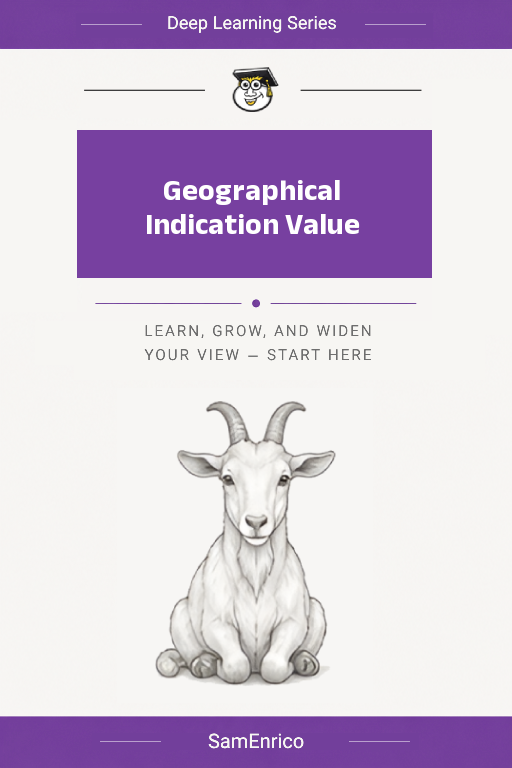
Geographical Indication Value eBook
Values geographical indications as intangible asse
Values geographical indications as intangible assets including collective marks and appellation of origin rights.
Formats
Free sample
Chapter 1: The Name Problem--–- Elena Moretti had never thought of her family’s olive oil as an asset.It was Sunday afternoon in late September, and the crush was two weeks away. The olives on her 1,200 trees – mostly Frantoio and Leccino, some planted by her grandfather in 1962 – were still green but showing the first blush of purple at the tips. Another two weeks of warm days and cool nights, and they would be ready. She had walked these groves every day for twenty-three years, since she was seventeen and her father had handed her the pruning shears and said, “You know which branches to cut. I’ve shown you a hundred times.”She knew.
She had always known.Her father, Vittorio, had learned from his father, who had learned from his father, who had been given the land by the Bishop of Spoleto in 1894 as a wedding gift. The Morettis had been pressing oil in the Valleverde – the Green Valley – for six generations. The valley itself was a narrow cut in the Umbrian hills, running east from Monte Subasio toward the Topino River. The soil was volcanic, rich in potassium, and the afternoon winds from the mountains dropped the humidity just enough to keep fungus away. Every olive oil textbook called this combination – soil, climate, slope, exposure – terroir.
Elena called it home.She did not call it an asset.She did not call it intellectual property. She did not call it a geographical indication, a collective mark, or an appellation of origin. She called it our oil, and when people asked what made it special, she said, “Taste it,” and poured a little into a spoon.That Sunday, after checking the groves, she drove into the town of Montelibero – population 1,402, down from 2,100 in 1970 – to buy bread and cheese at the Coop. The drive was twenty minutes on a road that followed the valley floor, past the abandoned tobacco drying sheds and the one-room schoolhouse that had closed in 1988. The radio played a song she didn’t recognize.
She was thinking about harvest labor costs.She parked outside the Coop, walked past the produce bins (cherry tomatoes from Puglia, lettuce from Lazio, everything trucked in from somewhere else), and turned down the aisle with cooking oil.And stopped.There, on the middle shelf, was a bottle she had never seen before. Dark green glass, 750 milliliters, a label with a stylized olive branch and gold lettering. The brand name was Valleverde.She picked it up. The label said, in Italian and English: “Valleverde Extra Virgin Olive Oil – A product of Turkey.”Her hand tightened around the bottle.She read it again. “Product of Turkey.” And underneath, in smaller type: “Bottled in Greece for Euro-Oli d.o.o., Ljubljana.”There was no mention of Montelibero.
No mention of the Moretti family. No mention of the valley she had walked that morning, whose soil clung to her boots, whose wind had dried her laundry for her entire life.But the name on the bottle was Valleverde.She bought the bottle – €6.90, on sale from €9.90 – and walked back to her car in a daze. She sat in the driver’s seat with the engine off and the bottle in her lap. Her own oil, the one she pressed in October and sold to restaurants in Perugia and Rome and, last year, a tiny shop in Florence, was called Valleverde too. Not officially – not registered, not trademarked, not anything.
It was just what she called it. “Valleverde Olio Extra Vergine,” handwritten on a sticker she printed at home and stuck on bottles she bought from a supplier in Terni.Had she ever said the name out loud? Of course. For six generations, her family had said “the Valleverde oil” to mean the oil that came from this valley. It was not a brand.
It was a description. Like saying “the cheese from the mountain” or “the wine from the south slope.”But now someone else had put it on a bottle. Turkish olives. Greek bottling. Slovenian company.
And somehow, somewhere, they had decided that Valleverde was a name they could use.She called her cousin Marco, who lived in Rome and had gone to university and knew about things like trademarks. He answered on the third ring.“Marco. Can someone just take the name of our valley and put it on olive oil from Turkey?”A pause. “What do you mean, take it?”“I mean I’m holding a bottle. Valleverde.
From Turkey.”Another pause. “Did you register the name?”“What do you mean, register?”“Elena. You can’t just own a place name. You have to register it. As a trademark or a GI or something.
If you didn’t register it, it’s just… words.”“It’s not just words. It’s our valley. Our name.”Marco sighed. She could hear him lighting a cigarette – something he had promised his wife he would stop doing. “Listen.
I’m not a lawyer. But I think you have a problem. Let me ask around.”She drove home with the Turkish bottle on the passenger seat, the glass clinking against her keys. She thought about her father, who had died in 2014, and her grandfather, who had died in 1991, and all the olive oil they had pressed, and all the times they had said “Valleverde” without ever imagining that someone could take it.She thought about the word asset.What Is a Geographical Indication?This book is about that bottle. More precisely, this book is about what that bottle represents: the collision between place, reputation, and law.The name Valleverde – if it were protected – would be what lawyers call a geographical indication (GI).
The World Trade Organization’s Agreement on Trade-Related Aspects of Intellectual Property Rights (TRIPS) defines a GI as “indications which identify a good as originating in the territory of a Member, or a region or locality in that territory, where a given quality, reputation or other characteristic of the good is essentially attributable to its geographical origin.”Let’s unpack that dense sentence.A GI has three essential elements. First, there is a name – a place name, usually, but sometimes a non-geographic name that has become associated with a place (think “Roquefort” for the village of Roquefort-sur-Soulzon). Second, there is a product that comes from that place. Third – and this is the crucial part – the product’s quality, reputation, or other characteristic must be essentially attributable to that place. Not incidentally related.
Not incidentally associated. Essentially attributable.The law uses a French word to capture this essential attribution: terroir.The Concept of Terroir Terroir is one of those words that resists direct translation. It comes from the Latin terra, meaning earth or land. But in the context of geographical indications, terroir means much more than soil. It refers to the unique combination of natural and human factors that gives a product its distinctive character.The natural factors include:Climate: temperature ranges, rainfall patterns, hours of sunlight, wind direction Geology: soil composition, drainage, mineral content, p HTopography: altitude, slope angle, aspect (which direction the land faces)Biology: native yeast strains, microbial communities, local plant and animal varieties The human factors include:Knowledge: traditional cultivation techniques, harvest timing, processing methods Skill: manual techniques…
This is the end of the free sample. Get the eBook to keep going. Buy now
About this book
Details
- Author
- Crandall Francoise
- Publisher
- SamEnrico
- Language
- English
- Genre
- Non-Fiction, Capital & Valuation Register, GI
- Released
- 2026-06-01
- Pages (approx.)
- 138
- Available as
- eBook, Audiobook

Read better in the ZLOADR app
Your eBooks on your phone or tablet. Sign in with your SamEnrico account and start reading.
More by Crandall Francoise
 Talent Acquisition in Regulated IndustriesCrandall Francoise$11.99
 Vendee Counter Revolution Civil War HandbookCrandall Francoise$11.99
 The Assertive Interruption GuideCrandall Francoise$11.99
 Emotional Exposure HierarchyCrandall Francoise$11.99
 The Divorce Financial Recovery GuideCrandall Francoise$11.99
 Mark Clark: The General Who Liberated ItalyCrandall Francoise$11.99
 How to Start a Muslin Weaving Business (Beginners Guide)Crandall Francoise$11.99
 Finance CoordinatorCrandall Francoise$11.99
 1688 Negotiation GuideCrandall Francoise$12.99
 Understanding Syn: Legionnaires' DiseaseCrandall Francoise$17.99