
Non-FictionInformativeEducational
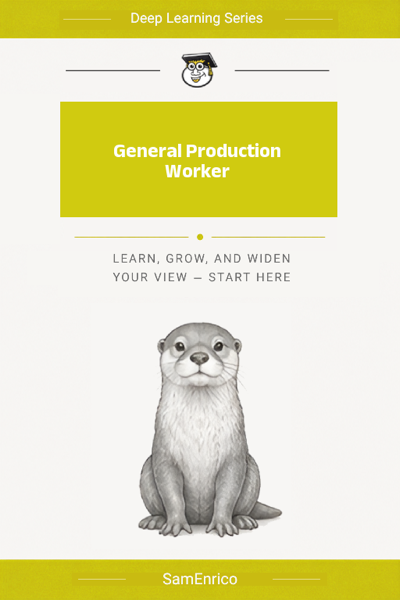
General Production Worker
A Coursebook on General Production Worker
A Coursebook on General Production Worker
Formats
About this book
Free sample
Chapter 1: Beyond the Assembly Line...--The modern production worker is not a cog in a machine. You are the eyes, the ears, and the hands of an intricate, intelligent system that powers the global economy. For decades, the popular image of factory work was one of repetition and anonymity—a worker performing the same single task for eight hours, day after day, on a deafeningly loud assembly line. That image is not only outdated; it is a dangerous misconception. Today, the general production worker is a problem-solver, a data interpreter, a safety enforcer, and a continuous improvement specialist.
You are the first line of defense against defects, the critical observer who notices a subtle vibration before a bearing fails, and the team member who suggests a workflow change that saves the company thousands of dollars. This chapter will redefine your understanding of your own potential, map out the landscape of modern manufacturing, and establish the mindset required not just to survive, but to thrive as a knowledge worker on the shop floor.The Great Shift: From Hands to Heads To understand where you are going, you must first understand where the industry has been. The history of manufacturing can be divided into three distinct revolutions, and we are living through the fourth.The First Industrial Revolution (late 18th century) introduced water and steam power to mechanize production. The Second (late 19th century) brought electricity and the assembly line, most famously perfected by Henry Ford. This was the era of mass production: long runs of identical products, minimal variation, and workers trained to do one highly specific task.
The worker’s value was in physical stamina and speed. Thinking was left to engineers and managers.The Third Industrial Revolution (late 20th century) introduced computers and automation. Programmable Logic Controllers (PLCs) and early robotics began to handle repetitive, dangerous, or precision tasks. The worker’s role shifted to monitoring machines, loading materials, and basic troubleshooting.Now, we are firmly in the Fourth Industrial Revolution, often called Industry 4.0. This is not just incremental improvement; it is a fundamental change.
Industry 4.0 is characterized by the convergence of the physical and digital worlds. Machines are equipped with sensors that measure…
This is the end of the free sample. Get the eBook to keep going. Buy now
Contents
- Chapter 1
- Chapter 2
- Chapter 3
- Chapter 4
- Chapter 5
- Chapter 6
- Chapter 7
- Chapter 8
- Chapter 9
- Chapter 10
- Chapter 11
- Chapter 12
Details
- Author
- Torrence Lucienne
- Publisher
- SamEnrico
- Language
- English
- Genre
- Non-Fiction, Informative, Educational
- Released
- 2026-05-25
- Pages (approx.)
- 132
- Available as
- eBook, Audiobook

Read better in the ZLOADR app
Your eBooks on your phone or tablet. Sign in with your SamEnrico account and start reading.
More by Torrence Lucienne
 Chronic Illness Childhood Self Worth CourseTorrence Lucienne$11.99
 Uber Pro Rewards GuideTorrence Lucienne$11.99
 Latin America Remote Living GuideTorrence Lucienne$11.99
 Breath Awareness for RunnersTorrence Lucienne$11.99
 Posture Priming for ConfidenceTorrence Lucienne$11.99
 The Golden Lyre: Sappho and the Birth of Love PoetryTorrence Lucienne$11.99
 Savings and Investment ReportTorrence Lucienne$12.99
 Non Resident LLC Formation ChecklistTorrence Lucienne$12.99
 How to Become a Last IronerTorrence Lucienne$11.99
 Understanding Lowry–Yong SyndromeTorrence Lucienne$17.99
You may also like
 Hong Kong Handover 1997Dunn Johnnie$11.99
 Zumba For Postnatal Recovery CourseNeal Christian$11.99
 Zumba for BeginnersLadner Nikia$11.99
 YouTube Comment Mining GuideHumes Pandora$12.99
 Worry Box MeditationCarlin Rudy$11.99
 Workplace Stress MeditationNguyen Lynn$11.99
 Workplace Stress and Sleep RepairHawley Ivory$11.99
 Workplace Perfectionism CureDelaney Jeffry$11.99
 Workplace Injustice Anger GuideWallen Isabelle$11.99
 Work Addiction and Burnout LinkGreenwood Ester$11.99
 Women in Yoga and WellnessBeattie Galina$11.99
 Women in Stand Up ComedyChun Evangeline$11.99