
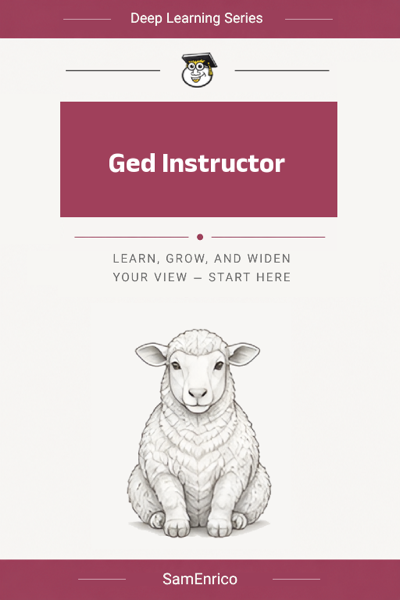
Ged Instructor eBook
A Coursebook on Ged Instructor
A Coursebook on Ged Instructor
Formats
Free sample
Chapter 1: The Gateway Mindset--–- The first time Maria walked into my GED classroom, she sat in the back row with her arms crossed and refused to make eye contact. When I asked what brought her here, she said, “My caseworker said I have to.” That was her only reason. Three weeks later, she stopped coming. I never saw her again.That was my second year as a GED instructor. I had spent hours preparing lessons on subject-verb agreement and solving for x.
I had a perfect pacing guide. My worksheets were color-coded. None of it mattered, because Maria never wanted to be there in the first place. I was teaching content to someone who had not made a psychological commitment to learning. I had failed to address the only question that actually matters before any instruction begins: Why are you here?This chapter is not about lesson plans or curriculum standards.
Those come later. This chapter is about the fundamental shift every GED instructor must make before they teach a single math problem or writing exercise. It is about moving yourself and your students from what I call the Test-Taker Mindset to the Gateway Mindset. The difference between these two mindsets is the single most important predictor of whether your students will persist through difficulty or disappear from your roster after three weeks.Most new GED instructors focus exclusively on content delivery. They worry about covering all four subjects, memorizing the test blueprint, and finding the right textbook.
These are not unimportant concerns, but they are secondary. The primary job of the GED instructor is not to teach math, reading, science, and social studies. The primary job is to teach students why those subjects matter to their actual lives. Until a student sees the GED as a gateway to something they genuinely want—a job, a promotion, college admission, military service, self-respect—you are pushing a rope.The Two Mindsets That Determine Everything Let me define these two mindsets precisely, because the terminology matters for everything that follows in this book.The Test-Taker Mindset is characterized by a narrow, instrumental view of the GED. The student thinks: “I need to memorize enough information to get a passing score.
Once I pass, I never have to think about this material again.” This mindset produces fragile motivation. It works fine when the material is easy or familiar, but it collapses the moment the student encounters difficulty. A student with a Test-Taker Mindset hits fractions and thinks, “This is hard. I must be bad at math. Maybe I should quit.” The test is an obstacle to be endured, not an opportunity to be seized.The Gateway Mindset is fundamentally different.
The student thinks: “This diploma opens specific doors that I want to walk through. Every skill I learn is a tool I will use in my real life.” This mindset produces durable motivation. When this student hits fractions, they think, “This is hard. But I need fractions to pass the test, and I need the test to get that nursing assistant job. Let me try a different way to understand this.” The test is a gateway to a better life, and every piece of content is a key.Here is the critical insight that most GED training programs miss: You cannot assume students arrive with a Gateway Mindset.
In fact, most arrive with the opposite. Many have been sent by caseworkers, parole officers, or family members. Others have failed the test before and see it as a humiliating obstacle. Even those who genuinely want the credential often cannot articulate what they want it for. They know the GED is “good” in some abstract way, but they have not connected it to a concrete, emotionally compelling goal.The instructor’s first job, therefore, is not to teach.
The first job is to convert the mindset. You must systematically move each student from “I have to do this” to “I want to do this because it gets me something I truly want.”The Two Components of Motivation: Intrinsic and Situational Before we go further, I need to clarify something that confuses many instructors. In Chapter 3 of this book, we will explore Malcolm Knowles’ principles of adult learning, including the idea that adults are internally motivated. You might read that chapter and think it contradicts what I am saying here. It does not.
Let me explain the distinction.Intrinsic motivation refers to the deep, life-defining goals that already exist within a student. A student may want to provide for their children, escape poverty, honor a parent’s memory, or prove something to themselves. This motivation is already present. The instructor cannot create it from nothing. But the instructor can uncover it and connect it to the GED.
That is what the diagnostic process in Chapter 4 will teach you to do.Situational motivation refers to the immediate, lesson-by-lesson sense that this specific activity is worth doing. This motivation can be taught. When you show a student how fractions apply to doubling a recipe or calculating a tip, you are creating situational motivation. When you connect a reading passage about workplace safety to a student’s actual job, you are creating situational motivation.Here is the relationship between the two: intrinsic motivation provides the destination (I want a better life for my children). Situational motivation provides the fuel for each leg of the journey (this fractions lesson gets me closer to that destination).
You need both. Chapter 4 will help you uncover intrinsic motivation during intake. This chapter focuses on how to generate situational motivation in your first week of instruction, using career-focused activities that make the GED feel immediately relevant.Why Career Pathways Must Come Before Content I have observed dozens of GED programs over the past decade. The most successful ones share a common practice: they start with careers, not with content. In the first week—sometimes the very first day—students are writing resumes, practicing interviews, researching job requirements, and mapping out educational pathways.
The math and reading come after the student has answered the question, “What am I working toward?”This is counterintuitive to many instructors. Your instinct may be to start with a diagnostic test (Chapter 4) and then jump into content remediation. But research on adult learning, supported by the career development modules referenced throughout this book, shows that adults invest effort in proportion to the perceived value of the outcome. If a student does not know what the GED will get them, they will not persist through the inevitable difficulties of learning.Consider two students. Student A takes a math pretest on day one, scores poorly, and immediately begins a fractions unit because that is what the pacing guide says.
Student B spends day one writing a resume, researching three jobs that require a GED, and calculating the wage difference between a GED and no diploma. Then Student B takes the same math pretest and begins the same fractions unit. Which student is more likely to push through when fractions get hard? Student B, because they have already attached a concrete dollar amount and a specific job title to the act of learning.The career activities in this chapter are not “fluff” or…
This is the end of the free sample. Get the eBook to keep going. Buy now
About this book
Details
- Author
- Irwin Shenita
- Publisher
- SamEnrico
- Language
- English
- Genre
- Non-Fiction, Informative, Educational
- Released
- 2026-05-08
- Pages (approx.)
- 159
- Available as
- eBook, Audiobook

Read better in the ZLOADR app
Your eBooks on your phone or tablet. Sign in with your SamEnrico account and start reading.
More by Irwin Shenita
 Translating Criticism With NVCIrwin Shenita$11.99
 Gacy Last Words TranscriptIrwin Shenita$11.99
 D Day Paratrooper NightIrwin Shenita$11.99
 The Opposite Action DBT SkillIrwin Shenita$11.99
 The Vanishing of the Blue Lake: Australia's First National Park MysteryIrwin Shenita$11.99
 AI Code Smell Detection GuideIrwin Shenita$12.99
 Learn to Play the VuvuzelaIrwin Shenita$11.99
 10 Ways to Use Fennel Seeds (Recipe Book)Irwin Shenita$11.99