
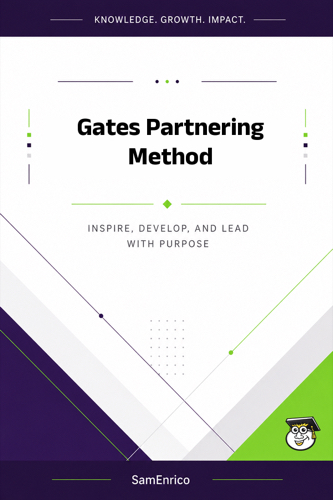
Non-FictionBiographyPartnerships
Gates Partnering Method eBook
Form strategic alliances to outflank competitors.
by Demers Sal
Form strategic alliances to outflank competitors.
Formats
Free sample
Chapter 1: The Lone Wolf Dies--–- The boardroom was silent. Twelve executives sat around a polished mahogany table in a high-rise overlooking San Francisco Bay. On the screen was a forecast that none of them wanted to believe: their company, a once-legendary hardware manufacturer with sixty years of history, was projected to lose thirty percent of its market share within eighteen months. Not because their products had gotten worse. Not because their prices were too high.
But because a competitor they had never considered a threat had quietly assembled a coalition of suppliers, distributors, and software developers that was now strangling their supply chain from three directions simultaneously.The CEO, a man who had built his reputation on turning around failing divisions through sheer internal discipline, asked the question that would haunt him for the rest of his career: "How did they beat us without ever fighting us?"The answer, which no one in that room wanted to hear, is the subject of this book. The competitor had not won through superior technology or deeper pockets. They had won through a method that most executives still misunderstand, mistrust, or simply fail to recognize as a weapon. They had won through strategic alliances. And they had used those alliances not to save money or share risk, but to outflank every competitor in their path.This is the story of how the old rules of competition died.
And this is the manual for the new ones.The Myth of the Self-Sufficient Giant For most of modern industrial history, the dominant logic of business strategy was simple: build moats, scale walls, and grow larger than everyone else. The biggest firm with the most resources, the most patents, and the most vertical integration was supposed to win. Companies like General Electric, IBM in its heyday, and later Apple under Steve Jobs pursued strategies of aggressive internal development, acquiring what they needed and building what they could not acquire. The assumption was that the firm was a fortress, and the goal was to make the fortress impregnable.That logic has collapsed.Consider the evidence. In 1990, the average lifespan of a company on the S&P 500 was sixty-seven years.
By 2020, it had fallen to less than twenty years. By 2030, it is projected to be twelve years. The most valuable companies in the world today—Alphabet, Amazon, Microsoft, Apple—did not achieve their dominance by building everything themselves. They achieved it by orchestrating ecosystems. Apple outsources manufacturing to Foxconn.
Amazon relies on millions of third-party sellers. Microsoft has tens of thousands of certified partners. Even the most resource-rich corporations on the planet have realized that no single organization can control all the capabilities necessary to win in a complex, fast-moving economy.But the evidence goes deeper than the tech sector. In aerospace, Boeing's attempt to build the 787 Dreamliner largely through internal development and traditional contracting led to years of delays and cost overruns. Meanwhile, Airbus, a consortium of competing European aerospace firms, continued to gain market share through a quasi-concentration alliance model.
In automotive, the rise of electric vehicles has been driven not by any single manufacturer but by a web of alliances between battery makers, software firms, charging infrastructure providers, and traditional automakers. Tesla, often celebrated as a lone genius, has strategically partnered with Panasonic for batteries, with multiple states for factory incentives, and with a global network of suppliers for components it does not produce internally.The pattern is unmistakable. The age of the self-sufficient corporation is over. The winners are not the biggest firms. The winners are the firms that build the most effective coalitions.The Printing Press, the Telegraph, and the Shape of Competition To understand why this shift is permanent and not merely a trend, we need to look at the deep history of how competition works.
The economist Carlota Perez has shown that technological revolutions follow a predictable pattern: a disruptive technology emerges, markets become chaotic, and then a new institutional form crystallizes that allows the technology's full potential to be realized.The Gutenberg printing press, invented around 1440, did not immediately transform Europe. For decades, printers operated as isolated craftsmen, each trying to master the entire process of typefounding, printing, binding, and distribution. But the real winners of the printing revolution were not the solo craftsmen. They were the publishers who formed networks of authors, printers, paper suppliers, and booksellers. The Medici family, for example, did not print books.
They financed and orchestrated the entire ecosystem. They understood something that most executives today still struggle with: the firm that controls the network controls the industry.The telegraph in the nineteenth century followed the same pattern. Early telegraph companies tried to own everything: the wires, the stations, the operators, and the message content. That model failed. The successful model was the alliance network: Western Union partnered with railroads for rights-of-way, with newspapers for content, and with banks for financial transmission services.
The firm that tried to go it alone died. The firm that built alliances dominated.The internet has accelerated this dynamic by orders of magnitude. The cost of coordinating across firm boundaries has fallen to near zero. The value of owning physical assets has declined relative to the value of owning relationships and data. In this environment, the firm that tries to build everything internally is not prudent.
It is slow, expensive, and strategically blind.The Alliance Revolution That Most Executives Miss Despite overwhelming evidence that alliances are the primary weapon of modern competition, most executives still treat partnerships as a back-office function. They have a "corporate development" department that does deals. They have a "strategic alliances" group that manages relationships. But they do not treat alliance capability as a core strategic competency on par with product development or marketing.This is a catastrophic error.The data is stark. According to research by Benjamin Gomes-Casseres at Brandeis University, firms that actively manage a portfolio of alliances grow faster, are more profitable, and are more likely to survive industry disruption than firms that do not.
In a study of the computer, pharmaceutical, and automotive industries, he found that the top-performing firms were not those with the most internal R&D spending but those with the most sophisticated alliance networks. The firms that tried to do everything internally consistently underperformed.Consider the rise of the Android ecosystem. Google did not build Android alone. It created an open alliance of handset manufacturers (Samsung, HTC, LG), chipmakers (Qualcomm, Texas Instruments), and carriers (Verizon, T-Mobile, T-Mobile). By forming this coalition, Android was able to outflank Apple's i OS, which was largely a closed, internally-developed system.
Apple's i Phone is a brilliant product. But Android's alliance-based strategy captured eighty percent of the global smartphone market because it mobilized the resources of dozens of firms simultaneously.Or consider the pharmaceutical industry. Drug development is so expensive and risky that no single company can maintain a robust pipeline alone. The winners—firms like Pfizer, Merck, and Novartis—maintain portfolios of hundreds of alliances with biotech startups, university labs, and contract research organizations. The loser is the firm that tries to do everything in-house.The lesson is clear: alliances are not a supplement to your strategy.
They are your strategy.Defining the Gates Method: Asymmetric Advantage Through Partnership This book is called The Gates Partnering Method, and…
This is the end of the free sample. Get the eBook to keep going. Buy now
About this book
Details
- Author
- Demers Sal
- Publisher
- SamEnrico
- Language
- English
- Genre
- Non-Fiction, Biography, Partnerships
- Released
- 2026-06-09
- Pages (approx.)
- 143
- Available as
- eBook, Audiobook

Read better in the ZLOADR app
Your eBooks on your phone or tablet. Sign in with your SamEnrico account and start reading.
More by Demers Sal
 Signal Corps Radio OperatorDemers Sal$11.99
 Comparing Relationship WorkbookDemers Sal$11.99
 TikTok Personal Brand GuideDemers Sal$11.99
 Professional Liability PrimerDemers Sal$11.99
 The Asynchronous Remote Work GuideDemers Sal$11.99
 Visual Working Memory DrillsDemers Sal$11.99
 EQ for Workplace SuccessDemers Sal$11.99
 The Lady of the South China Sea: The Deadly Deception of Chen Man-LiDemers Sal$11.99
 The Kings of the North: How the Vikings Built a Seafaring EmpireDemers Sal$11.99
 How to Produce Finger PaintDemers Sal$11.99
 Last 30 Days JEE Revision GuideDemers Sal$12.99
 Cooperative Succession Planning WorkbookDemers Sal$12.99
You may also like
 Hong Kong Handover 1997Dunn Johnnie$11.99
 Zumba For Postnatal Recovery CourseNeal Christian$11.99
 Zumba for BeginnersLadner Nikia$11.99
 YouTube Comment Mining GuideHumes Pandora$12.99
 Worry Box MeditationCarlin Rudy$11.99
 Workplace Stress MeditationNguyen Lynn$11.99
 Workplace Stress and Sleep RepairHawley Ivory$11.99
 Workplace Perfectionism CureDelaney Jeffry$11.99
 Workplace Injustice Anger GuideWallen Isabelle$11.99
 Work Addiction and Burnout LinkGreenwood Ester$11.99
 Women in Yoga and WellnessBeattie Galina$11.99
 Women in Stand Up ComedyChun Evangeline$11.99