
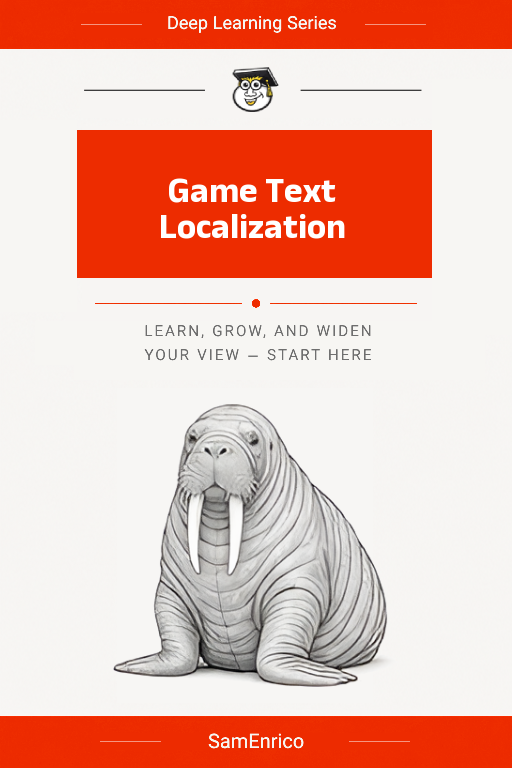
Game Text Localization eBook
Localize game dialogue, UI, and in-game text using
by Reiter Arlie
Localize game dialogue, UI, and in-game text using AI. Manage context, character limits, and voiceover sync for 20+ languages simultaneously.
Formats
Free sample
Chapter 1: The $47 Million Period...–- On a Tuesday morning in March 2023, a senior localization manager named Elena watched her Slack channel explode. A raid boss in her company's flagship MMORPG had spawned twelve hours early. Players in Seoul and Berlin and São Paulo had captured video of the impossible encounter, posted it to You Tube, and within ninety minutes the hashtag #Early Raid was trending on three continents. The bug was traced to a single missing period in a Japanese UI string. A conditional statement had misinterpreted a timezone offset.
Forty-seven million dollars in refunds, cancelled subscriptions, and goodwill later, Elena's team was disbanded. The game survived. Her career did not.This is not a horror story. It is a post-mortem. And it is why you are reading this book.The New Mathematics of Global Gaming Let us begin with a number that will either terrify you or vindicate every argument you have ever made to your production lead: fifty-three percent.
According to the 2024 Global Games Market Report, 53% of all gaming revenue now originates outside English-speaking territories. That is not a rounding error or a niche opportunity. That is the majority of your potential audience, and if you are releasing in English only, you are leaving more than half your money on the table.But the raw percentage tells only part of the story. The distribution matters more. Japan alone accounts for nearly 20billionannuallyingamingrevenue.China,despiteregulatoryheadwinds,contributesanother20 billion annually in gaming revenue.
China, despite regulatory headwinds, contributes another 20billionannuallyingamingrevenue.China,despiteregulatoryheadwinds,contributesanother45 billion. Germany, France, and South Korea each punch well above their weight in per-player spending. When you add Brazil, Mexico, Poland, the UAE, and Turkey, the map of gaming's financial center of gravity looks nothing like the map of English fluency.Here is the uncomfortable truth that keeps localization managers awake at night: the top five non-English languages by gaming revenue—Simplified Chinese, Japanese, Korean, German, and French—represent more spending power than the entire English-speaking market combined when you factor in in-app purchases, battle passes, and cosmetic microtransactions. Players in these markets do not just buy games. They buy seasons, skins, battle passes, and subscriptions at higher average rates than their English-speaking counterparts.Yet most game studios still treat localization as a post-launch patch.
A "we will get to it when we have time" item on the backlog. A cost center rather than a revenue driver.That mindset is how you lose $47 million to a missing period.The Sim-Ship Imperative The industry has a name for the old way: staggered localization. You release in English. You wait six weeks. You release in German and French.
You wait another month. You release in Japanese and Korean. By the time you get to Simplified Chinese, the hype cycle is dead, the streamers have moved on, and your game is yesterday's news.The new standard is Sim-Ship—simultaneous launch across all target languages on day one. And Sim-Ship is not a nice-to-have. It is a competitive necessity.Consider the data from Steam's 2023 year-end review.
Games that launched with full localization into eight or more languages had 210% higher first-week revenue than games that launched with English only and added languages post-launch. The difference was not incremental. It was exponential. Players in non-English markets have been burned too many times by broken translations, missing UI text, and voiceover that switches inexplicably to English halfway through a cutscene. They have learned to wait.
They read reviews. They check forums. And if they see a single screenshot of a placeholder variable—{Error: String not found}—they move on to the next game.Sim-Ship signals competence. It says, "We respect you enough to have prepared for you." And in the modern gaming economy, respect is a currency more valuable than any battle pass.Case Study: The Legend of Zelda and the Rise of Fan Expectations To understand how we arrived at the Sim-Ship imperative, we must first understand how dramatically player expectations have shifted. And there is no better lens than Nintendo's The Legend of Zelda franchise.The Fan-Translation Era (1990s–2000s)When The Legend of Zelda: Ocarina of Time released in 1998, Japanese players had the game for six months before English players saw a single screenshot.
European players waited another three months after that. The concept of "day one" did not exist. You bought the game when it arrived in your language, and you were grateful.Fan translations emerged as a response to this neglect. Passionate volunteers with hex editors and too much free time would rip ROMs, extract text strings, translate line by line, and release patches that ranged from surprisingly professional to hilariously broken. The community was forgiving.
The bar was low.The Staggered Era (2000s–2010s)By the time The Legend of Zelda: Skyward Sword released in 2011, Nintendo had professionalized its localization pipeline. But staggered releases remained the norm. Japan first. North America six weeks later. Europe another month.
Australia whenever. Players in non-English European markets waited up to four months for their language.Forums of the era show a distinct shift in tone. Gratitude gave way to impatience. Impatience gave way to anger. "Why does Germany get the game before France?" "Why is the Japanese voice track locked behind a completion bonus?" The bar was rising.The Sim-Ship Revolution (2020s)When The Legend of Zelda: Tears of the Kingdom launched on May 12, 2023, it did so in nine languages simultaneously.
Japanese, English, French, German, Spanish, Italian, Dutch, Korean, and Simplified Chinese all available on day one. No staggered rollout. No "coming soon." Every player, everywhere, at the same time.The result was not just commercial success—it became the fastest-selling Zelda game in history, moving over 10 million copies in its first three days. But more importantly, the conversation was unified. Streamers in Tokyo and Los Angeles and Berlin were discovering the same secrets at the same time.
The community was not divided by language. It was united by simultaneity.The lesson is clear: fan expectations have shifted from "we hope it gets translated" to "we demand perfect localization at launch." The Zelda franchise evolved over twenty-five years to reach this standard. You do not have twenty-five years. You have one release window.The Hidden Costs of Getting It Wrong Elena's $47 million missing period is dramatic, but it is not the only way localization can destroy value. Let us examine the spectrum of failure, from annoying to existential.Tier 1: The Reputation Leak (Cost: Thousands to Tens of Thousands)This is the "minor" bug that goes viral on Reddit.
A UI button that says "Cancel" in English but "Delete All Progress" in German. A character line translated so literally that it becomes an unintentional joke. These failures do not crater your revenue overnight, but they accumulate. Each one is a tiny cut to your brand's credibility. Enough cuts, and you bleed out.Tier 2: The Support Meltdown (Cost: Hundreds of Thousands)Recall the Hawaii bug mentioned in Chapter 10 of this book.
A placeholder variable—{Error: String not found}—shipped to five million players because a translation memory corrupted the source key. The result was not a funny meme. It was seventy thousand support tickets in seventy-two hours. The studio's support costs for that week exceeded…
This is the end of the free sample. Get the eBook to keep going. Buy now
About this book
Details
- Author
- Reiter Arlie
- Publisher
- SamEnrico
- Language
- English
- Genre
- Non-Fiction, AI Operator
- Released
- 2026-05-29
- Pages (approx.)
- 144
- Available as
- eBook, Audiobook

Read better in the ZLOADR app
Your eBooks on your phone or tablet. Sign in with your SamEnrico account and start reading.
More by Reiter Arlie
 British Spitfire Pilot LogReiter Arlie$11.99
 Body Scan for HospitalizedReiter Arlie$11.99
 Stress and LGBTQ RelationshipsReiter Arlie$11.99
 EQ for Anxiety DisordersReiter Arlie$11.99
 Dancing with Nature: The Visionary Gardens of Joseph PaxtonReiter Arlie$11.99
 Call Center ManagerReiter Arlie$11.99
 How to Produce Body OilReiter Arlie$11.99
 How to Become a Hide PullerReiter Arlie$11.99
You may also like
 AI Presentation WorkbookSommers Tonda$11.99
 PowerPoint Copilot MasteryConway Lanita$11.99
 Branded AI DecksWindham Loni$11.99
 AI Presentation CourseGrooms Olin$11.99
 AI Presentation CertificationBlank Dolly$11.99
 AI Deck Version ControlMedley Lorina$11.99
 AI Deck Update AutomationFraser Tresa$11.99
 AI Deck Myths DebunkedCrittenden Romelia$11.99
 AI Deck Customization GuideDove Hannelore$11.99
 AI Bullet to Slide ConverterKohn Eloisa$11.99
 AI Deck Notes CreatorBarela Sunday$11.99
 AI Deck Outline GeneratorAshmore Morgan$11.99