
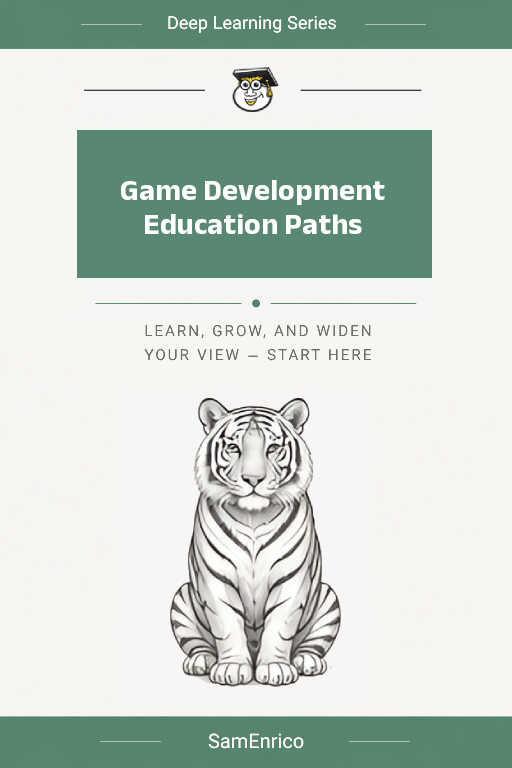
Non-FictionStudent's ShortcutGame DevelopmentStudio Careers
Game Development Education Paths eBook
Compare game design bootcamps and CS degrees for r
Compare game design bootcamps and CS degrees for roles at studios like Ubisoft Nintendo and indie success.
Formats
Free sample
Chapter 1: The Fun Loop...–- In the summer of 2015, a 22-year-old computer science graduate named Maya sat in a cramped San Francisco apartment, staring at a rejection email from Electronic Arts. She had perfect grades, a four-year degree from a reputable university, and a portfolio filled with technical demos she had spent hundreds of hours building. The rejection letter was polite, generic, and utterly crushing. Three thousand miles away, in a basement studio in Michigan, a 19-year-old high school dropout named Derek uploaded his first complete game to itch.io. It was a messy, unpolished platformer about a depressed robot.
It had no tutorial, no save system, and a game-breaking bug on level four. Within two weeks, it had been downloaded forty thousand times. A producer from Devolver Digital sent him a direct message on Twitter.The question that haunts every aspiring game developer is not "Can I code?" or "Do I have good ideas?" The question is far more fundamental, and far more terrifying: Why do people play games at all? And if you cannot answer that question with genuine insight, no degree, no bootcamp, and no amount of technical skill will save you.This chapter is not about education paths. It is not about CS degrees versus bootcamps.
It is not about Unity versus Unreal, or C++ versus C#, or any of the other surface-level debates that dominate online forums. This chapter is about the single most important concept in game development, the concept that separates the games you remember from the games you delete after five minutes. That concept is fun. And despite what you have been told, fun is not subjective. Fun is not mysterious.
Fun is not something you stumble upon by accident. Fun is a neurochemical process, a pattern recognition engine running inside three pounds of electrified meat inside your skull, and once you understand how that engine works, you can build games that feel inevitable, addictive, and unforgettable.The Neurochemistry of Why We Play Before you write a single line of code, before you open Unity or Unreal or Godot, before you decide whether to enroll in a four-year CS program or a twelve-week bootcamp, you need to understand what happens inside a player's brain when they engage with your game. This is not optional. This is not "nice to know." This is the foundation upon which every successful game is built, from the simplest mobile puzzle game to the most sprawling open-world RPG.When a player picks up a controller, touches a screen, or sits down at a keyboard, their brain enters a state of active prediction. The brain is, at its core, a prediction engine.
Every waking moment, it is running simulations: If I press this button, what will happen? If I jump now, will I clear that gap? If I attack from this angle, will the enemy fall? When the brain's prediction matches reality, nothing interesting happens. You expected the jump to land, and it did.
The brain files that away as "correct" and moves on.But when the brain's prediction is wrong in a specific way, something remarkable occurs. The brain releases a small pulse of dopamine. Not the massive flood associated with drugs or gambling, but a precisely calibrated squirt of neurochemical reward that feels like a tiny "aha!" The brain learns. It updates its internal model of the game world. It says, Okay, I didn't expect that to work, but now I know.
Next time, I will do that again. That tiny reward, delivered hundreds of times per play session, is the engine of engagement. That is fun.Raph Koster, the legendary game designer behind Ultima Online and Star Wars Galaxies, codified this insight in his seminal book A Theory of Fun for Game Design. Koster's argument is deceptively simple: Fun is the brain's reward for learning. Every time you master a pattern, solve a puzzle, or internalize a new mechanic, your brain gives you a little hit of pleasure.
Games are literally learning engines disguised as entertainment. The best games are the ones that teach you something new at exactly the right pace, never so fast that you get frustrated and never so slow that you get bored.This explains why babies spend hours dropping spoons off high chairs. It explains why teenagers spend hundreds of hours mastering Street Fighter combos. It explains why adults spend thousands of hours optimizing factory layouts in Factorio. In every case, the brain is doing the same thing: learning a pattern, receiving a reward, and demanding more.The Two Faces of Game Design: Math and Magic Here is where the education debate enters the picture.
A computer science student and a bootcamp student approach the same design problem from radically different angles, and understanding both angles is essential if you want to build games that people actually enjoy.Consider the humble jump mechanic. Every platformer has one. Every action game uses it. But ask a CS student to implement a jump, and they will likely start with the physics. They will talk about velocity, gravity, acceleration, and framerate independence.
They will write a function that takes the player's current position, applies a parabolic arc based on Newtonian physics, and ensures that the jump height is consistent regardless of whether the game is running at thirty frames per second or three hundred. They will optimize the memory allocation so the jump state doesn't create garbage collection spikes. They will write unit tests to ensure that the jump behaves identically on every platform. Their jump will be mathematically perfect, technically flawless, and utterly lifeless.Now ask a bootcamp student to implement the same jump. They will start with a prototype, a rough approximation using simple arithmetic.
They will play it, feel it, and immediately notice that it feels "floaty" or "heavy" or "wrong." They will add a squash-and-stretch animation on the character sprite during the ascent. They will add a small screen shake on landing. They will add a satisfying "whoosh" sound effect that plays at the apex of the jump. They will adjust the gravity curve so the character hangs in the air slightly longer than real physics would allow, because that feels more responsive. Their jump will be sloppy under the hood, potentially buggy on different framerates, and absolutely delightful to use.Which jump is better?
The answer, of course, is both. The perfect game requires the mathematical precision of the CS student and the tactile responsiveness of the bootcamp student. This is the central tension that runs through every aspect of game development. Depth without feel is sterile. Feel without depth is brittle.Jesse Schell, the Carnegie Mellon professor and author of The Art of Game Design, calls this tension the "Lens of Essential Experience." In his framework, you constantly ask yourself: What experience am I trying to create for the player?
What does that experience feel like? And what systems, mechanics, and content will reliably produce that feeling? The lens forces you to think simultaneously about the emotional destination and the mechanical path. You cannot design the feeling without understanding the systems that create it. And you cannot build the systems without understanding the feeling they are supposed…
This is the end of the free sample. Get the eBook to keep going. Buy now
About this book
Details
- Author
- Wilburn Allegra
- Publisher
- SamEnrico
- Language
- English
- Genre
- Non-Fiction, Student's Shortcut, Game Development, Studio Careers
- Released
- 2026-05-30
- Pages (approx.)
- 141
- Available as
- eBook, Audiobook

Read better in the ZLOADR app
Your eBooks on your phone or tablet. Sign in with your SamEnrico account and start reading.
More by Wilburn Allegra
 Celebratory Speech Anxiety GuideWilburn Allegra$11.99
 Growth Hormone Cycling ProtocolWilburn Allegra$11.99
 Self Hypnosis for GratitudeWilburn Allegra$11.99
 The Parent Mindfulness PracticeWilburn Allegra$11.99
 AI Voiceover Timing and PacingWilburn Allegra$11.99
 The Last Voyage of the SS America: A Titanic of the DeepWilburn Allegra$11.99
 Echoes of the Forgotten: The Last Voyage of the SS Andrea DoriaWilburn Allegra$11.99
 Inventory Control LeadWilburn Allegra$11.99
 How to Become a Scale OperatorWilburn Allegra$11.99
 Ecommerce Carbon Footprint OutlookWilburn Allegra$12.99
 Understanding Breast CancerWilburn Allegra$17.99
You may also like
 Hong Kong Handover 1997Dunn Johnnie$11.99
 Zumba For Postnatal Recovery CourseNeal Christian$11.99
 Zumba for BeginnersLadner Nikia$11.99
 YouTube Comment Mining GuideHumes Pandora$12.99
 Worry Box MeditationCarlin Rudy$11.99
 Workplace Stress MeditationNguyen Lynn$11.99
 Workplace Stress and Sleep RepairHawley Ivory$11.99
 Workplace Perfectionism CureDelaney Jeffry$11.99
 Workplace Injustice Anger GuideWallen Isabelle$11.99
 Work Addiction and Burnout LinkGreenwood Ester$11.99
 Women in Yoga and WellnessBeattie Galina$11.99
 Women in Stand Up ComedyChun Evangeline$11.99