
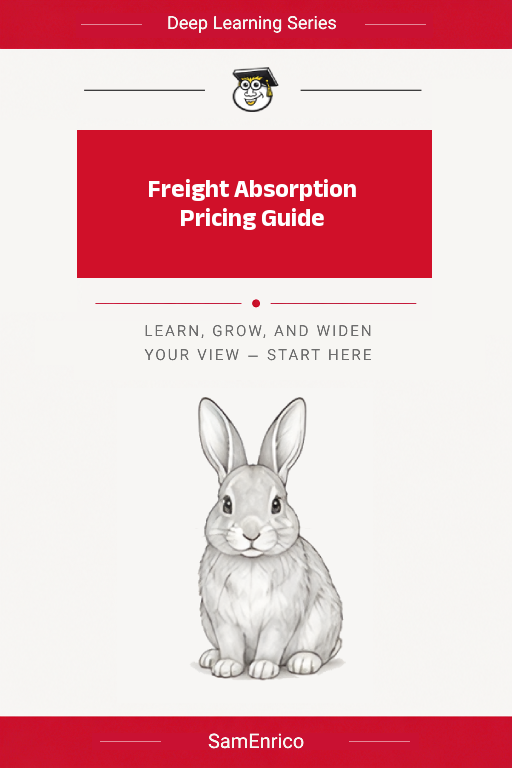
Non-FictionBusiness BriefShipping Strategy
Freight Absorption Pricing Guide eBook
Absorb shipping costs while raising product prices
by Simon Penny
Absorb shipping costs while raising product prices to make inflation driven total seem lower to customers.
Formats
Free sample
Chapter 1: The Anchor That Sank...--The first price a customer sees is the only price that matters. Everything after that is just noise, friction, and—if you are not careful—a reason to leave.This is not an opinion. It is a neurological fact. When the human brain evaluates a purchase, it locks onto the first number it encounters with the tenacity of a drowning man gripping a lifeline. That number becomes the anchor.
Every subsequent cost—taxes, fees, handling, and yes, shipping—is judged against that anchor. If the anchor is low, everything added feels like a violation. If the anchor is strategically set, the additions become invisible.This chapter will introduce the single most important psychological mechanism in freight absorption pricing: cognitive anchoring. You will learn why customers remember the product price and forget the total, how the "pain of paying" works in the brain, and why traditional e-commerce advice about partitioned pricing (29.99+29.99 + 29.99+5 shipping) is dangerously incomplete. Most importantly, you will learn the critical caveat that separates successful absorption strategies from catastrophic failures: this approach is not for every customer.
By the end of this chapter, you will understand who benefits from absorption, who will punish you for it, and how to avoid the most common mistake that destroys conversion rates overnight.The Anatomy of an Anchor Let us begin with a simple experiment that has been replicated in dozens of pricing studies over the past two decades. Researchers showed two groups of consumers the exact same product—a standard kitchen blender—with two different price presentations. Group A saw the blender priced at 39.99withaseparate39.99 with a separate 39.99withaseparate9.99 shipping fee, for a total of 49.98.Group Bsawthesameblenderpricedat49.98. Group B saw the same blender priced at 49.98.Group Bsawthesameblenderpricedat49.98 with free shipping. The total was identical.
Yet when asked which offer felt like a better deal, Group A overwhelmingly chose their own offer. They perceived the 39.99anchorasabargain,eventhoughthe39.99 anchor as a bargain, even though the 39.99anchorasabargain,eventhoughthe9.99 shipping fee made them slightly annoyed. Group B perceived a higher anchor and felt no annoyance about shipping, but they also felt they were paying more for the product itself.This is the paradox of partitioned pricing. For decades, e-commerce experts have taught that splitting price into product plus shipping feels cheaper to customers. And they are right—for approximately sixty percent of shoppers.
But they are wrong for the other forty percent. And that forty percent, known as Shipping Skeptics, is growing rapidly in an era of junk fees, inflation, and consumer distrust.The anchor works like this: the brain's dorsolateral prefrontal cortex, responsible for numerical comparison and decision-making, captures the first price and uses it as a reference point for everything that follows. This happens automatically, unconsciously, and almost instantly. Once the anchor is set, the brain evaluates subsequent numbers not in absolute terms, but in relative terms against that anchor. A 5shippingfeefeelssmallagainsta5 shipping fee feels small against a 5shippingfeefeelssmallagainsta100 product anchor.
The same 5feefeelsenormousagainsta5 fee feels enormous against a 5feefeelsenormousagainsta15 product anchor. The anchor determines the emotional response, not the absolute size of the additional cost.Here is where most merchants go wrong. They assume that a lower anchor is always better. They race to the bottom on product prices, then tack on shipping fees, believing that customers will mentally add the two numbers and make a rational comparison. But customers are not rational.
They are emotional, anchored, and increasingly skeptical. A low anchor followed by a surprise fee triggers what behavioral economists call the "pain of paying"—an actual neurological response that activates the insula, the same region of the brain that processes physical pain. When a customer sees a low product price, they emotionally commit to that number. When shipping appears at checkout, it feels like a betrayal. The low anchor that was supposed to attract them becomes the source of their frustration.The Pain of Paying: Why Shipping Hurts More Than Price Let us define a term that will appear throughout this book: the pain of paying.
Coined by behavioral economist George Loewenstein and later popularized by Dan Ariely, the pain of paying refers to the negative emotional experience associated with parting with money. This pain is not constant. It varies based on context, framing, and the perceived fairness of the transaction.Shipping fees generate an unusually high pain of paying for a specific reason: they provide no perceived value. When you pay for a product, you receive a tangible object. When you pay for shipping, you receive...
a box that arrives. The service itself is invisible. The customer does not see the warehouse worker, the truck driver, or the fuel costs. They see only a line item that adds to their total without adding to their excitement. This is why economists call shipping a "deadweight loss" in the customer's mental accounting—a cost with no corresponding gain.Mental accounting theory, developed by Nobel laureate Richard Thaler, explains that consumers do not treat money as fungible.
Instead, they create separate mental accounts for different categories of spending. A 50productpurchasegoesintothe"householdgoods"account,whereitisjudgedasaninvestment.A50 product purchase goes into the "household goods" account, where it is judged as an investment. A 50productpurchasegoesintothe"householdgoods"account,whereitisjudgedasaninvestment.A10 shipping fee goes into the "service fees" account, where it is judged as a pure loss. The two accounts are not combined. The product can be a win while the shipping remains a loss.
And losses hurt twice as much as equivalent gains, a phenomenon known as loss aversion.The Silver Lining Effect, which we will explore in depth in Chapter 2, occurs when you eliminate a small loss to make a larger gain more palatable. But before we can eliminate the loss, we must understand who feels that loss most acutely. And that brings us to the most important caveat in this entire book.The Critical Caveat: Not All Customers Are the Same If you take only one insight from this chapter, let it be this: freight absorption is not a universal strategy. It works brilliantly for one type of customer and fails catastrophically for another. Applying absorption to the wrong audience will lower your conversion rates, increase your cart abandonment, and generate customer service complaints that you cannot resolve.Based on peer-reviewed research by consumer psychologist Promothesh Chatterjee and colleagues (2019), shoppers fall into two distinct psychographic profiles when it comes to shipping fees.The first group, comprising approximately forty percent of online shoppers, are Shipping Skeptics.
These customers have been burned before. They have experienced surprise fees at checkout, hidden charges in their final total, or "free shipping" offers that came with unexpected conditions. As a result, they have developed a defensive posture toward e-commerce pricing. Skeptics prefer all-inclusive pricing. They want to see one number that represents the total cost.
They are willing to pay a slightly higher product price if it means they will not encounter a surprise shipping fee at checkout. For Skeptics, transparency is a feature, not a bug. They will reward a merchant who shows a single, honest total with higher trust, higher conversion, and higher loyalty.The second group, comprising approximately sixty percent of online shoppers, are Non-Skeptics. These customers are attracted to low base prices. They…
This is the end of the free sample. Get the eBook to keep going. Buy now
About this book
Details
- Author
- Simon Penny
- Publisher
- SamEnrico
- Language
- English
- Genre
- Non-Fiction, Business Brief, Shipping Strategy
- Released
- 2026-06-01
- Pages (approx.)
- 159
- Available as
- eBook, Audiobook

Read better in the ZLOADR app
Your eBooks on your phone or tablet. Sign in with your SamEnrico account and start reading.
More by Simon Penny
 Baseball Batting HypnosisSimon Penny$11.99
 Children of Addicts TriggersSimon Penny$11.99
 The Remote Time ChallengeSimon Penny$11.99
 Cynicism Reversal HandbookSimon Penny$11.99
 Early Riser Productivity PlanSimon Penny$11.99
 Cialdini Principles AppliedSimon Penny$11.99
 Burn Fluid ResuscitationSimon Penny$11.99
 Athlete Imposter SyndromeSimon Penny$11.99
 The Coral Sea Gambit: How a Forgotten Naval Battle Saved AustraliaSimon Penny$11.99
 The Puppet Master of Medellín: Colombia's Chilling Psychological ManipulatorSimon Penny$11.99
 How to Start a Hobby in BoatingSimon Penny$11.99
 Black Russian Terrier: Protective & CalmSimon Penny$11.99
You may also like
 Hong Kong Handover 1997Dunn Johnnie$11.99
 Zumba For Postnatal Recovery CourseNeal Christian$11.99
 Zumba for BeginnersLadner Nikia$11.99
 YouTube Comment Mining GuideHumes Pandora$12.99
 Worry Box MeditationCarlin Rudy$11.99
 Workplace Stress MeditationNguyen Lynn$11.99
 Workplace Stress and Sleep RepairHawley Ivory$11.99
 Workplace Perfectionism CureDelaney Jeffry$11.99
 Workplace Injustice Anger GuideWallen Isabelle$11.99
 Work Addiction and Burnout LinkGreenwood Ester$11.99
 Women in Yoga and WellnessBeattie Galina$11.99
 Women in Stand Up ComedyChun Evangeline$11.99