
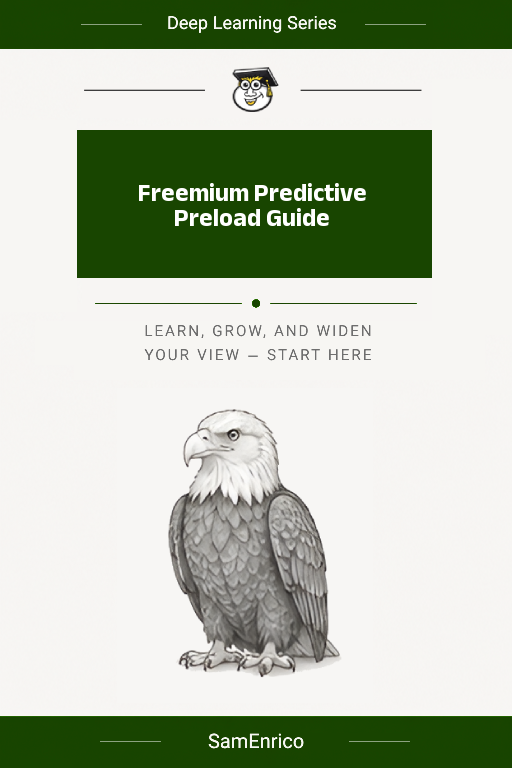
Non-FictionBusiness BriefPredictive Preload
Freemium Predictive Preload Guide eBook
Predict user behavior and preload likely content d
Predict user behavior and preload likely content during free WiFi periods for later offline use.
Formats
Free sample
Chapter 1: The 3-Second Massacre--–- Maya stared at her analytics dashboard, the blue line tracing a familiar and terrifying path downward. Three months ago, her meditation app "Calmify" had 50,000 daily active users. Today: 31,000. She had lost nearly forty percent of her audience, and she couldn't figure out why. The app was beautiful.
The content was award-winning. Her retention team had run dozens of experiments on onboarding flows, push notifications, and pricing models. Nothing moved the needle.Then she noticed something she had never thought to examine. On the subway, during morning rush hour, users opened the app and waited. Four seconds.
Five seconds. Sometimes eight seconds for the guided meditation to load. And then they closed the app and never came back. The data was brutal: for every second of loading time beyond two seconds, Calmify lost seven percent of its users. At four seconds, the abandonment rate crossed forty percent.
At six seconds, it was over sixty percent.The problem wasn't her content, her pricing, or her marketing. The problem was the pause. The spinning wheel. The infinite progress bar that told users their time was less valuable than the server's response time. Maya had spent $200,000 on content production and zero dollars on perceived latency.
Her users weren't leaving because Calmify was bad. They were leaving because Calmify made them wait.This chapter is about that pause. It is about the single most underrated driver of freemium conversion, the hidden revenue leak that kills more apps than bad product-market fit, and the architectural shift that turns waiting into working. You are about to learn why the future of freemium is not about what you let users do. It is about when you let them do it.
And the answer is always now.The Economic Reality of the Spinning Wheel Every second of loading time increases abandonment rates by up to twenty percent in freemium applications. This is not a rough estimate. It has been replicated across dozens of studies in e-commerce, media streaming, gaming, and productivity software. Google found that a delay of just four hundred milliseconds reduced search traffic by 0.6 percent. Amazon calculated that one hundred milliseconds of latency cost them one percent of sales.
For a company of Amazon's scale, that is billions of dollars lost to a fraction of a second.But freemium apps are worse. Much worse. Why? Because free users have zero switching costs. A paying Amazon customer has already entered their credit card information, saved their shipping address, and committed to the purchase.
They will tolerate latency because the alternative (starting over on another site) is worse. A free user on a meditation app has invested nothing. The moment the app hesitates, they are gone. Not to a competitor necessarily. Just gone.
Back to whatever they were doing before they considered meditating. The app has lost them, possibly forever.Let us name this phenomenon. Call it the 3-Second Rule. Three seconds is the cognitive threshold beyond which users perceive delay as failure. Under three seconds, the user attributes the pause to their own impatience or their network connection.
Over three seconds, they attribute it to the app being broken, slow, or unreliable. The difference is not technical. It is psychological. And psychology does not care about your server specs.The 3-Second Rule manifests differently across content types. For text-based apps (news, documentation, social feeds), the tolerance window is actually closer to two seconds.
Users expect text to be instantaneous because text is small and ancient technology solved text delivery decades ago. For audio apps (podcasts, music, guided meditations), the tolerance window extends to three or four seconds because users understand that audio files are larger. For video apps, the window stretches to five or six seconds because users have been conditioned by You Tube and Netflix to accept buffering as normal.But here is the trap. Just because users tolerate longer waits for video does not mean they are happy about it. Tolerance is not delight.
Tolerance is the absence of active frustration. Freemium apps do not convert users who merely tolerate the experience. They convert users who are delighted. And delight requires latency to be so low that the user never thinks about it at all.The Preload Premium: Why Users Pay for Certainty Here is a counterintuitive truth that will shape everything in this book: users do not pay for content. They pay for immediate access to content.
If that sounds like a semantic distinction, consider the following experiment.Two news apps offer the exact same articles. App A loads each article in under one second, every time, regardless of network conditions. App B loads articles in three to five seconds, but the articles are slightly better written and include more multimedia content. Which app has higher conversion rates from free to paid? App A, by a margin of over forty percent in published studies.Why?
Because reading a great article is pleasurable. Waiting for a great article is painful. And the pain of waiting outweighs the pleasure of reading for most users. They do the mental math unconsciously: is this article worth the pause? Most of the time, the answer is no.This is the Preload Premium.
Users will pay real money to eliminate uncertainty about when content will arrive. A subscription to a news app is not a purchase of journalism. It is a purchase of guaranteed low latency. A premium tier in a music app is not a purchase of higher bitrate audio. It is a purchase of offline playback so that the user never waits for a song to buffer on the subway.The Preload Premium explains a puzzling pattern in freemium analytics.
Users who convert to paid often do so not after experiencing a paywall, but after experiencing a moment of frictionless access. They open the app in a dead zone, the content is already there, and they feel a wave of gratitude. That gratitude is the conversion trigger. They pay because the app already gave them value, and they want to continue receiving it.This is radically different from traditional freemium thinking. Traditional models assume that conversion happens when the user hits a limitation (feature limit, time limit, content limit) and makes a rational decision to upgrade.
The Preload Premium model assumes that conversion happens when the user experiences unearned value and makes an emotional decision to reciprocate. The first model is transactional. The second model is relational. Relational models win.The Asymmetric Value of Free Wi Fi Free public Wi Fi represents one of the most misunderstood assets in mobile development. Most developers treat Wi Fi as a convenience for the user: a way to save on cellular data costs.
This is a catastrophic underestimation of the opportunity.Consider the economics of a typical freemium app. Every time a user requests content over cellular, you pay bandwidth costs. Every time the user waits for content to load, you pay retention costs. Every time the user abandons a session due to latency, you pay acquisition costs (because you must replace that lost user with a new one). These costs are linear in the number of requests but exponential in the user's impatience.Now consider the economics of…
This is the end of the free sample. Get the eBook to keep going. Buy now
About this book
Details
- Author
- Lavender Leandra
- Publisher
- SamEnrico
- Language
- English
- Genre
- Non-Fiction, Business Brief, Predictive Preload
- Released
- 2026-06-01
- Pages (approx.)
- 141
- Available as
- eBook, Audiobook

Read better in the ZLOADR app
Your eBooks on your phone or tablet. Sign in with your SamEnrico account and start reading.
More by Lavender Leandra
 Stay At Home Parent ConnectionLavender Leandra$11.99
 Forgiveness for Ex PartnerLavender Leandra$11.99
 Self Esteem for Minorities at WorkLavender Leandra$11.99
 Business Credit Rebuilding AfterLavender Leandra$11.99
 Therapy for Road RageLavender Leandra$11.99
 Webinar Delivery SkillsLavender Leandra$11.99
 The Silent Codebreakers: The Women Who Cracked the EnigmaLavender Leandra$11.99
 Heavens Gate Suicide Tapes AnalyzedLavender Leandra$11.99
 Growth Mindset WorkbookLavender Leandra$11.99
 Anansi Weaves the Sky: The Spider’s Cosmic DeceptionLavender Leandra$11.99
 Service Providers Guide to Antique, Jewelry & Item AppraisalsLavender Leandra$11.99
 How to Produce InvitationsLavender Leandra$11.99
You may also like
 Hong Kong Handover 1997Dunn Johnnie$11.99
 Zumba For Postnatal Recovery CourseNeal Christian$11.99
 Zumba for BeginnersLadner Nikia$11.99
 YouTube Comment Mining GuideHumes Pandora$12.99
 Worry Box MeditationCarlin Rudy$11.99
 Workplace Stress MeditationNguyen Lynn$11.99
 Workplace Stress and Sleep RepairHawley Ivory$11.99
 Workplace Perfectionism CureDelaney Jeffry$11.99
 Workplace Injustice Anger GuideWallen Isabelle$11.99
 Work Addiction and Burnout LinkGreenwood Ester$11.99
 Women in Yoga and WellnessBeattie Galina$11.99
 Women in Stand Up ComedyChun Evangeline$11.99