
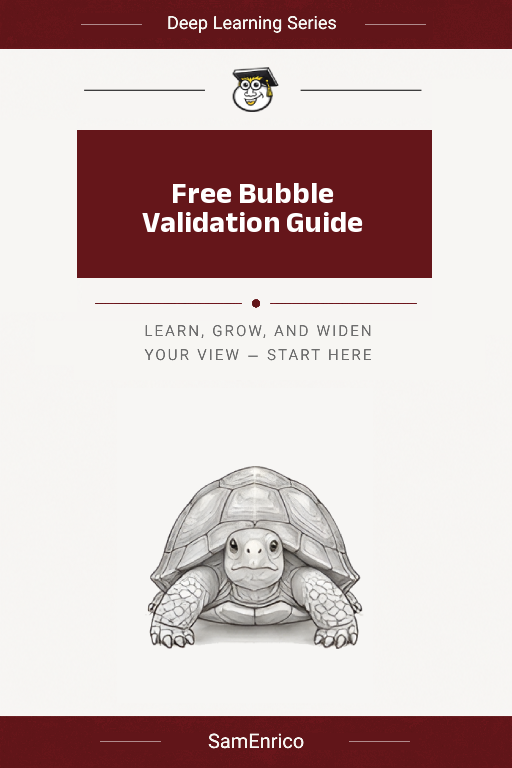
Non-FictionStartup GuideLean Methodology
Free Bubble Validation Guide eBook
Use free Bubble plan to validate web app demand. B
Use free Bubble plan to validate web app demand. Build functional prototypes.
Formats
Free sample
Chapter 1: The Polite Lie Epidemic--–- On a Tuesday morning in San Francisco, a first-time founder named Sarah pressed "send" on a Google Form she had distributed to 500 people in her network. The question was simple: "Would you use an app that helps you find last-minute meeting rooms for under 20/hour?"Ninety−threepercentsaidyes.Shespentfourmonthsand20/hour?" Ninety-three percent said yes. She spent four months and 20/hour?"Ninety−threepercentsaidyes.Shespentfourmonthsand12,000 building it. When she launched, seven people signed up. Three used it more than once.
The other 484 people who answered "yes" never even opened the email.Sarah had been lied to. Not maliciously. Not even consciously. She had been given what every entrepreneur receives when they ask "Would you use this?"—a polite lie.This chapter exposes the single greatest source of wasted time and money in software development: the gap between what people say they will do and what they actually do. You will learn why your mother, your best friend, and even your most honest mentor will unintentionally deceive you when you ask for feedback.
More importantly, you will learn the only reliable alternative: building a clickable prototype that captures behavioral truth instead of verbal fiction.The $12,000 Lesson That Every Founder Learns Too Late Before we talk about Bubble, before we discuss custom states or fake doors or workload units, we need to confront a brutal reality. The software industry has a 90% failure rate for new products. Not because the ideas are bad. Not because the teams lack talent. But because founders build based on what people say rather than what people do.Consider the data:80% of features in typical software products are rarely or never used (Standish Group Chaos Report)42% of startups fail because they built something nobody wanted (CB Insights)Only 5% of survey respondents who say they would buy a product actually purchase it when available (Harvard Business Review)These numbers are not random.
They follow a predictable pattern: ask → receive positive feedback → build → launch → failure. The variable that kills most projects is not execution. It is the assumption that verbal intent predicts actual behavior.The Polite Lie works like this: When you ask someone "Would you use this?" they hear a social question, not a product question. They want to be helpful. They want to avoid conflict.
They want to seem intelligent and forward-thinking. So they say yes. They say "that sounds great." They say "I would definitely use that." And then they walk away and forget the conversation ever happened.Sarah's 93% "yes" rate on her meeting room app was statistically meaningless. What she needed was not a survey. She needed a fake door—a button that looked real but led to a "coming soon" page—so she could measure how many of those 500 people would actually click it when they thought the product already existed.
That number would have been closer to 5-10%. And she would have saved $12,000.The Commitment Continuum: From Low Signal to High Signal Not all feedback is created equal. The method you use to gather input directly determines how much you can trust the answer. Think of feedback methods as existing on a continuum from low signal (unreliable) to high signal (trustworthy).Level 1: The Casual Question (Lowest Signal)"Hey, what do you think of this idea?" asked over coffee or a beer. This is the most common and the least reliable form of feedback.
The person has zero commitment. They face social pressure to be positive. They have nothing at stake. Signal value: nearly zero.Level 2: The Survey or Poll Better than a casual conversation because anonymity reduces social pressure. However, surveys still suffer from hypothetical bias.
People overestimate their future behavior dramatically. A classic study found that people who said they would buy a $2.99 charity calendar purchased at only 25% of the predicted rate. Signal value: low to medium.Level 3: The Mockup or Wireframe Showing a static image of what the app would look like moves slightly closer to reality. The person can visualize the interface. But they cannot click anything.
They cannot experience the workflow. Signal value: medium.Level 4: The Functional Prototype (This Book's Method)A clickable, interactive version of the app built on Bubble's free plan. The user can press buttons, see results, experience flows. They believe—even temporarily—that the app might be real. Their behavior in this environment correlates strongly with real-world behavior.
Signal value: high.Level 5: The Live Product with Payment (Highest Signal)The person actually pays money and uses the real thing. This is the ultimate truth. But you cannot start here. The goal of this book is to get you from Level 1 to Level 4 as quickly and cheaply as possible, so you can decide whether to pursue Level 5.Here is the critical insight: Every level on this continuum is more expensive than the last. The casual question costs nothing but gives no real information.
A survey costs time but still lies to you. A mockup costs a few hours of design work but still cannot capture behavior. A functional prototype on Bubble costs a few days of building but gives you 80% of the signal of a live product at 0.5% of the cost.The mistake most founders make is jumping from Level 2 (survey) directly to Level 5 (launch). They skip the functional prototype entirely. This book exists to close that gap.The Mom Test: Why Your Mother Is Your Worst Advisor Rob Fitzpatrick wrote a brilliant book called The Mom Test that every founder should read.
The core insight is simple: If you ask your mother "Do you like my business idea?" she will say yes because she loves you and wants to be supportive. That answer is worse than useless—it is actively misleading.The Mom Test rule: Never ask someone if they would use your product. Instead, ask about their past behavior and current problems.Let me give you an example.Bad question (invites a polite lie): "Would you use an app that finds cheap meeting rooms?"Good question (uncovers truth): "Tell me about the last time you needed to find a last-minute meeting room. What did you do? What frustrated you about that experience?"The difference is subtle but profound.
The first question asks for a hypothetical prediction. The second asks for a real memory. People are surprisingly accurate when describing past frustrations. They are wildly inaccurate when predicting future actions.A functional Bubble prototype sits at the intersection of these two approaches. It does not ask "would you use this?" It simply presents the interface and observes what the user actually clicks.
You do not need to ask the question because the data answers it for you.Why Mockups Fail: The Static Image Illusion Figma, Sketch, Adobe XD—these are excellent tools for visual design. But they are terrible tools for validation. Here is why.A mockup is a picture of an app. It shows you what the app would look like. But an app is not a picture.
An app is a sequence of decisions, anxieties, and tiny commitments. When a user clicks "Buy Now," they feel a small spike of anxiety. When they see a loading spinner, they feel impatience. When they complete a task, they feel satisfaction. These micro-emotions are…
This is the end of the free sample. Get the eBook to keep going. Buy now
About this book
Details
- Author
- Cantu Cherish
- Publisher
- SamEnrico
- Language
- English
- Genre
- Non-Fiction, Startup Guide, Lean Methodology
- Released
- 2026-05-30
- Pages (approx.)
- 155
- Available as
- eBook, Audiobook

Read better in the ZLOADR app
Your eBooks on your phone or tablet. Sign in with your SamEnrico account and start reading.
More by Cantu Cherish
 Incubation For Teeth Grinding Bruxism GuideCantu Cherish$11.99
 The Self Talk for BetrayalCantu Cherish$11.99
 Jealousy HandbookCantu Cherish$11.99
 TM for Smoking CessationCantu Cherish$11.99
 The Serial Killer Psychopath BrainCantu Cherish$11.99
 The Golden Hands of Meroë: Blacksmiths of the NileCantu Cherish$11.99
 Understanding Tietz SyndromeCantu Cherish$17.99
 Simul ClimbingCantu Cherish$11.99
 Oil and Gas Invoice FactoringCantu Cherish$12.99
 How to Become a Leather ToolerCantu Cherish$11.99
You may also like
 Hong Kong Handover 1997Dunn Johnnie$11.99
 Zumba For Postnatal Recovery CourseNeal Christian$11.99
 Zumba for BeginnersLadner Nikia$11.99
 YouTube Comment Mining GuideHumes Pandora$12.99
 Worry Box MeditationCarlin Rudy$11.99
 Workplace Stress MeditationNguyen Lynn$11.99
 Workplace Stress and Sleep RepairHawley Ivory$11.99
 Workplace Perfectionism CureDelaney Jeffry$11.99
 Workplace Injustice Anger GuideWallen Isabelle$11.99
 Work Addiction and Burnout LinkGreenwood Ester$11.99
 Women in Yoga and WellnessBeattie Galina$11.99
 Women in Stand Up ComedyChun Evangeline$11.99