
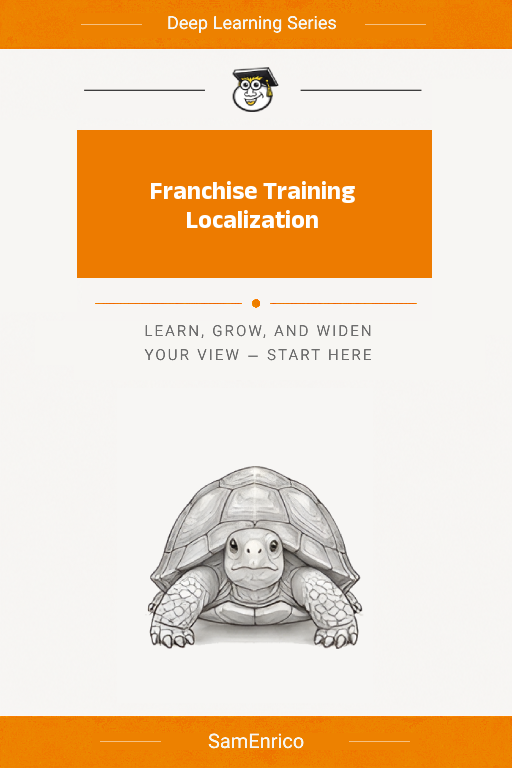
Franchise Training Localization eBook
Adapt your training programs for international fra
by Mahon Jayna
Adapt your training programs for international franchisees across different languages and cultures. Use remote learning, translation, and local trainers effectively.
Formats
Free sample
Chapter 1: The Bowing Problem--–- The first time Priya Sharma watched her Tokyo franchisee bow to a customer, she knew something had gone terribly wrong. Not because the bow was insincere—it was, in fact, exquisitely precise, a perfect 30-degree angle held for exactly two seconds. The problem was that nowhere in Brew World's 847-page operations manual had anyone mentioned bowing. The manual said "greet every customer with direct eye contact and a warm handshake." In Tokyo, direct eye contact is perceived as aggressive, handshakes are awkward at best, and the deepest respect is shown through the angle of one's spine. Priya had spent $80,000 translating every word of that manual into Japanese.
She had not spent a single dollar understanding what those words would mean to the people reading them.The Tokyo location opened on a rainy Tuesday in March. By Friday, customer traffic had dropped 40 percent. By the end of the first month, the franchisee—a well-capitalized, enthusiastic businessman named Kenji Tanaka—was begging for an emergency call. "Your training does not work here," he said, which in Japanese culture was the equivalent of screaming. Priya flew to Tokyo, walked into the store, and watched in disbelief as her carefully crafted systems collapsed in real time.A customer entered.
The Brew World-trained employee looked the customer directly in the eyes, extended a hand, and said loudly in rehearsed English, "Welcome to Brew World! How can I make your day amazing?" The customer visibly flinched, took a step backward, and murmured something about just looking. The employee, following the training script, pursued: "Our special today is the Mocha Swirl—are you sure I can't interest you?" The customer exited. The employee looked confused. The training had told her to be "friendly and persistent." In Tokyo, persistence reads as harassment.This is not a story about translation.
It is a story about the difference between words and meaning, between information and instruction, between a manual that sits on a shelf and a training program that lives in the bones of your employees. And it is the story of how Priya Sharma—a Seattle-based entrepreneur who had built Brew World from a single coffee cart into a 20-location regional chain—nearly lost everything she had built by making the single most common mistake in international franchising.The One-and-Done Delusion Here is what most franchisors believe: training is an event. You write the manual, you record the videos, you fly the new franchisee to headquarters for two weeks, you shake hands, and you pronounce them ready. This belief is seductive because it is simple. It reduces the terrifying complexity of scaling a brand across cultures into a checklist.
Write manual. Check. Translate manual. Check. Send manual.
Check. Done.This belief is also catastrophically wrong.Priya had followed the industry playbook precisely. She had hired a professional translation agency recommended by her lawyer. She had sent Kenji Tanaka to Seattle for ten days of hands-on training at her flagship store. She had given him access to her learning management system with all 47 video modules.
She had done everything right—according to the conventional wisdom that treats international expansion as a logistics problem rather than a cultural transformation.The conventional wisdom failed because it assumes that the people receiving your training are blank slates. They are not. They arrive with decades of cultural programming about what respect looks like, how authority works, whether questions are welcomed or punished, and what it means to serve another human being. Your training does not replace that programming. Your training swims through it, either with the current or against it.
In Tokyo, Priya's training was swimming upstream in a typhoon.The Anatomy of a Cultural Collision To understand why Priya's Tokyo training failed, we must distinguish between two different kinds of failure modes. The first is literal translation failure—the word means the wrong thing. (We will meet that disaster in Chapter 3, when a single mistranslated food safety protocol costs Priya $2 million in Brazil.) The second is cultural translation failure—the word means the right thing but the behavior feels wrong. The Tokyo disaster was pure cultural translation failure.Consider the Brew World greeting protocol, which Priya had developed over seven years of testing in Seattle. The protocol had five steps: (1) make eye contact within three seconds, (2) smile warmly, (3) greet the customer by name if known, (4) offer a handshake if the customer seems open to it, (5) ask an open-ended question like "What brings you in today?" Priya had data showing this protocol increased repeat customers by 22 percent in Seattle.Every single step of this protocol was wrong for Tokyo.Step one: eye contact within three seconds.
In Japanese business culture, direct eye contact is reserved for confrontation or intimacy. The appropriate gaze is at the neck or shoulders—a practice called "bowing with the eyes." Priya's employees were inadvertently staring customers down.Step two: smile warmly. The Japanese smile is subtler, often with the eyes rather than the mouth (the "eye smile" or me ga waratteiru). The broad, toothy American smile that Priya's training celebrated reads as aggressive or even mocking in Tokyo.Step three: greet by name if known. Using a customer's first name without invitation is presumptuous in Japan, where honorifics (-san, -sama) and family names govern all interactions.
The Brew World employee who said "Good morning, Yuki!" to a regular customer committed a minor social violation every time.Step four: offer a handshake. Handshakes are not offensive in Japan, but they are awkward—a foreign custom tolerated rather than welcomed. The appropriate greeting is a bow, with the angle indicating the depth of respect. Kenji Tanaka later explained to Priya that his employees had started bowing in addition to shaking hands, producing an anxious, double-motion gesture that customers found bizarre.Step five: ask an open-ended question. "What brings you in today?" is an American ritual of pseudo-intimacy designed to build rapport.
In Japan, it reads as intrusive. The appropriate question is a statement of service: "Welcome. Please let me know if I can assist you." The customer initiates, not the employee.Priya had not just failed to adapt her training. She had exported a customer service philosophy that was culturally specific to the Pacific Northwest of the United States and treated it as universal truth. This is the central error of the one-and-done model: the assumption that your way is the way.The 80/20 Rule You Cannot Afford to Ignore Every franchisor who expands internationally eventually confronts the same question: how much of the brand do I protect, and how much do I adapt?
The answer, refined over decades of research including Greg Nathan's seminal work Profitable Partnerships, is the 80/20 Rule of Global Franchising.Eighty percent of your operations must remain consistent across every market. These are your non-negotiables: food safety protocols, cash handling procedures, brand marks and logos, core product recipes, opening and closing checklists, and any element that touches legal liability or brand identity. If a customer walks into Brew World in Seattle, Tokyo, or São Paulo, the coffee must taste the same, the safety standards must be identical, and the brand must be recognizable.Twenty percent of your operations must adapt to local conditions. These…
This is the end of the free sample. Get the eBook to keep going. Buy now
About this book
Details
- Author
- Mahon Jayna
- Publisher
- SamEnrico
- Language
- English
- Genre
- Non-Fiction, Business Brief
- Released
- 2026-06-01
- Pages (approx.)
- 146
- Available as
- eBook, Audiobook

Read better in the ZLOADR app
Your eBooks on your phone or tablet. Sign in with your SamEnrico account and start reading.
More by Mahon Jayna
 Metta for All BeingsMahon Jayna$11.99
 Inflation Protected Index FundMahon Jayna$11.99
 Slave Ship Surgeon JournalMahon Jayna$11.99
 Walmart Supply Chain SecretsMahon Jayna$11.99
 The Gilded Shadows of El Escorial: Philip II and the Spanish Golden AgeMahon Jayna$11.99
 Clerk DeliMahon Jayna$11.99
 How to Produce Boot PullsMahon Jayna$11.99
 How to Start a Local Authority School Meals Service Business (Beginners Guide)Mahon Jayna$11.99
You may also like
 Hong Kong Handover 1997Dunn Johnnie$11.99
 Zumba For Postnatal Recovery CourseNeal Christian$11.99
 Zumba for BeginnersLadner Nikia$11.99
 YouTube Comment Mining GuideHumes Pandora$12.99
 Worry Box MeditationCarlin Rudy$11.99
 Workplace Stress MeditationNguyen Lynn$11.99
 Workplace Stress and Sleep RepairHawley Ivory$11.99
 Workplace Perfectionism CureDelaney Jeffry$11.99
 Workplace Injustice Anger GuideWallen Isabelle$11.99
 Work Addiction and Burnout LinkGreenwood Ester$11.99
 Women in Yoga and WellnessBeattie Galina$11.99
 Women in Stand Up ComedyChun Evangeline$11.99